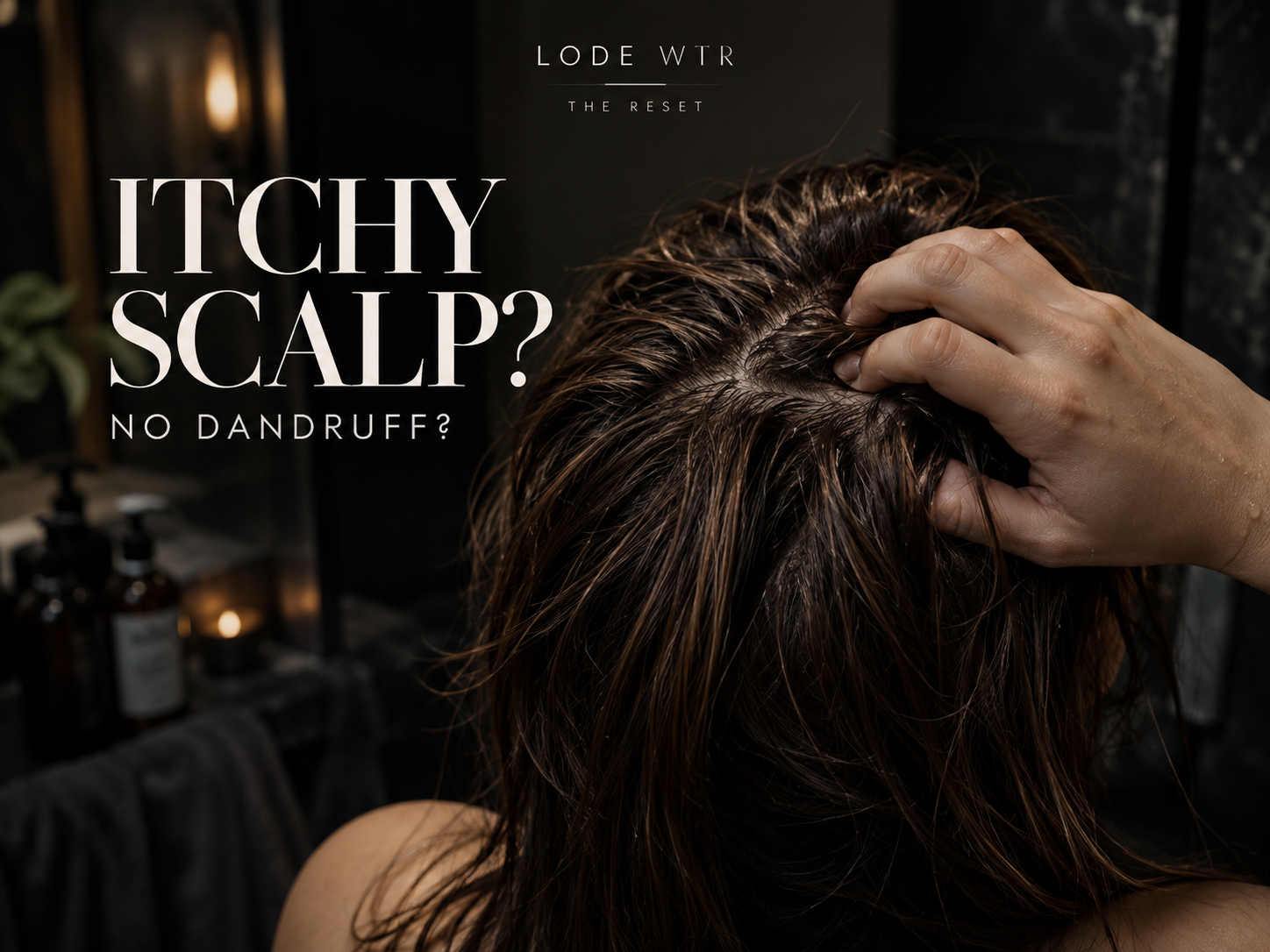
Your scalp itches.
Naturally, you check for dandruff.
Nothing.
No obvious flakes.
No snowstorm on your shoulders.
Just an annoying scalp that apparently wants your attention every five minutes.
So what gives?
Because itching is not exclusive to dandruff.
A scalp can itch because it is:
- Dry
- Irritated
- Covered in buildup
- Sweaty
- Reacting to a product
- Being washed too aggressively
- Not being washed enough for your routine
And sometimes the most obvious culprit is not the real one.
Here are nine reasons your scalp may be itchy even when dandruff doesn’t seem to be the problem.
First: Itching Is a Symptom, Not a Diagnosis
This is important.
“My scalp itches” tells you how the scalp feels.
It does not automatically tell you why.
The same sensation can appear in several completely different situations.
For example:
One person may itch because the scalp feels dry after washing.
Another may itch because there is heavy dry-shampoo buildup.
Another may be sensitive to a product.
Same symptom.
Different problem.
Which means:
Don’t automatically treat every itch the same way.
1. Your Scalp Is Dry
Let’s start with the obvious one.
A dry-feeling scalp may become itchy even without dramatic visible flakes.
You may also notice:
- Tightness
- Mild sensitivity
- Discomfort after washing
- A slightly rough or dry feeling
This can become more noticeable during:
- Cold weather
- Low humidity
- Indoor heating
- Frequent hot showers
And here’s the important part:
Your scalp can feel dry without looking visibly flaky.
So the absence of dandruff does not rule dryness out.
Read next: How to Moisturize a Dry Scalp Without Making Your Hair Greasy.
2. Your Shampoo Is Too Aggressive for Your Routine
Your cleanser may be doing exactly what it was designed to do.
Just more than your scalp needs.
This is especially worth considering if your scalp starts itching:
Soon after washing.
Look at your routine.
Are you using:
- Clarifying shampoo every wash?
- Two shampoos every time?
- Large amounts of cleanser?
- A strong formula despite minimal buildup?
If the scalp repeatedly feels:
Fresh for ten minutes, then tight and itchy
…your washing routine deserves attention.
Clean should not automatically mean uncomfortable.
3. Your Water Is Too Hot
Hot showers are excellent emotionally.
Your scalp may disagree physically.
Very hot water can make already-sensitive skin feel drier or more irritated.
Now combine that with:
Shampoo.
Scrubbing.
Maybe a second shampoo.
And suddenly your wash routine becomes a lot more intense than it looked on paper.
If your scalp consistently itches after showering, experiment with:
Comfortably warm water.
Not freezing.
Just less aggressive.
Simple changes are still changes.
4. Product Buildup Is Sitting on the Scalp
Now we move to the opposite problem.
Sometimes itching isn’t caused by cleaning too much.
It’s caused by too much sitting on the scalp.
That may include:
- Sebum
- Dry shampoo
- Hair oil
- Gel
- Styling cream
- Root powder
- Hairspray
- Sweat
If several layers accumulate between washes, the scalp may begin to feel:
- Coated
- Heavy
- Greasy
- Itchy
And there may be little or no visible dandruff.
This is why an itchy scalp doesn’t automatically need more moisturizing.
Sometimes it needs:
Cleaning.
Read: How to Remove Product Buildup on Your Scalp Naturally.
5. You’re Using Too Much Dry Shampoo
This deserves its own section because dry shampoo has become a lifestyle.
Day one:
Small spray.
Day two:
Another spray.
Day three:
Maybe quite a lot.
Meanwhile, actual scalp cleansing has not occurred.
Dry shampoo can help absorb visible oil.
What it does not do is remove:
- Sebum
- Sweat
- Existing product
- Itself
Eventually, the scalp may feel:
Powdery + oily + itchy.
A deeply confusing combination.
If you keep reaching for more dry shampoo because the roots look greasy while the scalp feels itchy?
It may simply be time to wash.
6. You’re Reacting to a Hair Product
Sometimes one product doesn’t agree with your scalp.
That could be:
- Shampoo
- Conditioner
- Hair dye
- Styling gel
- Scalp serum
- Fragrance
- Essential oils
- Another treatment
The useful clue is often timing.
Did the itching start after introducing something new?
Does it happen only after one particular product?
Does it improve when you stop using it?
Patterns like that are useful.
Because if a product consistently leaves your scalp itching, the solution isn’t necessarily:
Buy another product to calm the first product.
Sometimes the smartest move is removal.
7. Sweat Is Sitting on the Scalp for Too Long
Workout.
Hot day.
Hat.
Commute.
More workout.
Your scalp can spend hours dealing with:
Sweat + oil + styling product.
Sweat itself does not automatically create a scalp problem.
But when it mixes with existing residue and stays around the roots for long periods, the scalp may become uncomfortable.
This is especially relevant if you frequently:
- Exercise
- Wear hats
- Use dry shampoo afterward instead of washing
If your scalp tends to itch after sweaty days, your cleansing schedule may simply need to match your lifestyle better.
Read next: Post-Workout Scalp Care.
8. You’re Scratching So Much That the Scratching Became Part of the Problem
Itch.
Scratch.
Feels good for three seconds.
Then the scalp becomes more irritated.
So it itches again.
Scratch.
Now we’re in a loop.
Repeated scratching can create mechanical irritation even if the original trigger was relatively minor.
And if you use your nails?
Even more friction.
This is why aggressive scratching is not a treatment.
It is often an additional stressor.
When washing:
Use your fingertips.
If you’re itchy enough that you’re constantly scratching, focus on identifying the cause instead.
9. Your Scalp May Need Professional Assessment
Not every itchy scalp is a cosmetic routine problem.
Persistent scalp itching can occur with several skin conditions and other issues that require proper diagnosis.
Consider speaking with a dermatologist or healthcare professional if itching is:
- Severe
- Persistent
- Getting worse
- Disrupting sleep
Or accompanied by:
- Significant redness
- Thick scaling
- Swelling
- Sores
- Oozing
- Burning
- Pain
- Sudden hair loss
This is especially important if adjusting your routine makes no meaningful difference.
Hair-care products can support scalp comfort.
They cannot diagnose skin disease.
Why Does My Scalp Itch Immediately After Washing?
This pattern is particularly useful.
If your scalp feels comfortable before showering but itchy afterward, look at the wash itself.
Possible contributors include:
Hot water
The shower may simply be too hot.
Aggressive shampoo
You may be cleansing more strongly than necessary.
Double cleansing
The second wash may not be needed.
Scratching
You may be physically irritating the scalp during shampooing.
Product sensitivity
Something in your wash routine may not agree with your skin.
Start there.
Don’t automatically wash again.
Why Does My Scalp Itch When My Hair Gets Greasy?
Because greasy roots aren’t only oil.
By the time your hair looks oily, the scalp may also be carrying:
- Sweat
- Styling products
- Dry shampoo
- Environmental residue
That mixture can create an uncomfortable scalp environment.
The answer isn’t necessarily a stronger shampoo.
It may simply be:
Wash before buildup gets excessive.
Your ideal washing schedule should respond to what accumulates on your scalp.
Not an arbitrary number of days.
Why Is My Scalp Itchy but Not Flaky?
Because visible flakes are only one possible scalp symptom.
You can experience irritation from:
- Dryness
- Product sensitivity
- Sweat
- Buildup
- Friction
without obvious flaking.
So don’t wait for flakes before taking scalp discomfort seriously.
The scalp is giving you information already.
Can Your Scalp Be Itchy From Washing Too Much?
For some people, yes.
Frequent washing itself isn’t universally bad.
Plenty of people comfortably wash every day.
But the combination matters.
Daily washing with:
- Very hot water
- Strong clarifying products
- Aggressive scrubbing
is different from daily washing with a well-matched gentle routine.
Look at the result.
If your scalp becomes increasingly:
- Tight
- Dry
- Itchy
as washing frequency goes up?
That is useful feedback.
Can Your Scalp Itch Because You Don’t Wash Enough?
Also yes.
Scalp care loves refusing to give us one universal answer.
If you’re stretching wash days while repeatedly adding:
- Dry shampoo
- Oils
- Gel
- Styling cream
…the scalp may accumulate enough oil and residue to become itchy.
So the solution isn’t always:
Wash less.
And it isn’t always:
Wash more.
It’s:
Wash according to what your scalp and routine actually require.
What If Your Scalp Is Itchy and Oily?
This is common.
Do not automatically assume oily scalp equals healthy, moisturized scalp.
You can have:
Oily hair + irritated scalp.
Oiliness describes sebum and residue.
Irritation describes how the skin feels.
Different information.
If the scalp feels oily and coated, buildup may be contributing.
If it feels oily but also burns after washing?
Your cleanser may be part of the issue.
Look at the pattern.
What If Your Scalp Is Itchy and Dry?
Then dryness may be contributing.
Especially if you also notice:
- Tightness
- Sensitivity
- Symptoms immediately after shampooing
Before applying heavy oils, check whether your routine is creating the dryness.
Because otherwise you may end up with:
Dry-feeling scalp + oily-looking roots.
We already know how annoying that combination is.
Read next: Why Is My Scalp Dry but My Hair Gets Greasy?
Should You Put Oil on an Itchy Scalp?
Not automatically.
This is one of the most common scalp-care reflexes:
Itchy?
Oil.
Dry?
Oil.
Flakes?
Oil.
But if your itch is actually related to:
- Buildup
- Product sensitivity
- Sweat
- Another scalp condition
…adding more oil may not help.
It may just make the roots heavier.
First identify what kind of scalp you’re dealing with.
Then decide what it needs.
Should You Use a Scalp Scrub for Itching?
Not automatically.
If the itch comes from product buildup, effective cleansing may help.
But if the scalp is already irritated?
A physical scrub adds more friction.
Your scalp doesn’t need to be scraped into submission.
Start with the least aggressive solution that actually addresses the problem.
That’s a pretty good rule for scalp care in general.
Should You Clarify an Itchy Scalp?
Only if buildup is actually part of the problem.
Clarifying products can be helpful when the scalp has significant:
- Oil
- Product residue
- Dry shampoo accumulation
But if your scalp is already dry and sensitive?
A strong clarifying wash may make it feel worse.
Clarify because something needs removing.
Not because your scalp feels annoying and you’re hoping intensity will fix it.
What About a Sensitive Scalp?
Sensitive scalp care should still involve cleansing.
Just not unnecessary aggression.
That means looking at:
- Water temperature
- Cleansing strength
- Washing frequency
- Product layering
- Fragrance
- Scratching
- pH
Your scalp does not have to be completely stripped to be clean.
Read next: Best Natural Alternative to Shampoo for Sensitive Scalp.
Why Scalp pH Matters
Your scalp skin naturally maintains a mildly acidic surface environment.
That makes the pH of products applied to it relevant.
A thoughtfully formulated acidic cleanser can fit more naturally within that environment than highly alkaline DIY approaches.
At LODE WTR, the naturally low acidic pH is part of the broader scalp-first formulation approach.
Not because pH fixes every itchy scalp.
Because formulation details matter.
Read: Why Shampoo pH Matters.
Where Shikakai + Reetha Fit
If itching is being driven partly by oil and buildup, you still need cleansing.
LODE WTR uses:
SHIKAKAI + REETHA
Naturally occurring saponins that help lift:
- Excess oil
- Residue
- Product buildup
The goal isn’t maximum stripping.
It’s effective removal of the things that don’t need to stay.
That’s especially important when your scalp is sensitive enough that aggressive cleansing creates another problem.
Where Aloe + Botanicals Fit
Cleansing is only one side of the routine.
The scalp still needs to feel comfortable afterward.
LODE WTR uses:
ALOE + BOTANICALS
to help calm dryness and irritation.
That doesn’t turn Aloe into a medical treatment for every itchy scalp.
It simply means the formulation considers comfort alongside cleansing.
As it should.
The Best Itchy-Scalp Routine Is Usually Simpler Than You Think
If your scalp is itchy but you don’t see dandruff, resist the urge to immediately buy six new products.
Try simplifying.
Step 1: Look at when the itching starts
After washing?
After workouts?
After several days?
After a specific product?
Step 2: Reduce unnecessary root products
Especially dry shampoo, oils and heavy styling layers.
Step 3: Wash with warm water
Not extremely hot.
Step 4: Massage gently
Fingertips.
Not nails.
Step 5: Rinse thoroughly
Residue does not help an irritated scalp.
Step 6: Change one thing at a time
Otherwise you’ll never know what helped.
Simple experimentation gives you better answers.
Don’t Treat the Itch Before You Understand It
This is the main takeaway.
Itching is your scalp telling you:
Something is happening.
Maybe it’s dry.
Maybe there’s buildup.
Maybe your shampoo is too aggressive.
Maybe you’re reacting to a product.
Maybe you’ve spent three days layering dry shampoo after workouts.
The itch itself doesn’t tell you which one.
That’s why scalp care should start with patterns.
Not panic.
Your Scalp Shouldn’t Be Constantly Asking for Attention
A comfortable scalp is surprisingly boring.
You don’t think about it.
You don’t scratch every five minutes.
You don’t spend the day wondering why it feels tight.
You just have hair.
That’s a good baseline.
So if your scalp is constantly itchy, don’t normalize it.
Look at your routine.
Simplify.
Clean what needs cleaning.
Stop irritating what doesn’t need irritating.
And if the problem persists?
Get it properly assessed.
That’s getting to the:
Root of the Problem.
Less Scratching. More Understanding.
The answer to an itchy scalp without dandruff isn’t automatically:
More shampoo.
More oil.
More exfoliation.
More products.
Sometimes it’s better washing.
Sometimes it’s less washing.
Sometimes it’s removing one product your scalp doesn’t tolerate.
The useful response depends on the cause.
So listen to the pattern.
Clean effectively.
Respect the scalp.
Stop treating discomfort like normal.
Function Over Foam.
Frequently Asked Questions
Why is my scalp itchy if I don’t have dandruff?
An itchy scalp without visible dandruff may be related to dryness, product buildup, sweat, irritation, hot water, scratching or sensitivity to a hair product.
Can dry scalp itch without flakes?
Yes. A scalp can feel dry, tight or itchy without producing obvious visible flakes.
Can product buildup cause an itchy scalp?
Yes. Sebum, dry shampoo, styling products and sweat can accumulate around the scalp and contribute to discomfort or itching.
Can shampoo cause scalp itching?
A shampoo may be too aggressive for your scalp, or you may be sensitive to part of the formula. Look for patterns between product use and symptoms.
Why does my scalp itch immediately after shampooing?
Possible contributors include hot water, aggressive cleansing, scratching, over-washing or product sensitivity.
Can dry shampoo make your scalp itchy?
Repeated use can contribute to residue and buildup around the roots, especially if actual cleansing is delayed.
Should I put oil on an itchy scalp?
Not automatically. If the itch is related to buildup or product sensitivity, adding oil may not address the cause and may make the roots heavier.
Does an itchy scalp mean I need to wash my hair?
Sometimes buildup or sweat may mean it’s time to cleanse, but itching can also occur after over-washing or irritation. Consider when the itching occurs.
Can an oily scalp still be irritated?
Yes. Oil production and scalp sensitivity are separate issues.
When should I see a dermatologist for an itchy scalp?
Seek professional advice if itching is severe, persistent or accompanied by significant redness, swelling, thick scaling, sores, oozing, pain, burning or hair loss.
LODE WTR
Itch is information.
Don’t just scratch it.
Understand it.
SHIKAKAI + REETHA — Cleanse.
AMLA — Support.
ALOE + BOTANICALS — Calm.
LOW ACIDIC pH — Balance.
Function Over Foam.
Minimal Not Basic.
Root of the Problem.
Rebellion With Receipts.


