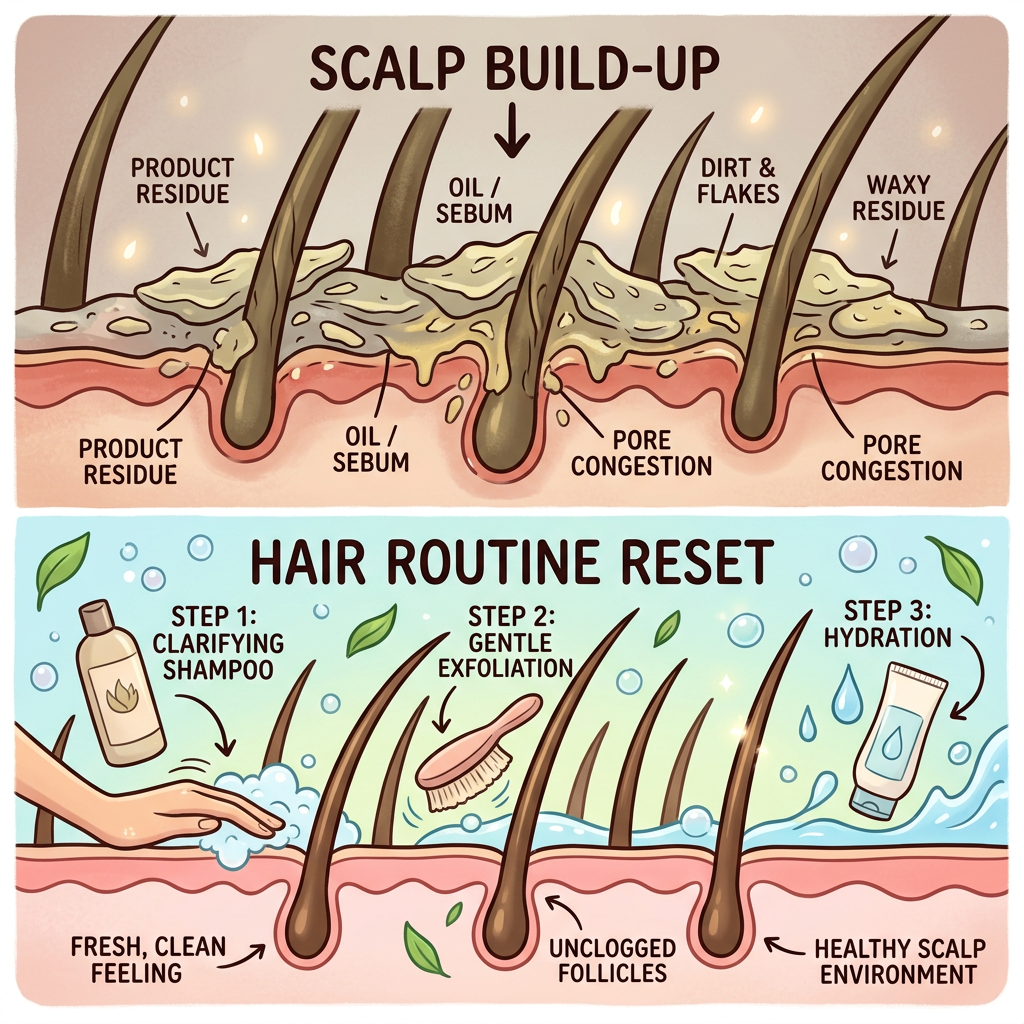
Your hair looks dull. Your roots feel coated no matter how much you lather. Your scalp itches in a way that washing never quite fixes. If any of that sounds familiar, you may not have a “dirty scalp” problem at all — you may have buildup. It’s one of the most common and most misunderstood scalp issues, and it usually isn’t solved by washing harder. Here’s what buildup actually is, how to tell it apart from natural oil, and how to reset your routine without going to war with your own scalp.
Direct Answer: Scalp buildup is an accumulated layer of sebum, dead skin cells, styling-product residue, minerals from hard water and sweat that regular washing doesn’t fully remove. It can look like flakes, feel greasy or waxy, and cause itch — and it responds best to gentle, thorough cleansing, not aggressive scrubbing.
Key Takeaways
- Buildup is a mixture — oil, dead skin, product residue, hard-water minerals — not a single substance, and it’s different from healthy sebum.
- Common signs: coated or waxy-feeling roots, dull hair, itch that washing doesn’t fix, and flakes that stick rather than fall.
- Dry shampoo, heavy stylers, silicone-based products and incomplete rinsing are frequent contributors.
- The fix is smarter cleansing and fewer residue-heavy products — not stronger detergents or harsher scrubbing.
- Persistent flakes, thick scaling, redness or soreness can signal a skin condition rather than buildup; that’s dermatologist territory.
What scalp buildup actually is (and isn’t)
Your scalp naturally produces sebum — a protective oil that keeps skin supple and hair conditioned. Sebum is not buildup. Sebum is supposed to be there.
Buildup is what happens when sebum combines with everything else your scalp encounters and the mixture outpaces your cleansing routine:
- Dead skin cells, which your scalp sheds continuously like the rest of your skin
- Styling product residue — gels, creams, sprays, serums, and especially repeated dry shampoo use
- Silicones and heavy conditioning agents that coat rather than rinse
- Hard-water minerals that deposit on hair and scalp over time
- Dried sweat and environmental grime
Layered together, that film can sit on the scalp surface and around follicles, which is why buildup often shows up as a waxy feel at the roots even right after washing — a sensation we dig into in why your scalp feels oily right after washing.
Buildup vs. oil vs. flakes: a quick field guide
- Natural oil: roots look shiny and feel slippery, improves completely after washing.
- Buildup: roots feel coated, waxy or stiff; hair looks dull; washing helps only briefly or not at all.
- Dry-scalp flakes: small, white, dry flakes that fall easily; often paired with tightness.
- Buildup flakes: larger, sometimes yellowish flakes that cling to hair or scalp because they’re held in place by oil and residue.
If instead you’re seeing thick, silvery scales, significant redness, or patches that are sore or weeping, stop reading and book a dermatologist — those patterns point to skin conditions, not product residue, and they need proper diagnosis.
What your scalp may be telling you
- “My roots feel dirty the same day I wash.” Likely incomplete rinsing or cleanser residue — or a cleanser too heavy for your scalp.
- “My dry shampoo works for a day, then everything feels worse.” Dry shampoo absorbs oil but adds its own layer of powder and starch. Used daily between washes, it becomes part of the buildup.
- “My hair went dull and flat even though it’s clean.” Coating from silicones, heavy stylers or hard-water minerals.
- “I itch most at the roots, near my part and hairline.” Concentrated residue where products are applied and rinsing is weakest.
- “Flakes come back within days.” Either the underlying mixture was never fully removed, or your routine is stripping your scalp into reactive flaking — same symptom, opposite cause. (Related: are you washing your hair too often?)
How to adjust your routine
Step 1 — Rinse like you mean it. Incomplete rinsing is the most fixable cause of buildup. After any cleanse, rinse for longer than feels necessary — especially at the nape, behind the ears and along the hairline — with lukewarm water.
Step 2 — Cleanse the scalp, thoroughly and gently. The aim is to loosen and lift the accumulated layer without stripping the barrier underneath. This is exactly the problem LODE WTR Scalp Water was built around: plant-derived saponins from shikakai and reetha gently lift oil and residue, amla and aloe support a calm, balanced scalp, and the naturally acidic pH respects the scalp barrier — with no sulfates, silicones or synthetic fragrance adding new residue of their own. Apply to a fully wet scalp, massage with your fingertips for a full 60 seconds (the massage does half the work), then rinse clean.
Step 3 — Audit what you put on. Count how many leave-on and styling products touch your roots in a week. Pull back the heaviest ones, keep dry shampoo to a day or two between washes maximum, and apply conditioners and masks to lengths only.
Step 4 — Give it two to three weeks. Buildup accumulated over months doesn’t always leave in one wash. Consistent gentle cleansing beats one aggressive “detox.”
Myth vs Fact
Myth: “Flakes always mean dandruff.” Fact: Flakes have many sources — dry scalp, product buildup, and yes, dandruff among them. The texture, color and what they come with (tightness vs. oil vs. redness) are the clues. Treating every flake like dandruff leads a lot of people to harsher products they never needed.
Myth: “You need a harsh clarifying scrub to remove buildup.” Fact: Aggressive scrubs and strong detergents can strip the scalp barrier and trigger the rebound oil and irritation that started the cycle. Loosening buildup gently and rinsing thoroughly is the more sustainable route — and dermatology guidance consistently favors gentle scalp care over abrasion.
Scalp Tip: Your fingertips are your best scalp tool — use the pads, not the nails. Sixty seconds of slow, firm circular massage loosens residue and boosts rinse-out far better than any scratchy brush, with none of the micro-damage.
Want a cleanser that removes buildup without starting the cycle over?Try LODE WTR Scalp Water — plant-powered, acidic-pH, and free of the sulfates and silicones that cause half the problem.
FAQ
What does scalp buildup feel like? Coated, waxy or stiff roots that don’t feel fully clean after washing; dull, flat hair; sometimes a slight film you can feel when you run a fingertip along your part.
Is scalp buildup the same as dandruff? No. Buildup is accumulated oil, skin cells and product residue; dandruff is a common scalp condition often linked to oil and yeast activity on the scalp. They can look similar and even coexist, but they respond to different approaches — and dandruff may need targeted care.
Can dry shampoo cause scalp buildup? Yes — it’s one of the most common contributors. Dry shampoo absorbs oil but leaves powders and starches behind. Fine occasionally; a problem when used daily as a wash replacement without real cleansing in between.
How long does it take to get rid of scalp buildup? Mild buildup can clear in one or two thorough, gentle washes. Heavier accumulation usually takes two to three weeks of consistent, low-residue routine changes.
When should I see a dermatologist about flakes? When flakes persist despite routine changes, or come with thick scale, redness, pain, sores, bleeding or hair loss. Those signs suggest a condition, not residue — and a proper diagnosis will save you months of guessing.
Buildup isn’t a character flaw, and it isn’t fixed by force. Remove what’s sitting on your scalp, stop adding what doesn’t need to be there, and give your scalp a few weeks of consistency — dull roots and mystery flakes rarely survive that.


