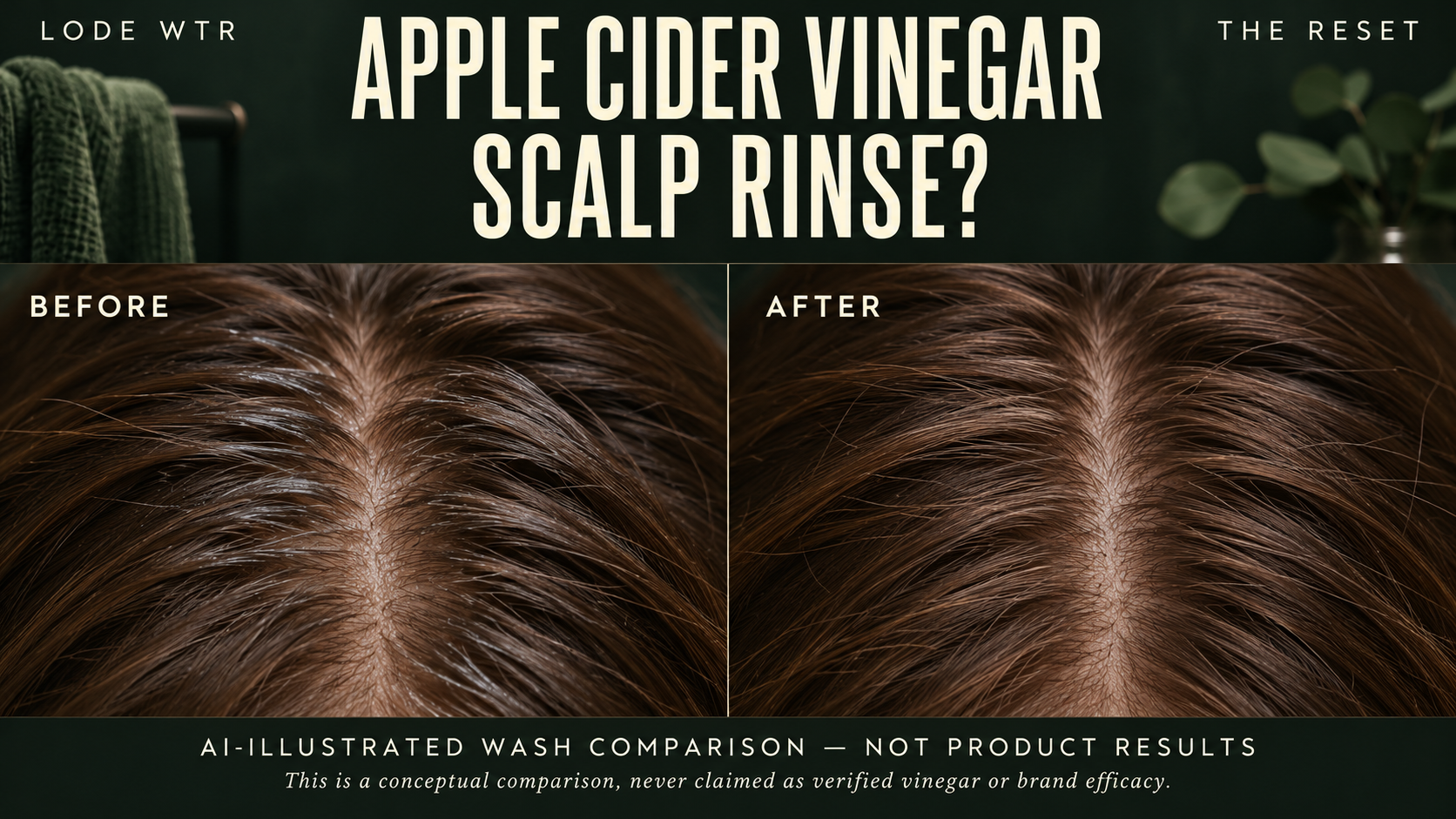
An ingredient from the kitchen. A quick rinse in the shower. The promise of fresher roots and shinier hair.
It’s easy to see why the apple cider vinegar scalp rinse has become a familiar part of the shampoo-alternative conversation.
But an ingredient can be popular without every claim about it being proven. Before adding vinegar to your routine, it helps to separate the idea behind the rinse from what research actually tells us.
What is an apple cider vinegar scalp rinse?
An apple cider vinegar scalp rinse is a hair-care rinse containing apple cider vinegar, often shortened to ACV.
That might mean a homemade mixture of vinegar and water. It might also mean a finished cosmetic product that includes vinegar alongside other ingredients.
Those are different formulations. A kitchen mixture does not automatically have the same concentration, final pH, preservation, or performance as a product developed for hair care.
Even two products with “ACV” on the label can work very differently.
Why do people use apple cider vinegar on their scalp?
Common reasons include wanting smoother-feeling hair, less visible residue, or a simpler routine.
Vinegar’s acidity is central to its appeal. However, acidity alone cannot tell you whether a rinse will be comfortable or useful.
It is also important to distinguish cosmetic effects from treatment claims. Hair feeling different after a rinse does not establish that the rinse has treated dandruff, repaired the skin barrier, or changed the scalp microbiome.
What does the research say?
Evidence for DIY apple cider vinegar scalp rinses is limited.
One small study examined diluted ACV soaks on the forearms of 22 participants, including people with eczema and healthy controls. The treatment did not produce a significant improvement in skin barrier integrity, and most participants reported mild irritation.
This was a forearm study, not a hair or scalp trial. It cannot tell us exactly how every scalp product containing vinegar will perform. It does show why we should avoid assuming that a diluted natural ingredient is automatically soothing.
A related study also found that the tested ACV routine did not significantly change the skin bacterial microbiome. Again, those results should not be stretched into conclusions about every cosmetic formula—but they do not support sweeping “microbiome reset” promises.
Is apple cider vinegar a scalp cleanser?
Not necessarily.
A rinse containing vinegar may also contain cleansing agents. A homemade vinegar-and-water mixture is a different proposition.
When comparing products, look beyond the headline ingredient:
- Is the product designed to cleanse, condition, or provide an additional rinse?
- Does it replace a washing step or follow one?
- What do the application and rinsing instructions say?
- Does the formula suit the rest of your routine?
This is particularly relevant if you use styling products. “Contains apple cider vinegar” does not, by itself, explain how a product will remove them.
Can an ACV rinse treat dandruff?
Do not rely on a DIY vinegar rinse as a dandruff treatment.
The American Academy of Dermatology recommends dandruff shampoos with appropriate active ingredients and emphasizes following the product’s directions. The right frequency and application can vary with hair type.
Recurring flakes deserve more attention than repeatedly changing a homemade recipe. If symptoms persist, a dermatologist can help identify what is happening and choose suitable care.
What to know before trying a vinegar rinse
More concentrated does not mean more effective
Vinegar can injure skin when used improperly. Poison Control documents burns associated with prolonged skin exposure and warns against using vinegar to treat wounds. Avoid applying undiluted kitchen vinegar to your scalp or leaving vinegar compresses against the skin.
Burning is a reason to stop
A sting is not evidence that a rinse is working. Stop using a product and rinse it away if it causes discomfort.
There is no universal DIY recipe
The research cited here does not establish a scalp-rinse dilution or schedule that is safe and effective for everyone. A ratio passed around online should not be treated as a tested standard.
Follow the finished product’s instructions
If you choose a hair-care product containing ACV, use it as directed. Adding extra vinegar changes the formulation you started with.
How LODE WTR approaches the ingredient
LODE WTR Scalp Water lists apple cider vinegar as one ingredient within a broader cleansing formula. It also contains cleansing surfactants and botanical extracts, including reetha and shikakai.
That makes it different from a homemade vinegar-and-water rinse.
When considering it, assess the complete product and its intended use rather than expecting one ingredient to do everything.
Frequently asked questions
Can I leave apple cider vinegar on my scalp overnight?
Avoid overnight DIY vinegar treatments. Prolonged exposure increases the opportunity for irritation or injury. Follow the directions of any formulated hair-care product.
Does apple cider vinegar replace shampoo?
Vinegar itself should not be assumed to provide complete cleansing. A finished product containing ACV may be designed to replace shampoo because of its overall formula.
Is apple cider vinegar part of the no poo method?
Some people include it in no poo routines, but it is optional. Choosing a shampoo alternative does not require using vinegar.
Should every scalp routine include an acidic rinse?
No. Add a step only when it has a clear purpose and works for you.
The most useful question is not whether apple cider vinegar is a good or bad ingredient. It is whether the complete product makes sense for your scalp and your routine.


