Search for a botanical shampoo alternative and one ingredient keeps appearing: soapnut.
Sometimes called reetha or soapberry, it shows up in traditional hair-care discussions, homemade wash recipes, and modern cleansing products.
But what exactly is a soapnut hair cleanser? And does seeing reetha on an ingredient list tell you how well a product will work?
The useful answer starts with the ingredient—and then looks at the whole bottle.
What are soapnuts?
Soapnuts are the fruits of Sapindus trees. Despite the name, they are commonly described as soapberries.
Their fruit pulp contains saponins: naturally occurring compounds with surfactant properties. Soapnuts have a history of use in traditional hair cleansing, including in India.
In cosmetic ingredient lists, you may see a name such as Sapindus Mukorossi Fruit Extract.
“Soapnut,” “reetha,” and the botanical ingredient name can therefore appear in discussions of closely related ingredients, although the exact species and preparation still matter.
How does a soapnut hair cleanser work?
The appeal of soapnut comes from its saponins. But an ingredient’s cleansing properties are only one part of product performance.
A finished wash may combine soapnut extract with other surfactants, ingredients that adjust pH, and components that influence how the product spreads and rinses.
That means there is a meaningful difference between:
- A homemade liquid prepared from soapnuts.
- A powdered botanical blend.
- A formulated cleanser containing soapnut extract.
- A shampoo that includes reetha alongside other cleansing ingredients.
All may mention soapnut. They should not be assumed to provide the same wash.
Is soapnut the same as soap?
The names can be misleading.
A product containing soapnut extract is not automatically equivalent to a traditional soap bar. Nor does the word “soapnut” tell you the final pH or strength of the finished formula.
Look at the product’s intended use and full ingredient list. A familiar botanical name cannot answer every question about formulation.
The same applies to “natural shampoo” and “plant-based cleanser.” Those descriptions tell you something about positioning or ingredients, but they are not a complete performance assessment.
Soapnut versus apple cider vinegar: what’s the difference?
These ingredients often appear together in conversations about the no poo method, but they bring different properties.
Soapnut is discussed primarily for its saponins and cleansing role.
Apple cider vinegar is discussed primarily as an acidic ingredient.
Neither name tells you whether a finished product will clean effectively, condition your lengths, or feel comfortable on your scalp. That depends on the formula and how you use it.
You also do not need a separate product for every ingredient you are curious about. A routine can become harder to evaluate when you keep layering new rinses and washes.
Does soapnut treat dandruff or help hair grow?
An ingredient’s history does not establish that every product containing it treats a scalp condition.
Avoid turning traditional use or laboratory findings into promises about hair growth, dandruff treatment, or permanent changes in oil production.
For shopping purposes, keep the question specific: is this a suitable cleanser for my routine?
If you need treatment for ongoing flakes, inflammation, or hair loss, that is a separate question that deserves appropriate professional guidance.
How to choose a soapnut hair cleanser
Look for a clear purpose
The product should explain whether it is a complete cleanser, an ingredient to mix, or an additional treatment step.
If the instructions are vague, it will be harder to know how it fits into your routine.
Read beyond the featured botanical
A product can contain reetha and other surfactants. That combination is not inherently a drawback.
What matters is the performance of the complete formulation, rather than how closely the ingredient list resembles a homemade recipe.
Consider your styling habits
Write down what you regularly apply: leave-in conditioner, oil, gel, wax, or dry shampoo.
Use that information when assessing whether a new cleanser leaves your roots feeling clean. A product that fits a minimal routine may feel different when used with several styling layers.
Follow the directions before improvising
Adding oils, vinegar, or powders makes it harder to evaluate the original product.
Start with the intended routine, then judge the result.
Where LODE WTR fits
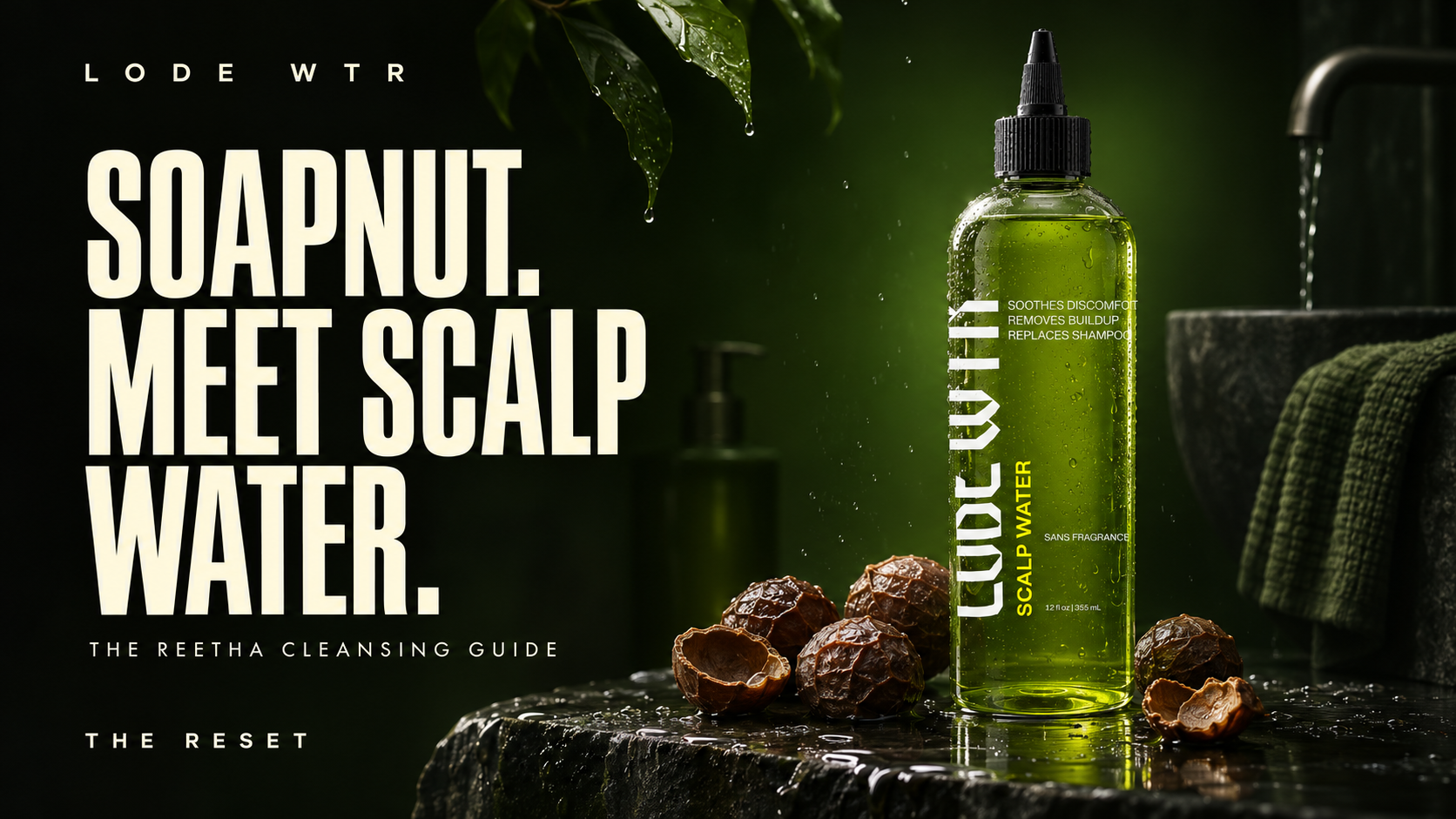
LODE WTR Scalp Water contains Sapindus Mukorossi Fruit Extract, alongside shikakai, amla, and cleansing surfactants.
It offers a formulated way to explore reetha within a scalp-cleansing routine, without preparing a soapnut wash yourself.
Use it according to the product directions, and evaluate how your scalp and hair feel after washing.
Frequently asked questions
Is reetha the same as soapnut?
Reetha is a common name used for soapnut in hair-care discussions. Check the botanical name on a product for the specific ingredient.
Is a soapnut cleanser a no poo product?
It may fit some versions of no poo because it provides an alternative to conventional shampoo. A formulated soapnut cleanser still uses cleansing ingredients; it is not water-only washing.
Does a soapnut cleanser need to be followed by vinegar?
No. Follow the cleanser’s directions rather than assuming it needs an additional acidic rinse.
Can I judge cleansing power by the amount of foam?
Foam alone is not a reliable way to compare finished products. Pay attention to how the wash performs and how your scalp feels afterward.
Is soapnut automatically gentle because it is botanical?
No ingredient description guarantees that a product will suit everyone. Stop using a product if it causes irritation.
Reetha is an interesting ingredient with a long cleansing tradition. The best reason to choose a soapnut hair cleanser is that the finished product works well in the routine you actually live with.


