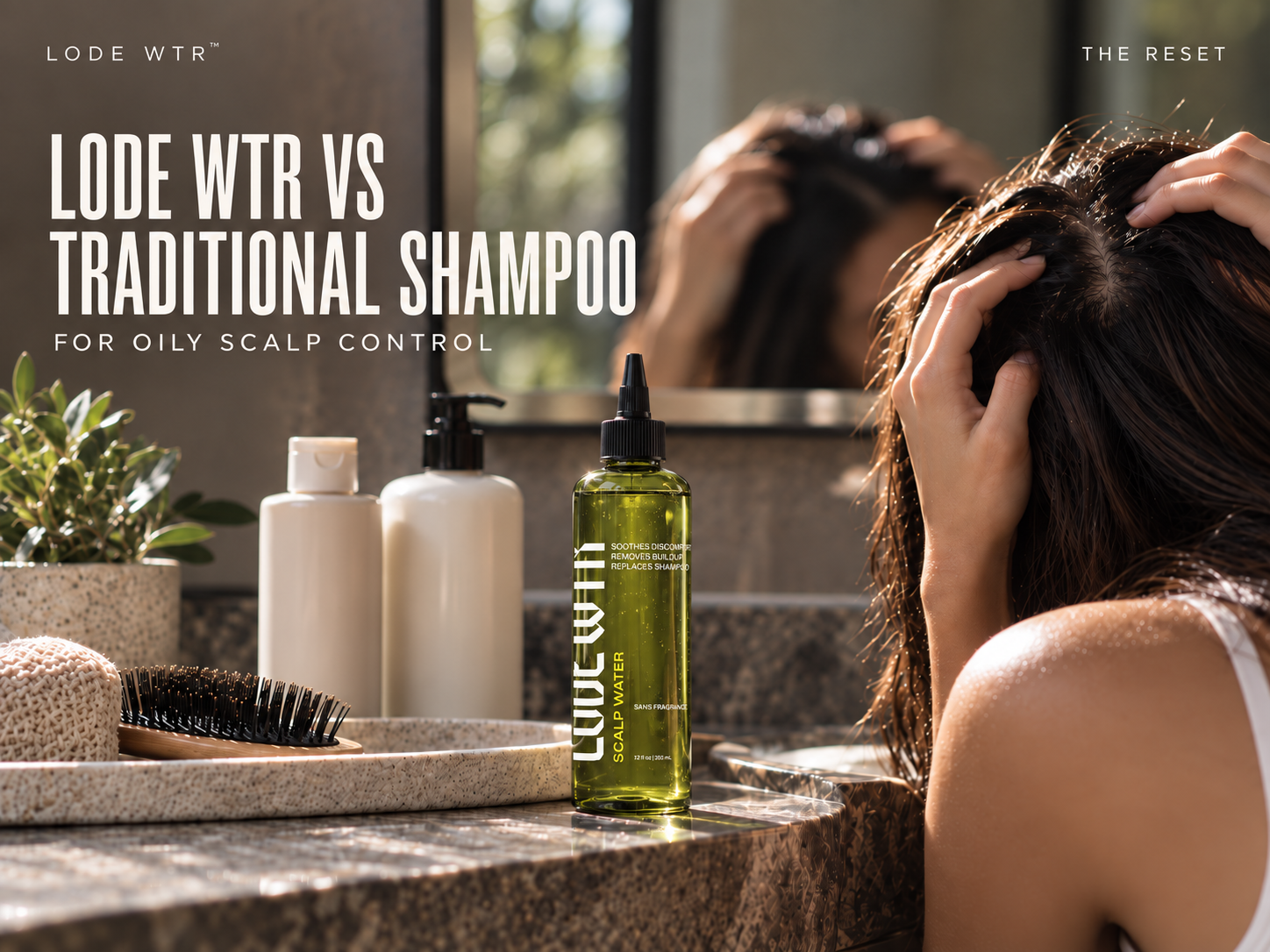
Your roots are greasy again.
So you shampoo.
They look clean.
Then, a day later:
Greasy again.
Naturally, the next move seems obvious.
Find a stronger shampoo.
Maybe more foam.
Maybe something labeled:
DEEP CLEAN.
OIL CONTROL.
CLARIFYING.
PURIFYING.
Whatever sounds most capable of declaring war on your sebaceous glands.
But oily scalp care is not always about using the strongest cleanser you can find.
Sometimes the better question is:
What exactly am I trying to remove?
Because “oily scalp” can actually mean a combination of:
- Natural sebum
- Sweat
- Dry shampoo
- Styling residue
- Conditioner
- Hair oils
- Product buildup
Traditional shampoo and LODE WTR both approach cleansing.
But they don’t necessarily approach it in the same way.
So let’s compare them properly.
No shampoo villainization.
No “natural equals better” nonsense.
Just:
What does each approach do, and which one makes more sense for your scalp?
First: What Does “Oily Scalp Control” Actually Mean?
Let’s fix the terminology before comparing products.
You cannot simply switch off your scalp’s sebaceous glands with a cleanser.
Your scalp naturally produces sebum.
That’s normal.
So when we talk about “oil control,” what we’re really talking about is usually:
- Removing excess sebum
- Removing oil mixed with product residue
- Keeping roots feeling clean
- Preventing heavy buildup
- Avoiding a wash routine that leaves the scalp uncomfortable
That distinction matters.
Because the goal should not be:
Zero oil.
The goal is:
Manage accumulation effectively.
Traditional Shampoo: The Standard Approach
Traditional shampoo generally uses surfactants to help remove:
- Oil
- Sweat
- Dirt
- Styling products
- Residue
Surfactants have parts that interact with water and parts that interact with oily substances.
That allows oily material to be dispersed and rinsed away.
Simple.
Effective.
And for many people, perfectly good.
Traditional shampoo is not automatically harsh.
There are:
- Gentle shampoos
- Strong shampoos
- Clarifying shampoos
- Moisturizing shampoos
- Fragrance-free formulas
- Scalp-specific formulas
So this comparison isn’t:
LODE WTR good. Shampoo bad.
It’s about a different cleansing philosophy.
How LODE WTR Approaches Oily Scalp Cleansing
LODE WTR takes a more scalp-specific approach.
The formulation centers around:
SHIKAKAI + REETHA
Sources of naturally occurring saponins that help lift:
- Excess oil
- Residue
- Product buildup
AMLA
Supports scalp health and helps hair feel smoother and more resilient over time.
ALOE + BOTANICALS
Help calm dryness and irritation.
NATURALLY LOW ACIDIC pH
Helps support the scalp barrier and maintain a balanced cleansing environment.
The difference is not that LODE WTR somehow avoids chemistry.
Everything here is chemistry.
The difference is the design philosophy:
Clean the scalp effectively without making maximum stripping or maximum foam the objective.
LODE WTR vs Traditional Shampoo: Quick Comparison
| LODE WTR | Traditional Shampoo | |
|---|---|---|
| Main goal | Scalp-focused cleansing | Hair + scalp cleansing |
| Cleansing approach | Shikakai + Reetha saponins | Varies by surfactant system |
| Foam | Not the main performance metric | Often more noticeable |
| Oil removal | Helps lift excess oil and residue | Can range from mild to very strong |
| Product buildup | Designed with buildup removal in mind | Depends heavily on formula |
| Scalp comfort | Aloe + botanicals included for support | Depends on formula |
| pH approach | Naturally low acidic pH | Varies between products |
| Amla | Yes | Depends on product |
| Best suited for | Scalp-first routines and alternative cleansing | Very broad range of needs |
| Can it eliminate oil production? | No | No |
The last line is important.
Neither product category should be expected to permanently stop your scalp producing oil.
Difference 1: Scalp First vs Hair First
Traditional shampoo generally treats hair washing as:
Clean hair and scalp together.
LODE WTR’s philosophy is more:
Start at the scalp.
Why?
Because that is where most of the things you’re trying to remove originate or accumulate.
Sebum comes from the scalp.
Sweat accumulates there.
Dry shampoo sits around the roots.
Styling residue often collects there.
So instead of thinking:
“My entire head needs aggressive cleansing.”
the scalp-first approach asks:
“Where is the actual buildup?”
Usually:
At the roots.
Difference 2: Foam
This is one of the biggest psychological differences.
Traditional shampoo often produces the familiar:
Lather. Foam. Bubbles.
And we’ve been trained to associate those bubbles with cleanliness.
But foam is not a reliable measurement of how clean your scalp becomes.
A cleanser may foam less when:
- More oil is present
- More buildup is present
- The formula is designed differently
That does not mean it is doing nothing.
LODE WTR’s philosophy is deliberately:
Function Over Foam.
The point is oil and buildup removal.
Not visual performance.
Difference 3: How the Cleansing Happens
Many traditional shampoos rely on conventional surfactant systems.
LODE WTR’s ingredient story emphasizes botanical saponins from:
Shikakai + Reetha.
Saponins have soap-like properties and can help interact with oily material so it becomes easier to rinse away.
That makes them useful for:
- Sebum
- Product residue
- Scalp buildup
This doesn’t mean conventional surfactants are inherently bad.
It means LODE WTR uses a different route to create part of its cleansing action.
Read next: What Are Saponins in Shampoo? Why Shikakai and Reetha Clean Differently.
Difference 4: How Strong Does Cleansing Need to Be?
If your scalp is very oily, it is tempting to assume:
Stronger = better.
Sometimes stronger cleansing is useful.
For example, if you have:
- Heavy silicone buildup
- Multiple layers of styling product
- Significant dry shampoo accumulation
A stronger clarifying shampoo may be appropriate.
But using intense cleansing automatically, every wash, isn’t necessarily better.
Especially if your scalp begins feeling:
- Tight
- Sensitive
- Dry
- Irritated
The ideal cleanser is not the strongest product available.
It’s the product strong enough for the amount of buildup you actually have.
Does Strong Shampoo Make Your Scalp Produce More Oil?
This claim gets oversimplified online.
You’ll often hear:
“If you strip your scalp, it produces extra oil to compensate.”
Human sebum production is more complicated than a simple shampoo-triggered switch.
So we wouldn’t frame it that way.
But aggressive cleansing can leave the scalp feeling uncomfortable.
And if your response to oily roots becomes:
Stronger shampoo.
More clarifying.
More washing.
You may end up with:
Clean-looking hair + unhappy scalp.
That is not the balance we’re looking for.
Why Your Hair May Look Oily Even When Sebum Isn’t the Only Problem
This is important.
“Greasy roots” can include more than fresh oil.
Think:
Sebum + dry shampoo + styling cream + conditioner residue + sweat.
That mixture can make roots:
- Flat
- Separated
- Heavy
- Shiny
- Waxy
So if you are constantly trying to “control oil” but never addressing buildup?
You may be solving the wrong problem.
This is one area where LODE WTR’s buildup-focused positioning makes sense.
Read: How to Remove Product Buildup on Your Scalp Naturally.
What Happens When Dry Shampoo Enters the Picture?
Dry shampoo can make oily scalp routines complicated.
You spray it because your roots are greasy.
It absorbs some visible oil.
Then fresh oil appears.
So you spray again.
Eventually, your roots may contain:
Sebum + sweat + dry shampoo + styling residue.
Traditional shampoo may absolutely remove that.
LODE WTR is also specifically designed around helping lift accumulated oil and residue.
The important part is:
At some point, the scalp needs actual cleansing.
Dry shampoo does not remove itself.
Which Is Better for Daily Washing?
There isn’t one answer.
Some people comfortably use traditional shampoo every day.
Others prefer a lower-foam scalp-focused routine.
Daily washing isn’t automatically harmful.
What matters is:
- What cleanser you’re using
- How much buildup you create
- How the scalp feels afterward
- Water temperature
- Washing technique
If daily shampoo leaves your scalp clean and comfortable?
Fine.
If it leaves you consistently:
Tight.
Itchy.
Irritated.
Then another cleansing approach may be worth exploring.
Which Is Better for Very Oily Scalp?
This depends on why the scalp looks oily.
If you naturally produce a lot of sebum and accumulate substantial residue quickly, you need effective cleansing.
Sometimes a conventional shampoo designed for oily hair may be ideal.
Sometimes a scalp rinse designed to remove oil and buildup may work well.
The key is the result.
Ask:
Are my roots clean after washing?
Then:
Does my scalp still feel comfortable?
If both answers are yes?
That’s what matters.
Which Is Better for Oily but Sensitive Scalp?
This is where things get more interesting.
Oily scalp does not equal bulletproof scalp.
You can have:
Greasy roots + sensitive skin underneath.
If stronger shampoos repeatedly leave your scalp:
- Tight
- Itchy
- Burning
- Sensitive
then a scalp-first alternative may make sense.
LODE WTR combines cleansing ingredients with:
Aloe + botanicals
to support scalp comfort.
And the naturally acidic pH is part of the broader barrier-conscious approach.
Read: Best Natural Alternative to Shampoo for Sensitive Scalp.
What About Oily Scalp With Dry Hair?
Extremely common.
Especially with:
- Long hair
- Curly hair
- Coily hair
- Chemically treated hair
The scalp becomes oily because sebum accumulates around the roots.
The lengths remain dry.
Now a highly aggressive full-length shampoo routine can create a problem.
You need to clean one area without unnecessarily stressing another.
This is where scalp-first washing makes particular sense.
Clean the roots.
Treat the lengths according to their own needs.
What Role Does Amla Play?
This connects directly to your oily-scalp routine.
Amla isn’t the main oil-removing ingredient in LODE WTR.
Its role is more supportive.
AMLA
Supports scalp health and helps hair feel smoother and more resilient over time.
So while Shikakai + Reetha help handle:
Oil + residue + buildup
Amla contributes to what the scalp and hair experience around that cleansing.
Different job.
Same system.
Read next: Is Amla Good for Balancing Scalp Oil Production?
What Role Does Aloe Play?
Aloe and supporting botanicals are there to help with scalp comfort.
That matters because a cleanser can be very good at removing oil and still create a poor overall experience if the scalp consistently feels irritated afterward.
Oil control should not mean:
Clean at any cost.
It should mean:
Clean effectively while keeping the scalp comfortable.
Why pH Makes the Comparison More Interesting
Traditional shampoos vary considerably in pH.
LODE WTR specifically emphasizes a naturally low acidic pH.
Why does that matter?
Your scalp skin naturally maintains a mildly acidic surface environment.
Hair also responds to pH.
More alkaline conditions can increase hair-fiber swelling and affect how the cuticle behaves.
So a low-pH formula isn’t there to make an impressive chemistry claim.
It is one component of a scalp-conscious formulation strategy.
Read next: Why Shampoo pH Matters.
Which One Removes Product Buildup Better?
The answer depends heavily on the traditional shampoo you’re comparing.
A dedicated clarifying shampoo may be significantly stronger than a gentle daily shampoo.
So there is no honest universal statement that:
LODE WTR always removes more buildup than shampoo.
That would be too simplistic.
What we can say is:
LODE WTR is specifically designed around oil, residue and scalp buildup removal using Shikakai and Reetha as part of its cleansing system.
If your conventional shampoo already removes buildup comfortably?
Great.
If your roots still feel coated or waxy afterward?
A scalp-focused alternative may be worth trying.
Which One Is Better After Workouts?
Again, it depends on your routine.
After exercise, your scalp may have:
- Sweat
- Sebum
- Existing styling product
If you work out frequently, the ideal cleanser needs to remove enough of that accumulation without making every workout require an extreme clarifying wash.
A scalp-focused rinse may be useful for people looking for a more targeted cleansing step.
Read: Post-Workout Scalp Care.
What About Curly and Textured Hair?
This may be one of the strongest use cases for alternative scalp cleansing.
Curly and coily hair often has:
Scalp that needs washing + lengths that don’t want aggressive cleansing.
A traditional shampoo can absolutely work.
But a scalp-first cleansing approach makes it easier conceptually to separate:
Scalp needs
from
hair-length needs.
Clean the buildup around the roots.
Then condition the curls appropriately.
What About Hair That Gets Greasy the Day After Washing?
Before changing products, examine your routine.
Your roots may look greasy quickly because of:
- Natural sebum production
- Conditioner near the roots
- Styling products
- Incomplete rinsing
- Buildup
- Hair texture
A stronger shampoo does not automatically solve all of those.
Sometimes the better change is:
Less root product.
Better rinsing.
More appropriate cleansing frequency.
Different conditioner placement.
The cleanser is one part of the system.
Does LODE WTR Replace Shampoo Completely?
Whether someone uses LODE WTR as their primary scalp cleanser or integrates it differently depends on:
- Their hair
- Scalp
- Styling routine
- Amount of buildup
- Individual cleansing needs
The important idea is that traditional shampoo is not the only possible cleansing format.
Your scalp needs cleansing.
It doesn’t necessarily care what category name appears on the bottle.
Read: 7 Shampoo Alternatives That Actually Clean Your Scalp.
Is LODE WTR Better Than Traditional Shampoo?
Not universally.
And we don’t need to pretend it is.
Traditional shampoo may be the perfect solution for someone whose scalp:
- Tolerates it well
- Gets properly clean
- Remains comfortable
LODE WTR becomes interesting when you want:
- A scalp-focused approach
- Botanical saponin cleansing
- Buildup removal
- Lower emphasis on foam
- A naturally acidic formula
- A system that also considers scalp comfort
The better product is the one that matches the problem.
That’s the LODE WTR philosophy anyway.
Root of the Problem.
When Traditional Shampoo May Make More Sense
Traditional shampoo may be preferable when you need:
Heavy clarification
Especially after unusually heavy product use.
A specific medicated shampoo
If a healthcare professional recommends a medicated cleanser for a diagnosed scalp condition, that is a different category entirely.
A formula you already know works
Don’t change something merely because an alternative exists.
If your current routine is working?
Great.
Hair care doesn’t need unnecessary reinvention.
When LODE WTR May Make More Sense
LODE WTR may be worth considering when you want:
Scalp-first cleansing
Especially if the roots are the main problem.
Buildup management
From oil, sweat and styling residue.
Less emphasis on traditional foaming
If you want to rethink the connection between lather and cleanliness.
Scalp comfort as part of the formula
Rather than treating it as an afterthought.
A botanical cleansing approach
Built around Shikakai + Reetha.
The Biggest Mistake in Oily Scalp Care
Treating oil like the enemy.
Your scalp is supposed to produce oil.
The challenge is managing the excess.
The endless cycle of:
Oil → stronger shampoo → tight scalp → more products → buildup → stronger shampoo
is not necessarily progress.
Sometimes better oil control comes from a simpler routine.
Less buildup.
More deliberate cleansing.
Better technique.
Fewer unnecessary root products.
That’s much more sustainable.
How to Test Which Approach Works Better for You
Don’t change seven things at once.
Pick a routine.
Observe.
Pay attention to:
Immediately after washing
Does the scalp feel clean?
Does it feel tight?
24 hours later
How oily do the roots look?
48 hours later
Is the scalp comfortable?
Is buildup becoming noticeable?
Over several washes
Do you feel like you’re constantly compensating with dry shampoo or extra products?
That’s much more useful than judging a cleanser based on one dramatic shower.
Oily Scalp Control Isn’t About Winning Against Sebum
You are not going to defeat your sebaceous glands.
They live there.
Instead:
Manage what accumulates.
Remove what doesn’t need to stay.
Avoid unnecessarily disrupting the scalp while you’re doing it.
That’s where the comparison between LODE WTR and traditional shampoo becomes useful.
Traditional shampoo can be excellent.
LODE WTR simply asks whether the familiar format is the only way to get the job done.
It isn’t.
Traditional Shampoo vs LODE WTR: The Bottom Line
If traditional shampoo keeps your scalp:
Clean + comfortable
there is no reason to treat it like a problem.
But if you’re dealing with:
- Repeated buildup
- Heavy roots
- Oil mixed with styling residue
- Discomfort after aggressive cleansing
- A desire for a more scalp-focused routine
LODE WTR provides another approach.
Not “cleanse less.”
Not “stop washing.”
Not “natural equals better.”
Just:
Clean differently.
Traditional shampoo
Can provide effective cleansing using a wide range of surfactant systems.
LODE WTR
Uses a scalp-first system built around:
Shikakai + Reetha — Cleanse
Amla — Support
Aloe + Botanicals — Calm
Low Acidic pH — Balance
Same basic challenge.
A different way of solving it.
Rethink Oil Control
The answer to greasy roots isn’t always:
More foam.
Stronger shampoo.
More dry shampoo.
More scrubbing.
Sometimes it is simply:
Better removal of what has accumulated.
And a routine your scalp actually tolerates.
That’s the reset.
Less buildup.
Less stripping.
More function.
Frequently Asked Questions
Is LODE WTR better than shampoo for oily scalp?
It depends on your scalp and routine. Traditional shampoos can work extremely well for oily scalps. LODE WTR offers an alternative scalp-focused approach built around botanical saponins, buildup removal and scalp comfort.
How does LODE WTR clean oily scalp?
LODE WTR uses Shikakai and Reetha, which contain naturally occurring saponins that help lift excess oil, residue and buildup so they can be rinsed away.
Does LODE WTR stop scalp oil production?
No cleanser should be expected to permanently stop natural sebum production. LODE WTR focuses on removing excess oil and accumulation rather than eliminating normal scalp oil.
Does traditional shampoo remove more oil than LODE WTR?
It depends on the shampoo. Traditional shampoos range from very gentle to strong clarifying formulas, so cleansing strength varies significantly.
Can LODE WTR help with greasy roots?
It is designed to help remove excess oil and buildup around the scalp and roots, which may help hair feel cleaner and less coated.
Is LODE WTR a clarifying shampoo?
LODE WTR is positioned as a scalp-focused cleansing rinse rather than a conventional high-strength clarifying shampoo.
Can you use LODE WTR if you have oily and sensitive scalp?
Its formula is designed around both cleansing and scalp comfort, including Aloe, botanicals and a naturally low acidic pH. Individual sensitivities can still vary.
Is LODE WTR good for product buildup?
The formula is designed to help lift oil, residue and buildup using Shikakai and Reetha as part of the cleansing system.
Does more shampoo foam mean better oil control?
No. Lather level does not directly measure cleansing effectiveness.
Is LODE WTR suitable for curly hair with oily scalp?
A scalp-focused approach can be useful for curly or textured hair because it allows you to target cleansing around the roots while treating the lengths separately.
Should I switch from shampoo if my current shampoo works?
Not necessarily. If your current cleanser leaves your scalp clean and comfortable and your hair manageable, there is no reason to change solely because an alternative exists.
LODE WTR
Traditional shampoo cleans.
So do alternatives.
The question is not:
Which one foams more?
It’s:
Which approach works for your scalp?
SHIKAKAI + REETHA — Cleanse.
AMLA — Support.
ALOE + BOTANICALS — Calm.
LOW ACIDIC pH — Balance.
Function Over Foam.
Minimal Not Basic.
Root of the Problem.
Rebellion With Receipts.


