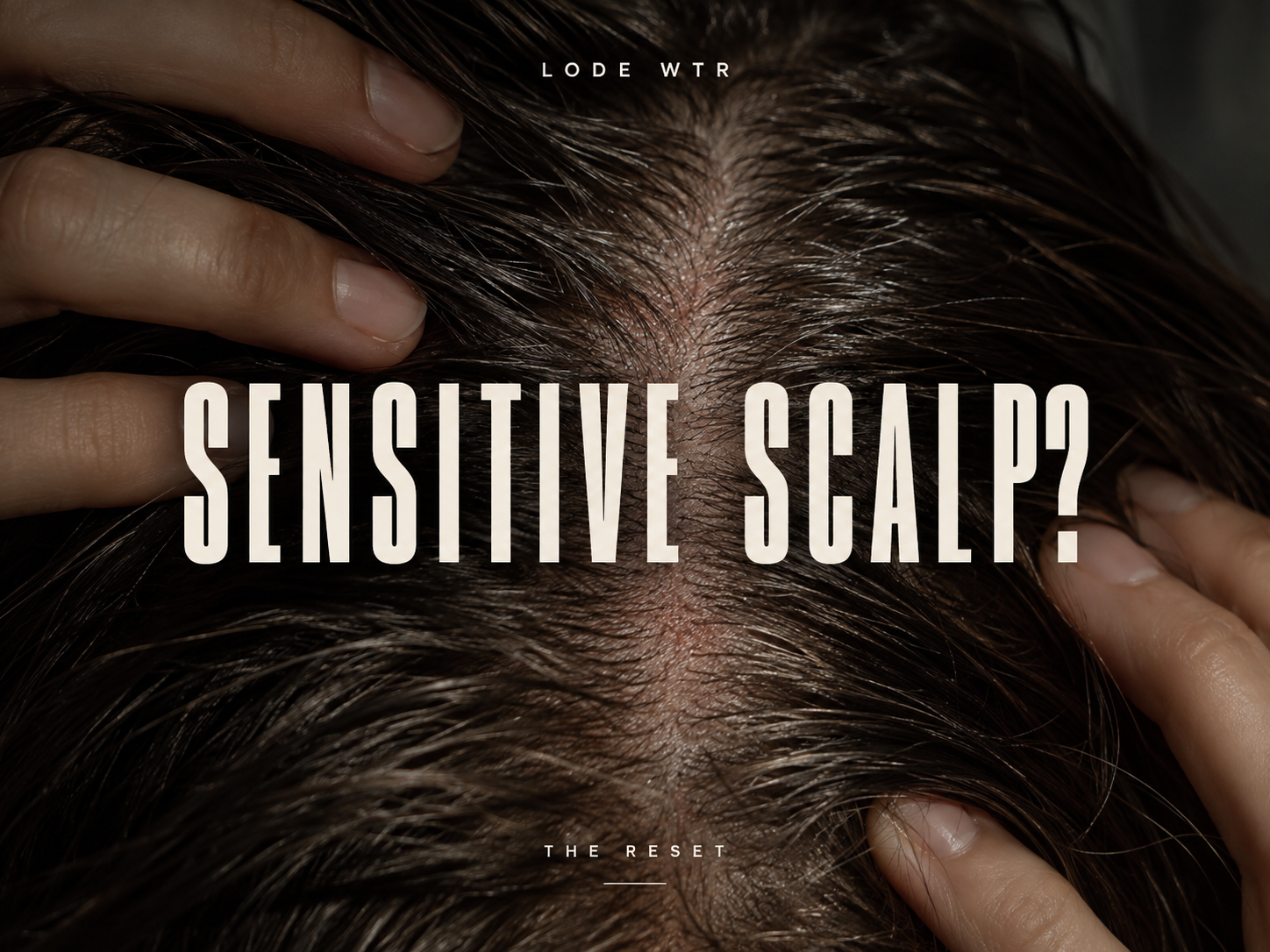
Your scalp feels tight after shampooing.
Maybe itchy.
Maybe a little irritated.
So naturally, you start looking for something gentler.
Then the internet gives you approximately seventeen thousand options:
Apple cider vinegar.
Baking soda.
Clay.
Soap nuts.
Herbal powders.
Oil cleansing.
Water-only washing.
And someone somewhere is definitely telling you to crack an egg over your head.
Helpful.
But if you have a sensitive scalp, the goal should not simply be:
Find the most natural thing possible.
The better question is:
What can actually clean the scalp without unnecessarily making it feel worse?
Because “natural” is not a cleansing mechanism.
And sensitive scalps still deal with:
- Sebum
- Sweat
- Styling residue
- Dry shampoo
- Environmental buildup
So you still need cleaning.
Just with more consideration.
Let’s look at what makes a useful natural alternative to traditional shampoo — and what is mostly internet theatre.
First: What Does “Natural Shampoo Alternative” Actually Mean?
There is no single official category called a natural shampoo alternative.
People generally use the term to describe cleansing methods that rely less on conventional shampoo formats or use plant-derived cleansing ingredients.
That might include:
- Shikakai
- Reetha or soapnut
- Botanical cleansing blends
- Certain cleansing powders
- Very minimalist scalp cleansers
But there is an important distinction.
A product isn’t automatically better for a sensitive scalp simply because it contains plant-derived ingredients.
The complete formula still matters.
A lot.
Sensitive Scalp Doesn’t Mean “Never Cleanse”
When your scalp feels irritated, it’s tempting to think:
Maybe I should stop shampooing altogether.
Sometimes reducing unnecessary washing intensity can help.
But avoiding cleansing indefinitely creates another problem.
Your scalp continues producing sebum.
You continue sweating.
Products continue accumulating.
Eventually you may have:
Sensitive scalp + oil + sweat + buildup.
Excellent combination.
A better goal is not:
No cleansing.
It’s:
Enough cleansing without unnecessary aggression.
That difference matters.
So What Should a Sensitive-Scalp Cleanser Actually Do?
Keep the requirements simple.
It should help remove:
- Excess oil
- Sweat
- Product residue
- Buildup
without routinely leaving the scalp feeling:
- Stripped
- Extremely tight
- Burning
- Painful
- Uncomfortably dry
That’s the job.
Not maximum foam.
Not maximum tingling.
Not maximum “detox.”
Clean and comfortable.
Shikakai: A Botanical Cleansing Option With an Actual Function
This is where Shikakai becomes interesting.
Shikakai comes from Acacia concinna and has a long history of use in traditional hair cleansing.
Why?
Because it naturally contains saponins.
Saponins are plant compounds with soap-like cleansing properties.
They can help lift:
- Oil
- Residue
- Buildup
so they can be rinsed away with water.
That gives Shikakai something we care about:
A real cleansing function.
Not just a nice botanical story.
Reetha: The Soapnut With Natural Saponins
Reetha is commonly known as soapnut.
Again, the name is not being subtle.
Reetha comes from Sapindus fruits that naturally contain saponins.
When combined with water, these compounds can contribute to cleansing action.
That makes Reetha another useful botanical ingredient when the goal is:
Remove excess oil and residue without making extreme cleansing the objective.
At LODE WTR, Shikakai and Reetha are used together for exactly that reason.
SHIKAKAI + REETHA
Provide natural saponins that gently cleanse, helping lift oil, residue and buildup without over-stripping.
Function.
Not folklore.
Why Shikakai + Reetha Make More Sense Than “Water Only”
The water-only method sounds wonderfully simple.
No shampoo.
No cleanser.
Just water.
The problem?
Water isn’t particularly good at removing oil by itself.
Sebum is oily.
And oil does not mix easily with water.
That’s why cleansing compounds exist.
They help loosen oily material so it can be rinsed away.
If you use:
- Hair oils
- Styling products
- Dry shampoo
or naturally produce more sebum, water alone may leave a significant amount behind.
So while less product can sometimes be useful, zero cleansing action isn’t automatically the same as gentle cleansing.
What About Apple Cider Vinegar?
Apple cider vinegar is one of the internet’s favorite shampoo alternatives.
Usually diluted with water.
And yes, vinegar is acidic.
But acidity alone does not make something a complete scalp cleanser.
It does not necessarily perform the same job as a carefully formulated cleansing system designed to remove oil and product buildup.
And DIY concentration matters.
Too strong?
Your scalp may not appreciate the experiment.
Particularly if it is already sensitive.
This is one reason finished formulations generally make more sense than kitchen chemistry.
Someone has hopefully already done the measuring.
What About Baking Soda?
For a sensitive scalp?
This would not be my first choice.
Baking soda is alkaline.
And hair and scalp naturally exist in a more acidic environment.
Highly alkaline approaches can also leave the hair feeling rougher.
So if your goal is:
Gentle scalp care
…using an aggressive DIY alkaline cleanser isn’t necessarily the obvious solution.
Natural does not automatically mean scalp-friendly.
Baking soda is natural-ish.
So is sand.
We aren’t shampooing with that either.
What About Clay?
Clays can absorb oil.
That may make them appealing if your roots feel greasy.
But absorbing oil and fully cleansing the scalp aren’t exactly the same thing.
Clay can also be:
- Messy
- Difficult to distribute
- Difficult to rinse from dense hair
And some people may find certain clay treatments drying.
If your scalp is already sensitive, experimentation with strong oil-absorbing treatments may not be where I’d start.
What About Oil Cleansing?
Oil cleansing makes intuitive sense because:
Oil dissolves oil.
But scalp cleansing isn’t just about sebum.
You’re also dealing with:
- Sweat
- Styling residue
- Environmental debris
And adding more oil to a scalp that already feels coated may not create the clean result you’re looking for.
This doesn’t make scalp oils universally bad.
It simply means:
Oil is not automatically a substitute for cleansing.
Different job.
What About Co-Washing?
Co-washing means using a conditioning cleanser or conditioner-like product instead of traditional shampoo.
It can work very well for certain:
- Curly
- Coily
- Dry hair routines
But whether it is enough depends on what you’re trying to remove.
If your routine involves:
- Heavy gel
- Oils
- Dry shampoo
- Frequent workouts
…a very mild co-wash may eventually struggle with accumulation.
So again:
There’s no universally superior cleansing method.
Your routine creates the cleansing requirement.
What Makes a Good Shampoo Alternative for Sensitive Scalp?
Rather than obsessing over the word “natural,” look for these characteristics.
1. It Actually Cleans
Sounds obvious.
Apparently isn’t.
You need something capable of helping lift excess oil and residue.
That’s why botanical saponins are interesting.
They have a function.
2. It Doesn’t Rely on Maximum Stripping
Your scalp should not have to feel extremely tight after every wash.
The goal is to remove excess accumulation.
Not leave the skin feeling like every lipid has been personally evicted.
3. The Finished pH Makes Sense
Your scalp naturally maintains a mildly acidic environment.
Hair also responds to pH.
That’s why a thoughtfully formulated low acidic pH can be part of a more scalp-conscious cleansing approach.
Read next: Why Shampoo pH Matters: What an Acidic Formula Means for Your Scalp and Hair.
4. It Considers Scalp Comfort
A sensitive scalp doesn’t need another product trying to prove how powerful it is.
Ingredients used to support comfort can make sense alongside cleansing.
At LODE WTR:
ALOE + BOTANICALS
Help calm dryness and irritation.
That does not mean one ingredient can magically treat every scalp condition.
It means comfort is part of the formulation goal.
As it should be.
5. It Doesn’t Need Heavy Fragrance to Feel “Clean”
We’ve somehow been trained to associate:
Strong fragrance = clean.
Your scalp doesn’t need perfume to confirm that oil was removed.
If you’re sensitive to fragranced products, heavily scented scalp products may simply add another variable.
Clean has no required smell.
What About Foam?
Here we go.
Again.
A sensitive-scalp cleanser does not need to create a shampoo commercial in your shower to work.
Foam can make a product:
- Easier to distribute
- More satisfying to use
But it does not directly tell you how appropriate the formula is for your scalp.
And botanical cleansers built around naturally occurring saponins may behave differently from the shampoos you’re used to.
That’s okay.
Function Over Foam.
We really mean it.
Why “Sulfate-Free” Isn’t the Entire Answer
If you’ve searched for sensitive-scalp shampoo before, you’ve probably seen:
SULFATE-FREE
everywhere.
But simply removing one ingredient category doesn’t automatically create the ideal sensitive-scalp product.
There are many different cleansing ingredients.
Some stronger.
Some milder.
The complete formula matters more than one marketing checkbox.
So instead of:
Does this contain ingredient X?
Ask:
How does the entire formula clean, and how does my scalp feel afterward?
Better question.
Natural Doesn’t Mean Hypoallergenic
This deserves its own section.
Botanical ingredients can still cause sensitivity in some people.
Essential oils.
Plant extracts.
Natural fragrances.
All can interact differently with individual skin.
So if you have a highly reactive scalp, do not assume:
Plant-derived = impossible to irritate me.
That’s not how skin works.
Introduce new products thoughtfully.
And stop using anything that consistently causes significant irritation.
What Does LODE WTR’s Approach Look Like?
The philosophy is intentionally straightforward.
SHIKAKAI + REETHA
Natural saponins that help lift excess oil, residue and buildup.
AMLA
Supports scalp health and helps hair feel smoother and more resilient over time.
ALOE + BOTANICALS
Help calm dryness and irritation.
NATURALLY LOW ACIDIC pH
Helps support the scalp barrier and maintain balance.
Different ingredients.
Different roles.
One cleansing system.
That’s much more useful than putting thirty botanicals on a label and hoping nobody asks why.
Why Amla Belongs in the Formula
Cleansing is only half the experience.
You can remove oil extremely effectively.
But if the hair feels terrible afterward?
Not ideal.
Amla is included to support scalp health and help hair feel smoother and more resilient over time.
It isn’t being asked to:
Reverse hair loss.
Transform your genetics.
Perform miracles.
It has a supporting role.
That’s enough.
Why Aloe Matters for Sensitive Scalp
If your scalp already tends to feel:
- Dry
- Tight
- Irritated
…it makes sense for the formulation to consider comfort.
Aloe is widely used in skin and hair formulations designed around soothing and hydration.
In the LODE WTR system, Aloe and supporting botanicals help calm dryness and irritation.
Again:
Support.
Not medical treatment.
If you have persistent severe scalp symptoms, a cosmetic product isn’t a substitute for a dermatologist.
Why Acidic pH Matters Here
Sensitive scalp care is not only about what you’re removing.
It’s also about what environment you leave behind.
Your scalp naturally maintains a mildly acidic surface environment.
That makes the pH of a cleansing product relevant.
An appropriately acidic formula can fit more naturally into that environment than a highly alkaline DIY alternative.
Which is one reason we would choose:
Thoughtfully formulated acidic cleansing
over:
Random kitchen experiment.
Less exciting content.
Better scalp logic.
What If Your Sensitive Scalp Is Also Oily?
Common.
And frustrating.
Your scalp feels:
- Tight
- Sensitive
- Easily irritated
But the hair gets greasy quickly.
So you assume:
I need something stronger.
Not necessarily.
You still need enough cleansing to remove excess sebum.
But oiliness does not mean your scalp is immune to irritation.
Clean the oil.
Don’t punish the skin.
Read next: Why Is My Scalp Dry but My Hair Gets Greasy?
What If Your Sensitive Scalp Is Flaky?
Flakes complicate things because they have multiple possible causes.
You may be dealing with:
- Dryness
- Dandruff
- Product residue
- Buildup
- Irritation
So don’t automatically assume:
Sensitive + flakes = needs oil.
And don’t automatically assume:
Flakes = needs stronger shampoo.
Look at the pattern.
Read: Dry Scalp vs. Dandruff: What’s Actually Causing the Flakes?
What If Shampoo Burns Your Scalp?
Stop treating burning like proof that something is working.
Significant burning or persistent stinging should be taken seriously.
Possible contributors include:
- Product sensitivity
- Hot water
- Scratching
- Aggressive cleansing
- Existing irritation
If one formula repeatedly causes burning?
Stop using it.
If the burning persists or is significant, seek professional advice.
Read next: Why Does My Scalp Burn After Shampooing?
What If You’re Sensitive to Fragrance?
Then fragrance may be one variable worth reducing.
A scalp cleanser doesn’t need a powerful perfume to work.
If fragranced products consistently leave your scalp feeling uncomfortable, consider simpler alternatives.
But remember:
Fragrance isn’t the only possible source of sensitivity.
Look at the full routine.
Not one ingredient in isolation.
Can You Wash a Sensitive Scalp Every Day?
Possibly.
There is no universal rule.
Some people comfortably cleanse daily.
Others do better with longer intervals.
What matters is:
- How oily your scalp becomes
- How much you sweat
- Your styling routine
- What cleanser you use
- How the scalp feels afterward
If daily cleansing leaves your scalp:
Clean and comfortable?
Fine.
If it leaves it:
Tight, itchy and increasingly reactive?
That’s information.
Adjust accordingly.
Should You Double Cleanse a Sensitive Scalp?
Only when there is a reason.
For example:
Significant oil.
Several workouts.
Heavy dry shampoo.
Lots of styling product.
If the first cleanse already removed everything?
Stop there.
A sensitive scalp does not need an obligatory encore.
Read next: Should You Shampoo Twice?
The Best Natural Shampoo Alternative Isn’t the Most Natural One
This is the important bit.
The best option for a sensitive scalp isn’t necessarily:
The rawest.
The oldest.
The most botanical.
The one with the longest ingredient story.
The one you can make in your kitchen.
It’s the one that does the job you need:
Clean effectively.
Avoid unnecessary irritation.
Respect the scalp environment.
Leave hair manageable.
That’s the standard.
The Problem With DIY Scalp Care
DIY can feel empowering.
But scalp formulation involves variables that aren’t obvious from a recipe.
Concentration.
pH.
Preservation.
Ingredient compatibility.
Rinsability.
The fact that someone on social media mixes three ingredients in a jar does not mean the result is optimized for scalp skin.
Your kitchen is great.
It does not automatically become a cosmetic laboratory because you bought pH strips.
Sometimes the Better Alternative Isn’t “No Shampoo”
It’s a different approach to cleansing.
Less obsession with:
Foam.
Fragrance.
Stripping.
Deep cleaning.
More focus on:
Oil removal.
Buildup removal.
Scalp comfort.
pH.
Ingredient function.
That’s a much more useful definition of alternative scalp care.
Where LODE WTR Fits
LODE WTR was built around a scalp-first idea:
What if cleansing could be functional without making conventional shampoo rituals the center of everything?
Instead of loading the story with vague natural claims, the ingredient system has clear jobs.
Shikakai + Reetha:
Cleanse.
Amla:
Support.
Aloe + botanicals:
Calm.
Low acidic pH:
Balance.
That’s the alternative.
Not “nature vs. science.”
Natural ingredients used with formulation logic.
Sensitive Scalp Care Should Feel Boring
This might be the highest compliment we can give it.
Your scalp shouldn’t constantly:
Burn.
Itch.
Feel tight.
Need fixing.
Demand another product.
The ideal result is almost boring.
You wash.
The scalp feels clean.
The scalp feels comfortable.
Then you forget about it.
Beautiful.
Less Drama. Better Cleansing.
If you’re searching for a natural shampoo alternative because your scalp is sensitive, don’t chase the most extreme solution.
You probably don’t need:
A kitchen experiment.
A seven-day detox.
A scalp scrub followed by a vinegar rinse followed by oil.
You need cleansing that understands the assignment.
Remove excess oil.
Remove buildup.
Respect the scalp.
Keep the formula functional.
That’s the reset.
Less stripping.
Less fragrance theater.
Less noise.
Function Over Foam.
Frequently Asked Questions
What is the best natural alternative to shampoo for a sensitive scalp?
There is no universal best product for every sensitive scalp. Look for an effective but considered cleansing system that removes excess oil and buildup without consistently leaving your scalp tight, burning or irritated.
Botanical ingredients containing naturally occurring saponins, such as Shikakai and Reetha, are one option used in scalp-cleansing formulations.
What can I use instead of shampoo for a sensitive scalp?
Options include formulated botanical cleansers, conditioning cleansers and other gentle scalp-cleansing systems.
The important part is ensuring the product actually removes oil and residue while remaining appropriate for your scalp.
Can Shikakai replace shampoo?
Shikakai naturally contains saponins with cleansing properties and has traditionally been used for hair cleansing.
In modern products, it can form part of an alternative cleansing system.
Is Reetha good for sensitive scalp?
Reetha contains naturally occurring saponins that can contribute to cleansing.
Whether a finished product is suitable for a sensitive scalp depends on the entire formula rather than Reetha alone.
Are natural shampoos better for sensitive scalps?
Not automatically.
Natural ingredients can also cause sensitivity, and the finished formulation, concentration, pH and cleansing strength all matter.
Is water-only washing good for sensitive scalp?
Water-only washing may not effectively remove excess oil and product residue for everyone because oil does not rinse easily with water alone.
Is apple cider vinegar a shampoo replacement?
Vinegar is acidic but does not necessarily provide the same complete cleansing function as a properly formulated scalp cleanser. DIY concentration can also vary significantly.
Is baking soda safe as a shampoo alternative?
Baking soda is alkaline and can be harsh on hair and scalp in DIY use. It would not generally be an obvious first choice for an already-sensitive scalp.
Should sensitive scalp products be fragrance-free?
Some people with sensitive skin prefer fragrance-free products because fragrance can be one possible trigger. However, scalp sensitivity can have many causes.
Does shampoo pH matter for sensitive scalp?
It can. The scalp naturally maintains a mildly acidic surface environment, so the pH of a finished cleansing formula is one relevant consideration.
Can you still have an oily scalp if it is sensitive?
Yes. Oil production and scalp sensitivity are separate issues. Your hair can become greasy while the scalp itself feels tight or irritated.
When should I see a dermatologist?
Seek professional advice if scalp sensitivity is persistent or accompanied by significant redness, swelling, burning, pain, sores, oozing, thick scaling or sudden hair loss.
LODE WTR
Cleansing, reconsidered.
SHIKAKAI + REETHA — Cleanse.
AMLA — Support.
ALOE + BOTANICALS — Calm.
LOW ACIDIC pH — Balance.
Natural isn’t enough.
It has to function.
Function Over Foam.
Minimal Not Basic.
Root of the Problem.
Rebellion With Receipts.


