Your scalp itches.
You notice flakes.
So you try a stronger shampoo.
Then another one.
Then something labeled “deep cleansing.”
But your scalp still doesn’t feel right.
Eventually, you start wondering:
Would a scalp rinse without sulfates be a better option?
Possibly.
But before we blame an entire ingredient category, there’s something important to understand.
Sulfate-free does not automatically mean gentle, and flakes do not always mean dryness.
The complete cleansing formula matters.
And so does the reason your scalp is itching or flaking in the first place.
Here’s what to look for when choosing a sulfate-free scalp rinse.
What Is a Sulfate-Free Scalp Rinse?
A sulfate-free scalp rinse is a cleansing product that does not rely on sulfate surfactants such as Sodium Lauryl Sulfate (SLS) or Sodium Laureth Sulfate (SLES).
Instead, it uses other cleansing ingredients to help remove:
- Excess sebum
- Sweat
- Styling-product residue
- Everyday buildup
Some sulfate-free cleansers produce substantial foam.
Others are designed around a lower-foam experience.
The absence of sulfates doesn’t mean the product has no surfactants.
It simply means the cleansing system uses other ingredients.
Why Do People Look for Sulfate-Free Scalp Care?
Usually because their scalp feels uncomfortable after washing.
Common complaints include:
- Dryness
- Tightness
- Itching
- Sensitivity
- Rough-feeling hair lengths
Some people find that certain sulfate-free formulations feel more comfortable.
But sulfate-containing shampoos aren’t automatically harmful, and sulfate-free products can still contain ingredients that irritate individual users.
Fragrance, preservatives, botanical extracts and other ingredients can also contribute to sensitivity.
Look at the formula, not just the front label.
First: What Is Causing Your Itchy, Flaky Scalp?
This question matters more than whether your shampoo contains sulfates.
An itchy, flaky scalp can have several possible causes.
Dry scalp
May involve tightness, dryness and small visible flakes.
Dandruff
Can cause persistent flaking and itching, sometimes alongside scalp oiliness.
Product buildup
Dry shampoo, styling products and residue may form particles that resemble flakes.
Contact irritation
A shampoo, hair dye, fragrance or another product may cause discomfort.
Scalp conditions
Seborrheic dermatitis, eczema, psoriasis and other conditions may require professional diagnosis and targeted treatment.
These problems don’t all have the same solution.
A cosmetic scalp rinse can cleanse.
It cannot replace medical care when a medical condition is causing the symptoms.
How Does a Sulfate-Free Scalp Rinse Clean?
Cleaning depends on surfactants.
These ingredients help loosen oily material and disperse it in water so it can be rinsed away.
Sulfate-free surfactants include ingredients such as:
- Sodium Cocoyl Glutamate
- Decyl Glucoside
- Cocamidopropyl Hydroxysultaine
The performance of a formula depends on how its ingredients work together.
The concentration, pH and overall formulation all matter.
An effective scalp rinse should remove enough accumulation without leaving the scalp unnecessarily uncomfortable.
Can Sulfate-Free Cleansing Help an Itchy Scalp?
It may, particularly if switching to a better-tolerated formula reduces irritation from your previous cleansing routine.
But the result depends on what caused the itch.
If your itching comes from product residue, proper cleansing may help.
If it comes from a specific ingredient sensitivity, removing that trigger may help.
If it comes from dandruff or another scalp condition, a targeted treatment may be necessary.
Gentle cleansing is useful. Accurate diagnosis is more useful.
What About Flakes?
Flakes deserve their own explanation.
Not all white particles around your roots are dandruff.
Some may come from:
- Dry skin
- Styling gel
- Dry shampoo
- Conditioner residue
- Product buildup
A scalp rinse may help remove loose material and accumulated products.
However, persistent dandruff is commonly managed with specific anti-dandruff treatments.
Don’t confuse washing away visible flakes with addressing the cause of ongoing flaking.
Why Scalp pH Matters
Healthy scalp skin naturally maintains a mildly acidic surface environment.
This is part of normal skin-barrier function.
The pH of a cleansing formula may affect the wash experience, particularly for people sensitive to certain products.
LODE WTR is formulated on the acidic side.
But acidic pH by itself does not guarantee that a product will treat irritation, prevent dandruff or suit every sensitive scalp.
It is one aspect of the complete formula.
Why Less Foam Doesn’t Mean Less Cleansing
We’ve been trained to associate a huge lather with cleanliness.
But foam volume is not a direct measure of how much oil a cleanser removes.
Some surfactant systems generate more visible bubbles than others.
A lower-foam cleanser can still clean effectively.
That is the thinking behind the LODE WTR philosophy:
Function Over Foam.
Focus on the outcome.
Not the bubbles.
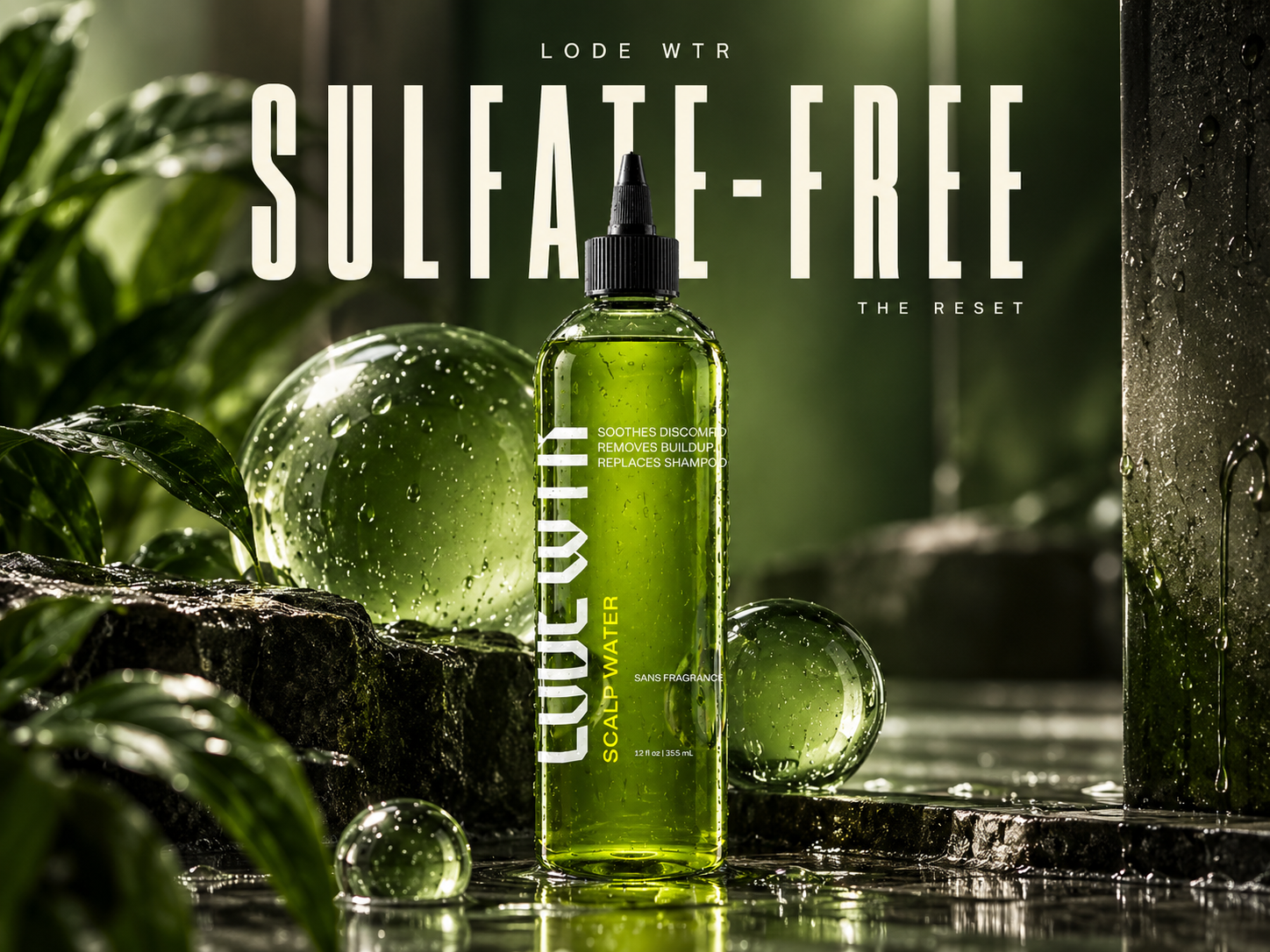
Introducing LODE WTR Scalp Water
LODE WTR Scalp Water is a sulfate-free, scalp-focused cleanser designed as an alternative to traditional shampoo.
Its published formula combines cleansing surfactants with botanical ingredients.
Shikakai
An extract traditionally used in hair care, containing naturally occurring saponins.
Reetha
Another natural saponin-containing botanical, commonly associated with traditional hair washing.
Amla
A supportive botanical included in the formula.
Aloe Vera
An ingredient commonly used in cosmetic formulations designed around hydration and skin comfort.
The formula also includes other functional ingredients involved in cleansing, conditioning, preservation and pH adjustment.
The important distinction is that LODE WTR is not simply water mixed with herbs.
It is a formulated cleansing product.
What Makes LODE WTR Different From Traditional Shampoo?
LODE WTR emphasizes a scalp-first, sulfate-free approach rather than a traditional high-foam shampoo experience.
Its formula is designed to help lift oil, residue and buildup.
That may appeal to people who want:
- A different shampoo format
- Targeted scalp cleansing
- A sulfate-free formula
- Less emphasis on foam
- Botanical ingredients alongside gentle surfactants
However, no cosmetic cleanser should be considered universally suitable for every irritated or flaky scalp.
Individual reactions can vary.
How to Use a Scalp Rinse Effectively
Always follow the product’s directions.
Good scalp-cleansing technique can also help.
Step 1: Thoroughly wet the scalp
Make sure water reaches the roots, especially with thick or curly hair.
Step 2: Apply the rinse to the scalp
Concentrate on the areas where oil and residue accumulate.
Step 3: Massage gently
Use the pads of your fingertips rather than scratching with nails.
Step 4: Rinse thoroughly
Allow enough water to reach all areas of the scalp.
Step 5: Evaluate how your scalp feels
A comfortable scalp shouldn’t need to feel squeaky or extremely tight to be clean.
If a product consistently causes burning or irritation, discontinue its use.
Should You Avoid All Sulfates?
Not necessarily.
Sulfates can be effective cleansing ingredients.
Some people tolerate them very well.
Others prefer certain sulfate-free formulations.
What matters most is:
- The overall formula
- Your scalp’s individual sensitivity
- How much buildup needs removing
- Your washing frequency
- Your hair type
Choosing sulfate-free is a preference that may be useful.
It isn’t a universal medical requirement.
What About Fragrance?
For a sensitive scalp, fragrance is another factor worth considering.
Both synthetic fragrances and natural essential oils can cause reactions in susceptible individuals.
LODE WTR’s published product information describes it as having no added synthetic fragrance.
However, its ingredient list includes botanical extracts such as peppermint, so people with known botanical sensitivities should still examine the full ingredient list.
No added synthetic fragrance does not mean zero possibility of irritation.
Can You Use a Sulfate-Free Rinse for Dandruff?
You can use sulfate-free cleansing products as part of a hair-care routine, but persistent dandruff may require treatment with established anti-dandruff ingredients.
Depending on the condition and local product availability, treatments may include ketoconazole, selenium sulfide or other appropriate active ingredients.
If you already use a medicated shampoo, don’t replace it with a cosmetic rinse without considering your treatment needs.
A dermatologist can help if symptoms recur or fail to improve.
Is a Scalp Rinse Suitable for Curly or Textured Hair?
It may be.
Curly and textured hair often has different needs at the scalp and through the lengths.
The scalp may accumulate oil or styling residue while the ends remain dry.
A scalp-focused cleansing routine allows you to concentrate cleaning around the roots while caring for the lengths separately.
This can be especially useful when you want to avoid unnecessary friction during wash day.
What If Your Scalp Is Itchy but Also Oily?
Oil and irritation can occur together.
An oily scalp isn’t necessarily a comfortable scalp.
If your roots are greasy and your scalp is itchy, consider:
- Dandruff
- Product buildup
- Dry shampoo accumulation
- Product sensitivity
- Incomplete washing
Don’t automatically add more oil simply because your scalp itches.
First look at what is causing the discomfort.
What If Your Scalp Is Itchy Immediately After Washing?
Consider whether the problem may involve:
- Water temperature
- Fragrance sensitivity
- A particular ingredient
- Excessive scrubbing
- An unsuitable cleansing formula
If symptoms repeatedly follow one product, stop using it.
Persistent or severe itching should be professionally assessed.
When Is a Medicated Shampoo More Appropriate?
If you experience recurring dandruff, significant inflammation or symptoms of a diagnosed scalp condition, medical treatment may be necessary.
A sulfate-free cosmetic rinse is not a substitute for prescribed treatment.
Seek medical advice for:
- Severe or persistent itching
- Thick scaling
- Redness or swelling
- Pain
- Open sores
- Oozing
- Hair loss
Taking scalp symptoms seriously is more important than staying loyal to a particular beauty philosophy.
How to Build a Simple Sensitive-Scalp Routine
A good starting point is:
- Choose a cleanser suited to your scalp.
- Avoid unnecessarily hot water.
- Massage gently rather than scratching.
- Rinse thoroughly.
- Limit unnecessary scalp-product layering.
- Wash according to oil and buildup accumulation.
- Introduce new products one at a time.
The objective is not to collect more products.
It’s to find a routine that leaves your scalp comfortable.
The Bottom Line
A scalp rinse without sulfates can be a useful alternative for people who want a different cleansing experience.
But the biggest question isn’t:
Does it contain sulfates?
It’s:
Does it remove what needs removing while remaining comfortable for your scalp?
LODE WTR Scalp Water offers a plant-powered, sulfate-free, scalp-first approach.
It is designed around cleansing oil and residue while considering scalp comfort.
For persistent dandruff or inflammatory scalp conditions, use the appropriate treatment rather than expecting a cosmetic rinse to solve everything.
Clean the buildup. Respect the scalp.
Function Over Foam.
Frequently Asked Questions
Is a sulfate-free scalp rinse good for itchy scalp?
It may be suitable for some people, depending on their sensitivity and the cause of the itch. Sulfate-free does not automatically mean non-irritating.
Can a sulfate-free scalp rinse remove flakes?
It may remove loose flakes and product residue, but persistent dandruff can require targeted treatment.
Is LODE WTR sulfate-free?
Yes. Sulfate surfactants are not listed in its published formulation.
Does sulfate-free mean chemical-free?
No. Sulfate-free products still contain chemical ingredients, including cleansing agents and other functional components.
Can sulfates cause scalp irritation?
Some people find certain cleansing formulas irritating, but irritation depends on the complete product and individual sensitivity.
Can I use LODE WTR instead of shampoo?
LODE WTR is marketed as a shampoo replacement. Whether it suits your routine depends on your cleansing requirements and scalp condition.
Is LODE WTR a dandruff treatment?
It is a cosmetic scalp cleanser, not a substitute for a medicated anti-dandruff treatment.
Does LODE WTR contain natural saponins?
Its Shikakai and Reetha extracts are associated with naturally occurring saponins, and the full formulation also contains other cleansing surfactants.
Can sulfate-free cleansers remove oily buildup?
Yes. Appropriately formulated sulfate-free surfactant systems can remove oil and residue.
What if my scalp continues itching after switching products?
Persistent itching should be evaluated, particularly if it is accompanied by redness, scaling, pain or hair loss.
LODE WTR — THE RESET
LESS FOAM. MORE FUNCTION.
Your scalp needs cleansing.
Not another complicated ritual.
SHIKAKAI + REETHA — CLEANSE.
AMLA — SUPPORT.
ALOE + BOTANICALS — COMFORT.
ACIDIC pH — BALANCE.
FUNCTION OVER FOAM.
Suggested internal links: Plant-Based Shampoo Alternatives for Eczema-Prone Scalp; Shikakai and Reetha Hair Wash Benefits for Dandruff; Why Is My Scalp Itchy but I Don’t Have Dandruff?; Is Aloe Vera Good for a Dry, Itchy Scalp?


