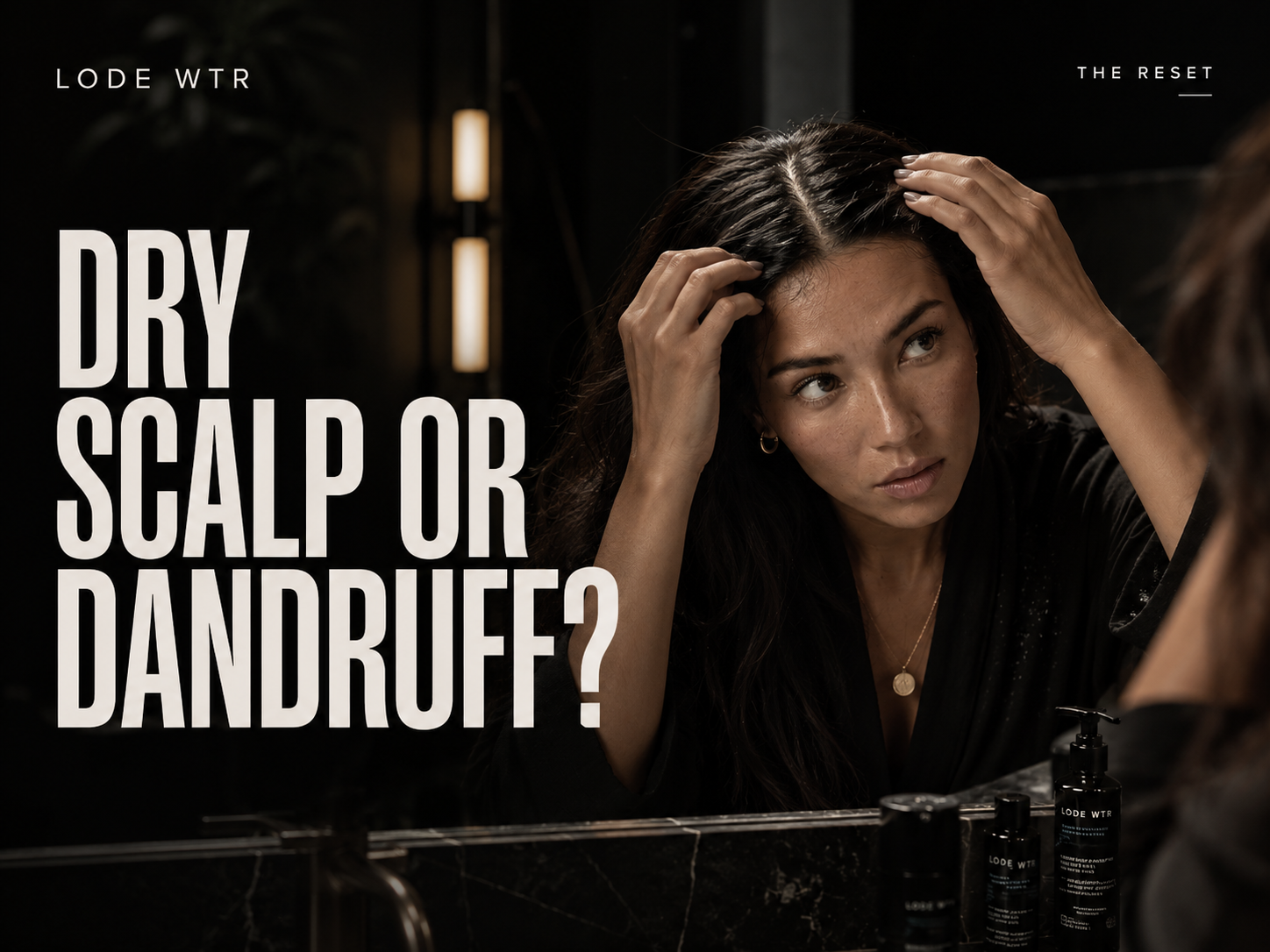
You look down.
Black shirt.
White flakes.
Perfect.
The immediate conclusion?
Dandruff.
So you buy an anti-dandruff shampoo.
Or you decide your scalp is dry and start putting oil on it.
Or both.
And then, somehow, everything gets even more confusing.
Because here’s the problem:
Not every scalp flake has the same cause.
Flaking can happen alongside dryness.
It can happen with oiliness.
Product residue can look like flakes.
And dandruff can appear on a scalp that doesn’t feel “dry” at all.
So before throwing another product at the problem, it helps to understand what you’re actually looking at.
Let’s get to the root of it.
First: Why Does the Scalp Flake?
Your scalp is skin.
Like the skin elsewhere on your body, it continuously renews itself.
Skin cells are naturally shed over time.
Most of the time, you don’t notice this happening.
But under certain conditions, shedding can become more visible.
That can leave noticeable flakes around:
- Your part
- Hairline
- Crown
- Behind the ears
- Shoulders
The difficult part is that several different scalp situations can produce a similar-looking result.
That means:
Flakes are a symptom. Not a diagnosis.
What Is a Dry Scalp?
A dry scalp generally refers to scalp skin that lacks enough moisture or feels dry and uncomfortable.
You may notice:
- Small flakes
- Tightness
- Mild itching
- A dry feeling after washing
- Less visible oil around the roots
The scalp may feel especially uncomfortable after:
- Very hot showers
- Frequent washing
- Aggressive cleansing
- Cold or dry weather
If your scalp feels like someone shrink-wrapped it after shampooing, dryness may be part of the picture.
But visible flakes alone don’t automatically mean dry scalp.
What Is Dandruff?
Dandruff is a common scalp condition characterized by visible flaking, often accompanied by itching.
It is commonly associated with factors involving scalp oil and the skin’s response to microorganisms naturally present on the scalp.
That last part matters.
Dandruff doesn’t necessarily happen because your scalp is “too dry.”
In fact, dandruff can occur on oilier scalps.
That’s why randomly pouring more oil onto a flaky scalp isn’t always the brilliant solution it sounds like at 11 PM after watching three hair-care videos.
Your scalp may already have plenty.
Dry Scalp vs. Dandruff: The Quick Difference
There’s overlap, but some patterns may give you clues.
Dry scalp may be more likely when:
- Flakes are relatively small and dry-looking
- Your scalp feels tight
- Your skin elsewhere also feels dry
- Washing makes the scalp feel more uncomfortable
- Your roots aren’t particularly oily
Dandruff may be more likely when:
- Flaking keeps returning
- There is noticeable itching
- The scalp is also oily
- Flakes are more visible or persistent
- Redness or irritation occurs
But this isn’t a perfect home diagnosis.
Scalp conditions overlap.
And if symptoms are persistent or significant, a dermatologist is far more useful than trying to identify your scalp under bathroom lighting.
1. Look at How Your Scalp Feels After Washing
This is one of the most useful clues.
Does your scalp feel:
Tight, dry and uncomfortable immediately after shampooing?
Your cleansing routine may be contributing to dryness.
Consider:
- Water temperature
- Shampoo strength
- Washing frequency
- Double shampooing
- How aggressively you’re massaging the scalp
If your scalp feels comfortable before washing and significantly worse afterward, that’s information.
Clean should not automatically mean tight.
2. Look at the Oil Around Your Roots
This is where the “all flakes equal dry scalp” idea starts falling apart.
Do you have visible flakes while your roots also feel:
- Greasy
- Shiny
- Heavy
- Oily relatively quickly after washing
Then simple dryness may not explain the whole situation.
Oil and flakes can exist together.
And adding more oil because you saw flakes may leave you with:
Flakes + even more oil.
Not exactly progress.
Read next: Why Does My Scalp Get Greasy So Fast?
3. Make Sure You’re Looking at Flakes — Not Product
Your scalp routine may leave behind more residue than you realize.
Common offenders include:
- Dry shampoo
- Styling gel
- Hair spray
- Root powder
- Curl products
- Leave-in conditioner
- Heavy creams
Once these products dry, they can sometimes become visible around the roots.
Scratch your scalp or brush your hair and suddenly white particles appear.
Instant panic.
But those particles may not all be skin.
This is especially common when products are layered repeatedly.
So before assuming your scalp has suddenly developed a major flaking problem, ask:
What have I put on it this week?
Read: What Is Scalp Buildup? Signs, Causes and How to Reset Your Routine.
4. Dry Shampoo Can Make the Situation Very Confusing
Dry shampoo absorbs oil.
It also leaves product behind.
Use it once?
Fine.
Use it repeatedly?
Now you may have powder, oil, sweat and styling residue sitting around the scalp.
Then you scratch.
White particles appear.
And you’re trying to decide whether it’s dandruff, dry skin or the three-day-old dry shampoo you forgot was there.
This is why your scalp needs actual cleansing eventually.
Dry shampoo can help extend a hairstyle.
It doesn’t replace washing indefinitely.
5. Overwashing Can Contribute to a Dry, Flaky Feeling
There is no universal wash schedule.
But if you’re cleansing aggressively and frequently, some scalps may start feeling increasingly dry or tight.
You may notice:
- Fine flakes
- Tightness
- Sensitivity
- Itching after washing
Then comes the classic reaction:
“My scalp has flakes. I need to wash it more.”
Which may make the scalp feel even drier.
The goal is not maximum washing.
It’s appropriate washing.
If you’re shampooing every day — or double shampooing every day — and your scalp feels worse afterward, take a closer look at the routine.
Read next: Can You Overwash Your Hair? 7 Signs Your Scalp Needs a Reset.
6. Not Washing Enough Can Create a Different Problem
And now, because scalp care enjoys making things complicated, the opposite can also be true.
Waiting too long between washes can allow:
- Oil
- Sweat
- Styling product
- Dry shampoo
- Skin-cell buildup
…to accumulate.
That may leave the scalp itchy, coated and flaky-looking.
So the answer isn’t:
Wash constantly.
And it isn’t:
Never wash.
It’s:
Wash according to what your scalp and routine actually need.
Revolutionary stuff.
7. Weather Can Change Your Scalp
Your scalp does not exist in a climate-controlled vacuum.
Cold weather.
Indoor heating.
Low humidity.
Hot weather.
Sweat.
Seasonal changes can all influence how your skin feels.
A scalp that seems perfectly comfortable in summer may suddenly feel:
- Tight
- Dry
- Flaky
…during colder months.
Likewise, hot weather can create more sweating and oil accumulation.
So if your scalp behavior suddenly changes with the season, don’t automatically assume your products stopped working overnight.
Your environment changed too.
Can Dandruff Happen on an Oily Scalp?
Yes.
And this is one of the most important points in this entire article.
Dandruff is not simply another word for dry scalp.
You can have flakes and oily roots at the same time.
That means covering a flaky scalp in heavy oils may not be the right move for everyone.
If your roots are already oily and flaking persists, the issue deserves a more thoughtful approach.
Sometimes the scalp doesn’t need more oil.
It needs the right kind of care.
Can a Dry Scalp Still Be Itchy?
Absolutely.
Dryness can make skin feel tight and itchy.
But itching can also happen with:
- Dandruff
- Product sensitivity
- Buildup
- Sweat
- Certain scalp conditions
That’s why “itchy” isn’t enough information on its own.
Look at the complete pattern.
Is your scalp oily?
Dry?
Red?
Coated?
Does it itch after washing?
After several days?
After using a particular product?
Patterns tell you more than one symptom.
Why Do I Get Flakes Right After Washing?
This is particularly frustrating.
You literally just washed.
How are there already flakes?
Possible reasons include:
- Your scalp feels dry after cleansing
- You used very hot water
- Your cleanser was too aggressive for you
- Existing flakes became loosened during washing
- Product wasn’t fully rinsed away
- Your scalp is dealing with something beyond simple buildup
If this happens repeatedly, don’t automatically shampoo again.
Especially if your scalp already feels tight.
You may simply create a wash → dryness → flakes → wash cycle.
Why Do Flakes Appear After I Scratch My Scalp?
Because scratching loosens whatever is sitting on the scalp.
That may include:
- Shed skin
- Dandruff flakes
- Dry shampoo
- Styling-product residue
- Other buildup
This is also why aggressively scratching your scalp to “remove flakes” can backfire.
Your fingernails are not a scalp exfoliation device.
Use your fingertips when washing.
Your scalp should not look like you’ve been trying to sand it down.
Should You Oil a Flaky Scalp?
Not automatically.
This is one of the most common reactions to flakes:
Dry-looking = add oil.
But remember:
The flakes may not be caused by simple dryness.
If your scalp is already oily or experiencing dandruff, adding more oil may simply make the roots heavier.
Instead, first look at the complete picture.
Does your scalp actually feel dry?
Or does it feel oily, itchy and coated?
Those are different situations.
Treating every flake with oil is like treating every car warning light by adding windshield fluid.
Sometimes unrelated.
Should You Scrub Flakes Away?
Gentle cleansing can help remove loose flakes and buildup.
Aggressive scratching?
Different story.
Scratching may temporarily lift flakes, but it can also irritate the scalp.
If you’re washing:
Use your fingertips.
Massage.
Rinse thoroughly.
There is no need to wage war against your scalp.
Clean isn’t supposed to hurt.
What About Scalp Scrubs?
Physical scalp scrubs are another product category frequently recommended for flakes and buildup.
But more exfoliation is not automatically the answer.
If your scalp is already:
- Irritated
- Sensitive
- Red
- Painful
…aggressive physical exfoliation may not be particularly helpful.
Again, identify the problem first.
Then choose the tool.
Function Over Foam.
And function over scrubbing, while we’re here.
How to Build a Better Routine for a Flaky Scalp
You don’t need to rebuild your entire bathroom.
Start with the basics.
1. Look at Your Washing Frequency
Are you washing extremely often?
Or waiting much longer than your scalp comfortably tolerates?
Adjust based on the pattern you’re seeing.
2. Turn Down the Water Temperature
Very hot showers may leave some scalps feeling tighter and drier.
Try comfortably warm water instead.
Simple experiment.
Zero new products required.
3. Clean the Scalp Gently
Focus shampoo around the roots.
Massage with your fingertips.
Avoid aggressive scratching.
4. Rinse Thoroughly
Especially if you use:
- Conditioner
- Curl cream
- Styling products
- Dry shampoo
Residue can complicate an already flaky situation.
5. Reduce Product Layering
If you’re trying to identify what is making your scalp unhappy, seven products are not helping the investigation.
Simplify temporarily.
Observe.
Add things back one at a time.
Rebellion With Receipts.
6. Stop Automatically Adding Oil
If your scalp genuinely feels dry, the right supportive routine may help.
But don’t assume every flake equals an oil shortage.
Look at whether the scalp is dry or oily first.
7. Pay Attention to What Keeps Returning
A one-off flaky day is different from persistent scaling and itching.
If the problem continually returns despite sensible routine changes, it may deserve professional assessment.
When Flakes Need More Than a Routine Change
Scalp care has limits.
If you’re experiencing persistent or significant:
- Redness
- Severe itching
- Thick scaling
- Pain
- Burning
- Sores
- Oozing
- Sudden hair loss
…talk to a dermatologist or healthcare professional.
There are scalp conditions that require proper diagnosis and treatment.
A blog post — including this one — cannot tell you exactly what’s happening on your scalp.
And neither can your favorite beauty influencer.
Stop Treating Every Flake the Same
This is the bigger point.
We see flakes.
We panic.
Then we buy something labeled:
ANTI-FLAKE.
But your scalp may be telling you different things.
Maybe it’s dry.
Maybe there’s product buildup.
Maybe you’re washing too aggressively.
Maybe you’re not washing enough for your routine.
Maybe you’re dealing with dandruff.
The useful question isn’t:
“How do I make the flakes disappear right now?”
It’s:
“Why are they there?”
That’s the difference between covering something up and getting closer to the actual problem.
Flakes Are Information
Your scalp isn’t trying to ruin your black shirt.
It’s responding to an environment.
Oil.
Water.
Products.
Washing.
Weather.
Sweat.
Friction.
The answer isn’t automatically more shampoo.
Or more oil.
Or another scalp gadget.
Start by understanding what kind of scalp you’re actually working with.
Then simplify.
Adjust.
Observe.
That’s scalp care at the root.
Function Over Foam.
Root of the Problem.
Frequently Asked Questions
How can I tell dry scalp from dandruff?
Dry scalp is more likely to involve a dry or tight feeling and smaller dry-looking flakes, while dandruff may involve more persistent flaking and itching and can occur on an oily scalp.
Because symptoms overlap, persistent problems may require professional assessment.
Can you have dandruff with an oily scalp?
Yes. Dandruff does not necessarily mean the scalp is dry.
Oiliness and visible flaking can occur at the same time.
Why do I have white flakes in my hair?
White particles may come from dry skin, dandruff, product buildup, dry shampoo or other residue.
Look at your overall scalp condition rather than identifying the problem based on flakes alone.
Can overwashing cause scalp flakes?
Frequent or aggressive cleansing may leave some scalps feeling dry, tight or uncomfortable and may contribute to visible flaking.
Can product buildup look like dandruff?
Yes. Dry shampoo and styling-product residue can sometimes become visible around the roots and resemble flakes.
Should I put oil on a flaky scalp?
Not automatically. Flaking doesn’t always mean the scalp lacks oil, and dandruff can occur on oily scalps.
First consider what may actually be causing the flakes.
Why does my scalp flake immediately after washing?
Hot water, aggressive cleansing, dryness, loosened existing flakes or product residue may all contribute.
If flaking keeps returning or is accompanied by significant irritation, seek professional advice.
Can I scratch dandruff off my scalp?
Aggressive scratching can irritate the scalp. Gentle cleansing with the fingertips is preferable to scratching with your nails.
When should I see a dermatologist for scalp flakes?
Consider professional evaluation if flaking is persistent, severe or accompanied by significant redness, pain, burning, sores, thick scaling or hair loss.
LODE WTR
Scalp care, stripped back.
Function Over Foam.
Minimal Not Basic.
Root of the Problem.
Rebellion With Receipts.


