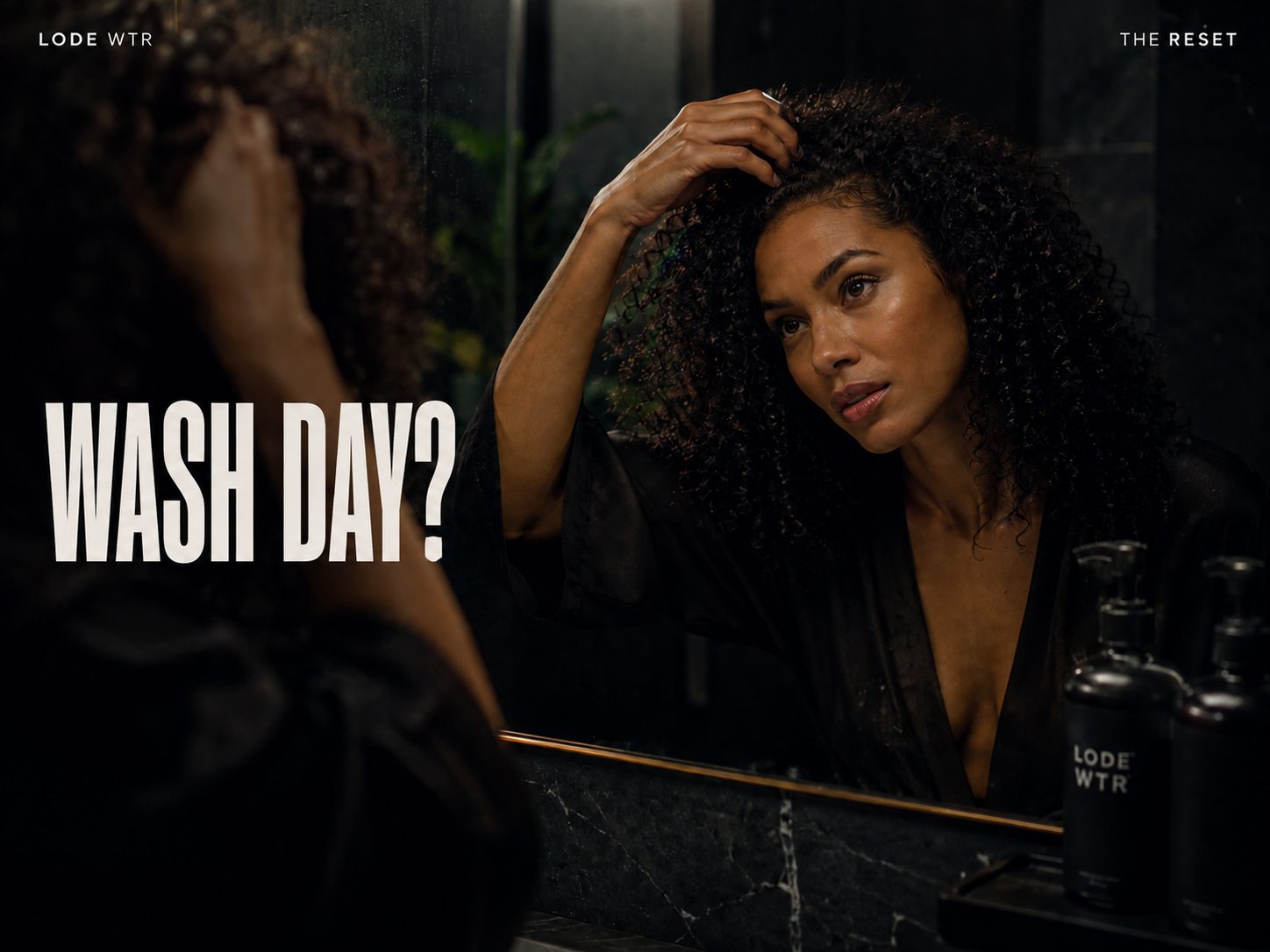
Three days?
Once a week?
Every ten days?
Never unless absolutely necessary?
Ask five people with curly hair how often you should wash it and you’ll probably get six answers.
That’s because curls and textured hair don’t operate by one universal rule.
Some scalps become oily quickly.
Others stay comfortable for days.
Some routines involve two styling products.
Others involve leave-in, cream, gel, oil, edge control and enough layering to qualify as architecture.
So instead of asking:
“How often should curly hair be washed?”
A better question is:
“How often does your scalp need to be cleaned?”
That distinction matters.
Because curl care often focuses heavily on protecting the hair lengths.
And understandably so.
But underneath the curls is still a scalp dealing with:
- Sebum
- Sweat
- Dead skin
- Styling products
- Dry shampoo
- Environmental residue
- Product buildup
Your curls may not need frequent manipulation.
Your scalp may still need cleansing.
Let’s find the balance.
Why Curly Hair Often Gets Washed Less Frequently
Sebum starts at the scalp.
With straighter hair, natural oil can travel down the hair shaft relatively easily.
With curly and coily textures, that journey becomes more difficult.
Every bend, curl and coil creates a less direct path.
As a result, the scalp may become oily while the lengths still feel dry.
That creates one of curly hair care’s biggest contradictions:
Oily roots. Dry ends.
Washing more aggressively may make the lengths feel drier.
Waiting too long may leave the scalp coated with oil, sweat and styling products.
The answer usually isn’t choosing one side.
It’s separating scalp needs from hair-length needs.
So, How Often Should You Actually Wash Curly Hair?
There is no correct universal number.
Some people with curls may feel best washing every few days.
Others may comfortably go a week.
Some tightly coiled textures may follow longer wash cycles.
What matters is what happens between washes.
Your ideal schedule depends on:
- Your scalp oil production
- Curl pattern
- Hair density
- How much you sweat
- How often you exercise
- Styling product use
- Protective styles
- Climate
- Scalp sensitivity
- How quickly buildup develops
Your curl type matters.
But your scalp condition matters more than a chart telling you what 3B or 4C hair is “supposed” to do.
1. Your Scalp Is the Best Place to Start
Look underneath the curls.
How does your scalp actually feel?
A scalp that is:
- Comfortable
- Not excessively oily
- Not itchy
- Not heavily coated
- Not carrying significant buildup
…probably does not need to be washed simply because the calendar says so.
But if your scalp feels:
- Greasy
- Itchy
- Sweaty
- Coated
- Heavy
- Uncomfortable
…it may be ready for cleansing even if your curls still look good.
This is one of the most useful shifts in curly hair care:
Stop letting the hairstyle make every scalp decision.
Your twist-out may have another two days left in it.
Your scalp may disagree.
2. Product Layering Changes Your Wash Schedule
Curly routines can involve a lot of product.
For good reason.
Leave-ins can improve manageability.
Creams can help with softness.
Gels can provide hold.
Oils can change the feel of the hair.
But every product added to the routine eventually has to go somewhere.
Consider a typical styling day:
Leave-in.
Curl cream.
Gel.
Maybe oil.
Then a refresh product the next morning.
More gel around the hairline.
Another refresh two days later.
By the end of the week, your scalp and roots may be carrying significantly more than natural oil.
That doesn’t mean curly styling products are bad.
It means your cleansing routine has to match your styling routine.
The more you layer, the more important effective removal becomes.
3. Curly Hair Can Have Buildup Without Looking Greasy
This is important.
With straight or fine hair, buildup often announces itself by making the roots visibly greasy or flat.
With textured hair, buildup may show up differently.
You might notice:
- Roots that feel coated
- Curls losing definition near the scalp
- Hair that feels sticky or waxy
- More itching
- Flakes mixed with styling residue
- Hair that seems harder to fully wet
- Products sitting on the hair instead of absorbing or distributing properly
So waiting until curly hair looks greasy isn’t always the best way to decide when to wash.
Your fingers may notice the buildup before your mirror does.
4. Your Workout Routine Matters
Curly hair and frequent workouts can create a tricky relationship.
You may want to preserve your style.
Your scalp, meanwhile, is sweating through a spin class.
Sweat doesn’t automatically mean you need a full wash after every workout.
But repeated heavy sweating adds moisture, salt and residue around the scalp.
Then you may add more styling product to refresh the curls.
Then sweat again.
Then refresh again.
Eventually the routine becomes:
Sweat + product + sweat + product + scalp trying to file a complaint.
If you exercise frequently, your wash schedule may need to be shorter than someone with the same curl pattern who doesn’t.
Your lifestyle matters as much as your curl type.
5. Co-Washing and Cleansing Are Not Always the Same Thing
Co-washing — cleansing with conditioner or a conditioning cleanser — is popular in curly and textured hair routines because it can feel gentler on the lengths.
For some people, it works beautifully.
But there’s an important distinction:
If your routine involves significant:
- Gel
- Heavy creams
- Oils
- Dry shampoo
- Edge products
- Sweat
…you may occasionally need more effective cleansing than a very mild co-wash provides.
The goal is not to declare co-washing good or bad.
The goal is to look at what you’re trying to remove.
If your scalp repeatedly feels coated immediately after washing, the cleansing step may not match the buildup you’re creating.
Function first.
6. Dry Ends Don’t Automatically Mean Your Scalp Should Stay Unwashed
This is where curly hair routines sometimes get stuck.
Your ends feel dry.
So you avoid washing.
That makes sense emotionally.
But your scalp and your ends don’t have identical needs.
You can cleanse the scalp while being gentler with the lengths.
Focus shampoo where oil and buildup accumulate:
At the roots.
Then let the rinse move through the rest of the hair rather than aggressively scrubbing every curl.
Your ends don’t have to pay the full price every time your scalp needs cleaning.
7. Protective Styles Still Need Scalp Care
Braids.
Twists.
Cornrows.
Extensions.
Protective styles can reduce daily manipulation of the hair.
But they don’t turn off your scalp.
Your scalp continues to produce:
- Oil
- Sweat
- Skin cells
And you may still be applying products around the roots.
That means scalp care remains important while wearing a protective style.
The challenge is cleaning effectively without creating unnecessary friction or disrupting the style more than necessary.
Focus on the scalp.
Be gentle.
Rinse carefully.
And avoid assuming that because the hair is styled, the scalp no longer needs attention.
Protective style.
Still an active scalp.
What Happens If You Wait Too Long Between Washes?
Waiting longer isn’t automatically bad.
But if you consistently go beyond what your scalp tolerates, buildup can accumulate.
You may start noticing:
- Itching
- Odor
- Heavy roots
- Visible residue
- Flakes
- Increased discomfort
- Curls that feel coated at the base
Then wash day becomes increasingly intense because you’re trying to remove ten days of accumulation in one session.
Sometimes a slightly more regular cleansing routine is easier than repeatedly needing a major reset.
There is no trophy for the longest wash interval.
Your scalp doesn’t care that you made it to day ten.
What Happens If You Wash Curly Hair Too Often?
The opposite problem exists too.
Frequent cleansing can be uncomfortable for some scalps and can make textured lengths feel increasingly dry, particularly when combined with:
- Strong cleansing
- Very hot water
- Aggressive detangling
- Frequent manipulation
If you’re washing often and notice:
- Tight scalp
- Dry-feeling roots
- Increased tangling
- Rougher lengths
- More breakage during wash day
- Persistent discomfort
…look at both frequency and technique.
The solution may not simply be “wash less.”
You may need to wash differently.
How to Know It’s Time to Wash Curly Hair
Forget the calendar for a moment.
Look for signals.
Your scalp feels oily
Natural sebum has accumulated enough that the roots feel slick or heavy.
Time to consider cleansing.
Your scalp is itchy
Mild itching after several days may be a sign that sweat, oil or product accumulation is becoming uncomfortable.
Persistent or significant itching deserves more attention.
Your roots feel coated
This is a big one for textured hair.
If you touch the roots and feel a film, residue or tackiness, buildup may be present even if the hair doesn’t look traditionally greasy.
Your scalp smells different
Oil, sweat and product accumulation can leave the scalp feeling less fresh.
If odor appears consistently before your scheduled wash day, your schedule may need adjusting.
Your styling products stop behaving normally
Sometimes buildup makes itself known through the next product application.
Your gel doesn’t distribute properly.
Your refresh spray seems to sit on top.
The roots feel heavy immediately.
Your hair may already be carrying more than it needs.
Should You Shampoo Curly Hair Twice?
Not automatically.
Double cleansing may be useful when there is significant:
- Oil
- Sweat
- Styling product
- Dry shampoo
- Buildup
But it doesn’t need to be a permanent ritual.
If the first cleanse leaves the scalp clean and comfortable, a second may not be necessary.
If you’re double shampooing every wash and your scalp feels tight while the lengths feel increasingly dry, reconsider.
More foam isn’t the goal.
A clean scalp is.
What About Clarifying Curly Hair?
Clarifying can be useful when regular cleansing isn’t removing accumulated styling products or residue.
But clarifying doesn’t need to become an aggressive weekly punishment.
Use it based on what your routine actually creates.
People who use significant styling products may need it more often.
People with simpler routines may need it less.
And if hard water is involved, products designed specifically for mineral buildup may be more relevant than simply using a harsher shampoo.
Again:
Treat the problem you actually have.
Not the one the internet assigned to your curl pattern.
How to Wash Curly Hair Without Turning Wash Day Into a Battle
Wash day has enough drama already.
Let’s simplify.
1. Start With the Scalp
Apply cleanser where the buildup actually lives.
Focus on the roots.
2. Use Your Fingertips
Massage gently.
Don’t use your nails to scrape the scalp.
You want clean.
Not archaeological excavation.
3. Work in Sections
Dense curls can make it difficult to reach the entire scalp.
Sections help you clean more intentionally and reduce random aggressive scrubbing.
4. Rinse Thoroughly
This matters even more with dense hair.
Make sure water reaches:
- The crown
- The nape
- Behind the ears
- Under thicker sections
Residue loves hiding places.
5. Condition Where You Need It
Your lengths may need more conditioning than your scalp.
That’s fine.
Different parts of your hair can have different needs.
6. Detangle With Intention
Detangling can create significant manipulation.
Use enough slip and work carefully rather than rushing through knots.
Wash day doesn’t need to become breakage day.
What If Your Scalp Gets Oily but Your Curls Stay Dry?
This is one of the most common textured-hair dilemmas.
Your scalp is producing oil.
The lengths aren’t benefiting much from it.
So the roots feel greasy while the ends feel dry.
The solution isn’t necessarily avoiding scalp cleansing.
Instead, separate the two needs:
Cleanse the scalp.
Condition the lengths.
Your entire head does not have to receive identical treatment.
That simple distinction can make a curly routine much easier to manage.
What If Your Scalp Itches Between Washes?
First, look at what’s accumulated.
Did you:
Exercise several times?
Use a lot of gel?
Apply dry shampoo?
Refresh repeatedly?
Wear a hat?
Keep your scalp damp for long periods?
The itching may simply be telling you that the current wash interval is too long for your routine.
But persistent itching isn’t something to endlessly solve with cosmetic experiments.
If itching is significant or accompanied by:
- Redness
- Pain
- Sores
- Thick scaling
- Burning
- Sudden hair loss
…talk to a dermatologist or healthcare professional.
Scalp care and medical scalp care are not the same thing.
Your Curl Pattern Doesn’t Own Your Wash Schedule
This may be the biggest takeaway.
Knowing your curl pattern can help you understand your hair.
But it shouldn’t dictate every part of your routine.
Two people with similar curls may have completely different:
- Scalp oil production
- Exercise habits
- Styling routines
- Hair density
- Climate
- Product use
So one may wash every three days.
The other every seven.
Both can be right.
Your routine should respond to your actual scalp.
Not a graphic you saved five years ago.
Curly Hair Care Starts Under the Curls
We spend a lot of time talking about:
Definition.
Frizz.
Shrinkage.
Hold.
Moisture.
All important.
But the curls are growing from somewhere.
The scalp.
If your roots are carrying layers of sweat, oil and styling products, the solution shouldn’t always be another curl refresher.
Sometimes the best thing you can do for the style is reset what’s underneath it.
That’s where LODE WTR starts.
Root of the Problem.
Literally.
Wash When Your Scalp Needs It
Not because someone said curly hair should only be washed once a week.
Not because someone else said daily washing is the only way to be clean.
And not because your styling product needs another layer to survive until Friday.
Look at your scalp.
Look at your routine.
Look at your lifestyle.
Then find the rhythm that leaves both your scalp and your curls working together.
Scalp first. Curls respected.
Function Over Foam.
Frequently Asked Questions
How often should you wash curly hair?
There is no universal schedule. Your ideal frequency depends on your scalp oil production, curl type, product use, workouts, hair density and how quickly buildup develops.
Is once a week enough for curly hair?
It can be for some people. Others may need more frequent cleansing, particularly if they sweat heavily, have an oily scalp or use many styling products.
Can you wash curly hair every day?
Some people can, but frequent washing may leave certain scalps or textured lengths feeling dry or uncomfortable. Pay attention to how your own hair and scalp respond.
How do I know when my curly hair needs washing?
Signs can include an oily or itchy scalp, coated roots, product buildup, odor, heavy-feeling hair or styling products no longer behaving normally.
Can curly hair get product buildup?
Yes. Leave-ins, creams, gels, oils, dry shampoo and other products can accumulate around the roots and hair over time.
Should I shampoo my curly hair twice?
Not automatically. Double cleansing may help when there is significant oil or product buildup, but if one cleanse leaves your scalp clean and comfortable, a second may not be necessary.
Should I wash curly hair after every workout?
Not necessarily. It depends on how much you sweat, how often you exercise and how your scalp feels afterward.
Why is my curly hair dry but my scalp oily?
Sebum starts at the scalp and may not travel easily through curly or coily lengths. This can leave roots oily while the ends still feel dry.
Is co-washing enough for curly hair?
It can work well for some routines, but heavy product use, sweat or buildup may require more effective cleansing occasionally.
Can protective styles cause scalp buildup?
Protective styles do not stop oil, sweat or product accumulation. The scalp still needs appropriate cleansing while the style is worn.
LODE WTR
Scalp care, stripped back.
Function Over Foam.
Minimal Not Basic.
Root of the Problem.
Rebellion With Receipts.


