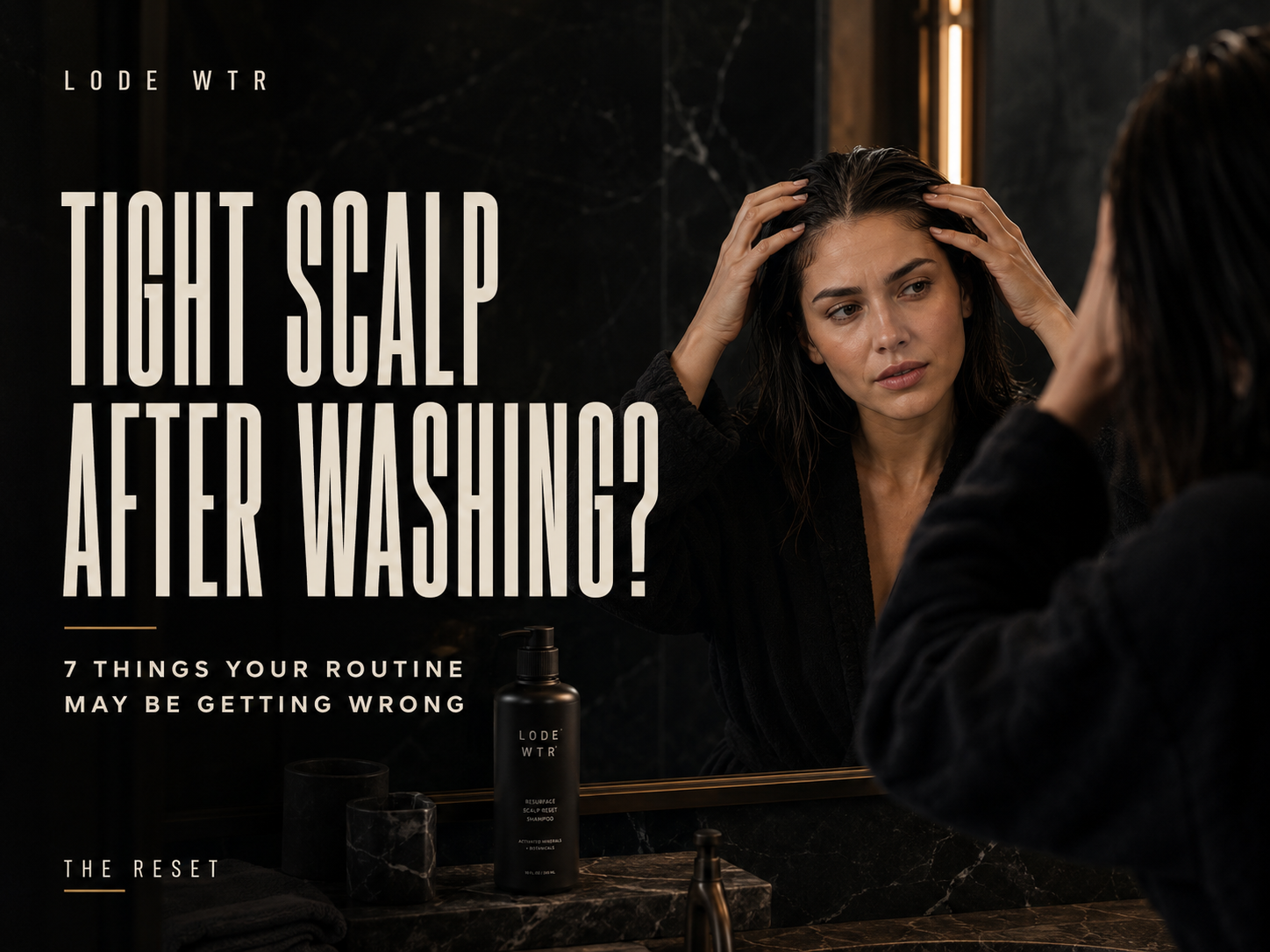
You step out of the shower.
Your hair is clean.
Your roots feel fresh.
But your scalp?
It feels like someone quietly tightened it while you weren’t looking.
Dry.
Stretched.
Maybe a little itchy.
Maybe just… uncomfortable.
And because it happened right after washing, the natural reaction is often:
“My scalp must be really dry.”
Maybe.
But tightness after washing can also have a lot to do with how you wash, what you wash with and how often you’re doing it.
Clean should feel comfortable.
If your scalp consistently feels worse after cleansing than it did before, that’s worth paying attention to.
Here are seven things that may be happening.
1. Your Cleanser Is Doing Too Much
There’s a strange idea in hair care that the cleaner your scalp feels, the better.
Maximum foam.
Maximum squeak.
Maximum everything.
But your scalp is skin.
And skin doesn’t necessarily love being stripped of every trace of oil.
Your scalp naturally produces sebum, which helps lubricate the skin and hair.
A cleanser needs to remove:
- Excess oil
- Sweat
- Dirt
- Product residue
It does not need to make your scalp feel like a freshly cleaned dinner plate.
If your scalp feels tight every single time you shampoo, the formula or amount you’re using may simply be more intense than your scalp needs.
The goal is:
Clean enough.
Not scorched earth.
2. Your Shower Is Way Too Hot
We know.
Hot showers are elite.
Unfortunately, your scalp may have a different review.
Very hot water can leave skin feeling drier and less comfortable after washing.
And if you’re already using a strong cleanser?
You’re stacking intensity on top of intensity.
Hot water.
Strong shampoo.
Aggressive massage.
Maybe shampoo twice.
Your scalp came in for a shower and accidentally booked a full renovation.
Try bringing the temperature down.
It doesn’t need to be cold.
Comfortably warm is enough.
3. You’re Washing More Often Than Your Scalp Likes
Some people comfortably wash their hair every day.
Others don’t.
Neither group wins a prize.
What matters is how your scalp responds.
If you wash frequently and notice that your scalp increasingly feels:
- Tight
- Dry
- Sensitive
- Itchy
- Uncomfortable
…your washing frequency may be worth reconsidering.
That doesn’t mean you should suddenly avoid shampoo for seven days.
It means there may be a gap between:
How often your routine says you should wash
and
How often your scalp actually wants to be washed.
Your scalp doesn’t know what day of the week it is.
Pay attention to how it feels.
4. You’re Shampooing More Than Once Because It Doesn’t “Feel Clean Enough”
The first shampoo doesn’t foam much.
So you shampoo again.
This time?
Foam everywhere.
Perfect.
Except more foam does not automatically mean more effective scalp care.
The first cleanse may already have removed much of the oil and residue that was interfering with the lather.
A second cleanse can be useful when there is significant buildup, sweat or styling product.
But it doesn’t need to become an automatic rule for everybody.
If double shampooing consistently leaves your scalp feeling tight afterward, test whether you actually need it every wash.
Hair care should solve problems.
Not follow rituals just because TikTok said so.
5. You’re Scrubbing Your Scalp Too Aggressively
Itchy scalp?
Scrub harder.
Greasy roots?
Scrub harder.
Want that “deep clean”?
You know what’s coming.
Scrub harder.
Except your scalp isn’t a stovetop.
Using your fingernails or aggressively scratching the skin can create mechanical irritation.
And irritated skin can feel tight, sensitive or uncomfortable afterward.
Use the pads of your fingertips instead.
Massage the scalp.
Don’t excavate it.
You don’t need to feel like you worked out your forearms during shampooing.
6. Your Scalp May Not Like Something in the Formula
Hair-care products contain many ingredients because they need to:
- Clean
- Condition
- Preserve the formula
- Create texture
- Provide fragrance
- Improve application
Most people tolerate their products without issue.
But individual scalps can react differently.
If you notice tightness or discomfort consistently after using a particular product, consider whether something in that formula simply isn’t working for you.
That doesn’t automatically mean the ingredient is universally “bad.”
It means your scalp doesn’t vote based on internet consensus.
If a product repeatedly makes your skin uncomfortable, stop using it and observe what changes.
One change at a time.
Otherwise you’ll have no idea what actually helped.
7. You’re Fixing Tightness With Products That Create Another Problem
This is where things get complicated.
Your scalp feels dry.
So you add oil.
Then your roots get greasy.
So you use dry shampoo.
Now your scalp feels coated.
So you clarify.
Then it feels tight again.
Congratulations.
Your scalp-care routine has become a closed-loop system.
This is exactly when simplifying can be more useful than adding another product.
If your scalp feels tight after washing, first look at:
- How often you’re cleansing
- How strong the cleanser feels
- Water temperature
- How much product you’re using
- Whether you’re double washing
- How aggressively you’re massaging
Before reaching for another bottle.
Does a Tight Scalp Mean Your Scalp Is Dry?
Sometimes.
But not always.
A tight sensation can be associated with dryness, particularly when the skin feels uncomfortable after cleansing.
But similar sensations may also occur with:
- Product irritation
- Aggressive washing
- Hot water
- Frequent cleansing
- Certain scalp conditions
That’s why it’s useful to look at the pattern.
Does your scalp only feel tight immediately after shampooing?
Does it improve later?
Does it come with itching?
Flaking?
Redness?
Those details matter.
If tightness is persistent, painful or accompanied by significant skin changes, speak with a dermatologist or healthcare professional.
Tight Scalp vs. Itchy Scalp
They often overlap.
But they’re not exactly the same.
A tight scalp may feel:
- Stretched
- Dry
- Less flexible
- Uncomfortable after washing
An itchy scalp creates an urge to scratch.
Sometimes you get both.
If itching is the bigger problem, read:
Why Does My Scalp Itch After Washing? 7 Possible Reasons.
Either way, repeatedly shampooing because your scalp feels “wrong” may make the cycle worse if cleansing itself is part of the trigger.
What About Flakes?
Tightness plus flakes often gets immediately labeled as dandruff.
But visible flakes can have different causes.
A dry-feeling scalp may shed small flakes.
Product residue can also appear flaky.
And certain scalp conditions can cause scaling that requires proper assessment.
So don’t diagnose your scalp based entirely on what fell onto a black T-shirt.
If flaking is:
- Persistent
- Heavy
- Very itchy
- Red
- Painful
- Associated with sores
…get professional advice rather than endlessly experimenting with products.
How to Make Your Wash Routine Gentler
If your scalp feels tight after every wash, you don’t necessarily need to throw everything away.
Start with a few controlled changes.
1. Turn the Water Temperature Down
This is the easiest experiment.
Try warm rather than very hot water for several washes.
See how your scalp feels afterward.
2. Use Only as Much Cleanser as You Need
More shampoo doesn’t necessarily equal a better wash.
Focus on distributing it across the scalp rather than repeatedly adding more product.
3. Massage, Don’t Scratch
Use your fingertips.
Gentle pressure is enough.
Your scalp doesn’t need aggression to become clean.
4. Question Automatic Double Shampooing
If your first cleanse effectively removes oil and buildup, you may not need another.
Use a second cleanse when it makes sense.
Not because it’s a rule.
5. Look at Your Washing Frequency
If your scalp is comfortable before washing and tight afterward, frequency deserves a look.
You may need to adjust how often or how intensely you cleanse.
6. Change One Thing at a Time
This is important.
Don’t simultaneously:
Buy a new shampoo.
Change conditioner.
Start a scalp serum.
Stop dry shampoo.
Install a shower filter.
And wash every third day.
If your scalp improves, you’ll have no idea why.
Treat your routine like an experiment.
Change one meaningful variable.
Observe.
Then adjust.
Rebellion With Receipts, remember?
Data beats guessing.
Should You Put Oil on a Tight Scalp?
Not automatically.
Hair oil and scalp oil aren’t universal solutions for scalp discomfort.
Adding oil may make the scalp feel temporarily different, but it won’t necessarily address why washing is leaving it tight in the first place.
If your cleanser is too harsh?
Oil doesn’t fix the cleanser.
If your water is too hot?
Oil doesn’t fix the water temperature.
If you’re shampooing twice every day?
Oil doesn’t fix the frequency.
First identify what might be creating the problem.
Then decide whether you actually need another product.
Can Hard Water Make Your Scalp Feel Tight?
Water quality may be another variable.
Hard water contains higher concentrations of minerals such as calcium and magnesium.
These minerals can leave deposits on hair and surfaces.
For some people, the combination of hard water, product residue and cleansing habits may leave hair feeling coated while the scalp feels uncomfortable.
If you also notice:
- Limescale around your shower
- Cloudy shower glass
- Waxy hair
- Hair that feels coated after rinsing
…water quality is worth investigating.
Read next: Is Hard Water Wrecking Your Scalp? Signs, Buildup and What to Do About It.
Should Your Scalp Feel Squeaky Clean?
We vote no.
That squeaky sensation often gets interpreted as proof that shampoo worked.
But the best scalp-cleaning experience isn’t necessarily the most dramatic one.
You want to remove what doesn’t need to be there.
Excess oil.
Sweat.
Product.
Buildup.
Then stop.
Your scalp doesn’t need to feel stripped to prove something happened.
Comfort is part of clean.
The Scalp Barrier Deserves Some Attention
Your scalp is skin.
And like the rest of your skin, it has a barrier that helps separate your body from the outside environment.
Yet our scalp routines can be strangely aggressive.
Scrub.
Strip.
Clarify.
Repeat.
Then wonder why everything feels irritated.
Scalp care should not be about removing every possible trace of oil.
It’s about creating an environment where the scalp feels clean and comfortable.
That distinction matters.
More Cleansing Isn’t Always Better Cleansing
This is one of the ideas behind LODE WTR.
We aren’t interested in complexity for complexity’s sake.
Or foam for foam’s sake.
Or adding another step because the last step created another problem.
We’re interested in function.
If your scalp feels tight every time you wash, that’s feedback.
Listen to it.
Maybe you need less heat.
Less friction.
Less cleanser.
Less frequency.
Less noise.
Clean Should Feel Comfortable
Your scalp doesn’t need to feel stretched after every shower.
And it definitely doesn’t need to feel punished to qualify as clean.
If your routine consistently leaves your scalp tight, start with the basics.
Change the water.
Look at the cleanser.
Question the frequency.
Be gentler.
And stop assuming another product is always the answer.
Sometimes a better routine isn’t about adding something.
It’s about doing less, better.
Function Over Foam.
Minimal Not Basic.
Frequently Asked Questions
Why does my scalp feel tight after shampooing?
A tight scalp after shampooing may be related to strong cleansing, hot water, frequent washing, vigorous scrubbing or sensitivity to a product.
If symptoms are persistent or severe, consider speaking with a dermatologist.
Does a tight scalp mean it’s dry?
It can, but tightness isn’t specific to dryness. Irritation, frequent cleansing and other scalp issues can create similar sensations.
Can washing hair every day make your scalp feel tight?
Frequent washing works well for some people, but others may notice dryness or discomfort when cleansing daily.
Pay attention to how your own scalp responds.
Can hot water dry out your scalp?
Very hot water may leave skin feeling drier or less comfortable, particularly when combined with strong cleansing.
Using comfortably warm water is a simple adjustment worth trying.
Should I double shampoo if my scalp feels dry?
Not automatically.
Double cleansing can be useful when there is significant oil or product buildup, but if your scalp consistently feels tight afterward, consider whether a second cleanse is necessary.
Why is my scalp tight but my hair greasy?
Scalp discomfort and oily-looking roots can occur at the same time.
Natural oil, styling products and buildup can make hair appear greasy even while the scalp itself feels uncomfortable.
Should I use scalp oil if my scalp feels tight?
Not necessarily.
First consider whether your cleansing frequency, shampoo, water temperature or technique may be causing the tight sensation.
Adding another product doesn’t always address the underlying cause.
When should I see a dermatologist about a tight scalp?
Seek professional advice if the problem is persistent, worsening or accompanied by significant redness, pain, sores, heavy scaling, burning or hair loss.
LODE WTR
Scalp care, stripped back.
Function Over Foam.
Minimal Not Basic.
Root of the Problem.
Rebellion With Receipts.


