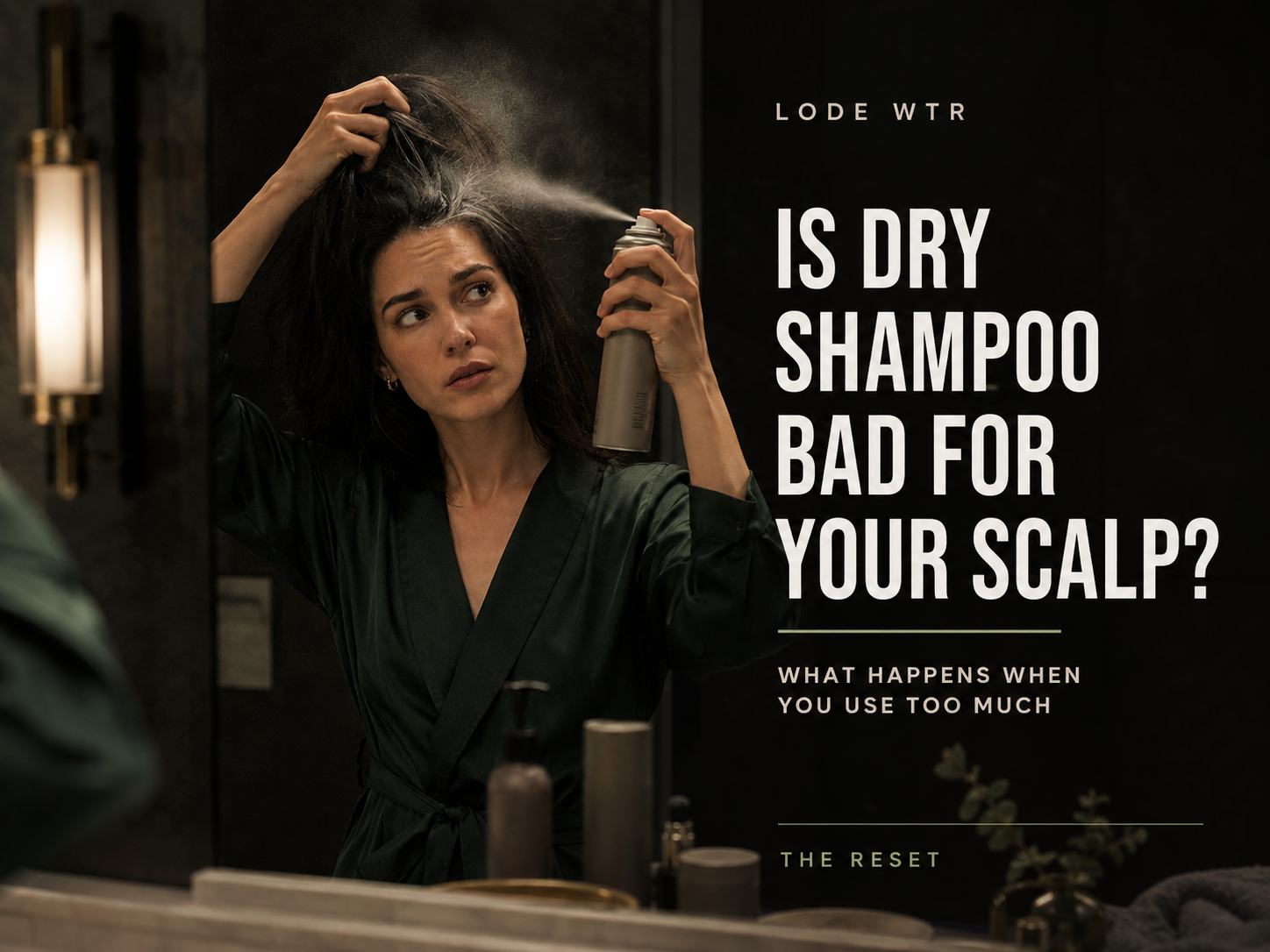

Dry shampoo has saved a lot of mornings.
No time to wash?
Dry shampoo.
Workout before work?
Dry shampoo.
Roots looking a little suspicious before dinner?
You already know.
A few sprays, a little massage, maybe a quick brush through — and suddenly your hair looks fresher.
Convenient?
Absolutely.
But there is one important detail hidden inside the name:
Dry shampoo does not actually wash your scalp.
It can absorb oil and temporarily change how your roots look and feel.
But the oil, sweat, styling residue and dry shampoo itself still have to go somewhere.
And if you’re layering it day after day, your scalp may eventually start asking for an actual reset.
So is dry shampoo bad for your scalp?
Not automatically.
But using too much of it — especially without regularly cleansing your scalp — can contribute to buildup and leave your roots feeling heavy, coated or uncomfortable.
Let’s talk about what is actually happening up there.
What Does Dry Shampoo Actually Do?
Despite the name, dry shampoo isn’t shampoo in the traditional sense.
Regular cleansing removes oil, sweat, dirt and product residue with the help of water.
Dry shampoo typically works differently.
It contains ingredients designed to absorb some of the oil around your roots.
That can make hair:
- Look less greasy
- Feel less oily
- Appear more voluminous
- Smell fresher
- Last another day between washes
Which is why people love it.
The problem begins when absorbing oil gets confused with removing it.
Dry shampoo can make your roots look cleaner.
That doesn’t mean everything sitting on your scalp has disappeared.
Does Dry Shampoo Clean Your Scalp?
Not really.
Think of it this way.
Imagine spilling something on a kitchen counter.
You sprinkle an absorbent powder over it.
The surface may look drier.
But until you actually remove the powder and residue, the counter hasn’t really been cleaned.
Your scalp isn’t a kitchen counter, obviously.
But the principle is similar.
Dry shampoo can absorb some oil.
It doesn’t necessarily remove:
- Sweat
- Dead skin
- Styling residue
- Environmental debris
- Existing buildup
- The dry shampoo itself
Layer enough of those things together and your scalp can start feeling very different from how it looks.
Fresh-ish hair.
Not-so-fresh scalp.
6 Signs You May Be Using Too Much Dry Shampoo
1. Your Roots Feel Heavy or Coated
You spray dry shampoo because your roots feel greasy.
Then they feel better.
So the next day you spray again.
And again.
Eventually, instead of feeling oily, your hair starts feeling almost dusty, stiff or coated.
That’s a clue.
You’re no longer only dealing with natural scalp oil.
You’re dealing with oil plus product.
This is one reason scalp buildup can be mistaken for grease.
When your roots feel heavy even though you’ve been using dry shampoo, adding another layer probably isn’t the move.
Sometimes the answer is water.
Revolutionary, we know.
2. Your Scalp Starts Itching
An itchy scalp has many possible causes.
But if the itching tends to appear after several days of dry shampoo use, product accumulation may be worth considering.
You’re potentially layering:
Sebum + sweat + dry shampoo + styling product + more dry shampoo.
That’s a lot happening in one small area.
Your scalp may simply be telling you that it’s ready to be properly cleansed.
If your scalp frequently itches even immediately after washing, check out our guide:
Why Does My Scalp Itch After Washing? 7 Possible Reasons.
And if the itching is severe, persistent or accompanied by significant redness, sores, pain or scaling, speak with a dermatologist or healthcare professional.
3. You’re Applying More Every Day
Day one:
A quick spray.
Day two:
A little more.
Day three:
Okay, quite a lot.
By day four you’re basically powder-coating your roots.
Dry shampoo works best when it’s helping your routine.
Not when it becomes the routine.
If you’re repeatedly adding more product because yesterday’s application isn’t doing enough anymore, your scalp may simply need cleansing rather than another layer.
4. Your Hair Looks Dull
Healthy-looking hair reflects light.
But when powders, oils and styling products build up on the hair around the roots, the surface can start looking flatter or duller.
That doesn’t necessarily mean your hair is damaged.
It may just be covered in stuff.
Lots of stuff.
A reset can often make the difference between hair that looks weighed down and hair that actually moves again.
5. Your Scalp Feels Oily and Dry at the Same Time
Yes.
This is possible.
Your roots can contain plenty of oil while your scalp simultaneously feels dry, tight or uncomfortable.
Dry shampoo may make that combination even more confusing because it changes the appearance of the oil without necessarily addressing why your scalp feels uncomfortable.
That can lead to the classic cycle:
Oily roots → dry shampoo → uncomfortable scalp → more dry shampoo → eventually wash aggressively → scalp feels tight → roots become oily again.
At that point, the problem isn’t just grease.
It’s the routine.
Read next: Why Your Scalp Feels Oily Right After Washing.
6. You Can’t Remember Your Last Actual Wash
This is your sign.
We support stretching a routine when it works for you.
We support convenience.
We support sleeping an extra twenty minutes.
But if you’ve reached the point where you’re trying to calculate your last wash using calendar arithmetic, your scalp probably deserves some attention.
Dry shampoo is a tool.
Not witness protection for your roots.
Can Dry Shampoo Cause Scalp Buildup?
Frequent use can contribute to buildup because the product itself remains around the scalp and hair until it is removed.
Add natural oil, sweat and styling products and the accumulation becomes easier to notice.
You may experience roots that feel:
- Coated
- Powdery
- Heavy
- Greasy
- Stiff
- Less movable
You may also notice that your scalp simply doesn’t feel particularly fresh anymore, even when your hair still looks presentable.
This is exactly why looking clean and being clean aren’t always the same thing.
For more on this, read:
What Is Scalp Buildup? Signs, Causes and How to Reset Your Routine.
What About Dry Shampoo After a Workout?
This is where things get interesting.
You finish a workout.
Your scalp is sweaty.
But you don’t have time — or don’t want — to wash your hair.
Dry shampoo feels like the obvious shortcut.
And occasionally?
Sure.
But remember what dry shampoo is doing.
It may absorb some moisture and oil.
It isn’t necessarily removing the sweat and residue that are already sitting on your scalp.
If every workout becomes:
Sweat → dry shampoo → workout → more dry shampoo → repeat
…you’ve created a layering routine.
Depending on how often you exercise, that can build up quickly.
You don’t necessarily have to fully wash your hair after every workout.
But repeatedly covering sweat with more product isn’t the only option either.
Read: Post-Workout Scalp Care: How to Handle Sweat Without Overwashing.
How Often Should You Use Dry Shampoo?
There’s no universal number that works for everyone.
How frequently you use dry shampoo depends on:
- Your scalp
- Your hair type
- How much oil you produce
- How much you sweat
- Your styling routine
- How often you properly cleanse your scalp
The more useful question is:
How does your scalp feel?
If your roots still feel comfortable and you’re cleansing regularly, occasional dry shampoo use may fit perfectly into your routine.
If your scalp feels itchy, coated, heavy or generally fed up, you’ve probably received the message.
Time to wash.
How to Use Dry Shampoo Without Turning It Into a Lifestyle
Dry shampoo doesn’t need to disappear from your bathroom.
Just use it like a tool rather than a substitute for scalp care.
1. Use Less Than You Think
You don’t necessarily need to cover your entire head.
Focus on the areas that actually look oily.
Usually that’s around the hairline, crown or part.
Spray strategically.
Not enthusiastically.
2. Don’t Automatically Reapply
Before adding more the next day, look at your scalp.
Does it genuinely need more product?
Or are you applying it because that’s simply what you always do?
There’s a difference.
3. Give It Time to Work
Depending on the product instructions, dry shampoo may need a short amount of time to absorb oil before you massage or brush it through.
Dumping more product onto your hair immediately isn’t necessarily better.
4. Eventually, Actually Wash Your Scalp
We had to say it.
Dry shampoo buys time.
It doesn’t replace cleansing forever.
At some point, oil, sweat and product accumulation need to be removed rather than covered.
5. Simplify Everything Else
If you’re using:
Dry shampoo.
Texture spray.
Root powder.
Hair oil.
Leave-in.
Hairspray.
And styling cream.
Your scalp is participating in a group project it never signed up for.
The more products you layer, the harder it can become to understand what’s making your scalp feel oily, heavy or uncomfortable.
Sometimes fewer variables give you a much clearer answer.
Dry Shampoo vs. Washing Your Hair
These two things don’t have to be enemies.
Think of them as different tools.
Dry shampoo
Useful for:
- Temporarily absorbing visible oil
- Extending a hairstyle
- Adding texture or volume
- Getting through a busy morning
Cleansing your scalp
Useful for removing:
- Excess oil
- Sweat
- Dry shampoo
- Styling residue
- General buildup
One can temporarily improve appearance.
The other actually resets what’s accumulated.
Different jobs.
Different tools.
What If Washing More Makes My Scalp Feel Worse?
Then the answer isn’t necessarily to alternate between aggressive washing and excessive dry shampoo.
You may need to rethink how you’re cleansing.
If your scalp feels extremely tight or uncomfortable after washing, your routine may be too aggressive for you.
That can leave you stuck between two extremes:
Don’t wash enough → buildup.
Wash aggressively → discomfort.
The goal isn’t either extreme.
It’s finding a routine that cleans your scalp effectively without making it feel like it just survived something.
Read: Can You Overwash Your Hair? 7 Signs Your Scalp Needs a Reset.
The Bigger Problem Isn’t Dry Shampoo
It’s the cycle.
We use product to hide oil.
Then product to create texture.
Then product to counter dryness.
Then another product because everything feels heavy.
Then a stronger wash because there’s too much product.
Then more product because the strong wash left our hair feeling different.
At some point, you have to ask:
Are we caring for the scalp or just managing products?
That question sits at the center of how we think about scalp care at LODE WTR.
More isn’t automatically better.
Foam isn’t automatically cleaner.
And a complicated routine isn’t automatically an effective one.
Function Over Foam.
Your Scalp Doesn’t Need Another Cover-Up
Dry shampoo can be useful.
Very useful.
But there is a difference between extending your wash and repeatedly covering up what your scalp is trying to tell you.
If your roots feel heavy, itchy, coated or permanently dependent on another spray, don’t immediately reach for the can.
Look at the whole routine.
Sometimes the smartest next step isn’t adding something.
It’s resetting.
Less product. Less noise. More scalp.
Frequently Asked Questions
Is dry shampoo bad for your scalp?
Dry shampoo isn’t automatically bad for your scalp. However, frequent use without adequate cleansing can contribute to product accumulation around the roots and scalp.
How well you tolerate it depends on your scalp, how much product you use and the rest of your routine.
Does dry shampoo actually clean your hair?
Dry shampoo primarily helps absorb oil and improve the appearance of greasy roots.
It does not cleanse the scalp in the same way washing with water and an appropriate cleanser does.
Can dry shampoo cause buildup?
Yes, dry shampoo itself can contribute to product buildup when it is repeatedly applied and not adequately removed.
This buildup can combine with oil, sweat and other styling products.
Can dry shampoo make your scalp itchy?
For some people, frequent product accumulation or sensitivity to a formula may contribute to scalp discomfort.
Persistent or severe itching should be assessed by a dermatologist or healthcare professional.
Should I use dry shampoo after working out?
Occasional use may be convenient, but applying dry shampoo repeatedly over sweat can contribute to accumulation.
Your post-workout routine should depend on how sweaty your scalp is and how often you’re exercising.
How do I know when I need to wash out dry shampoo?
If your roots feel coated, heavy, powdery, itchy or generally less fresh despite another application, it’s probably time to properly cleanse your scalp.
Can you use dry shampoo several days in a row?
Some people do, but repeated applications can increase the amount of product sitting around the roots.
Pay attention to how your scalp feels rather than focusing only on how your hair looks.
LODE WTR
Scalp care, stripped back.
Function Over Foam.
Minimal Not Basic.
Root of the Problem.
Rebellion With Receipts.


