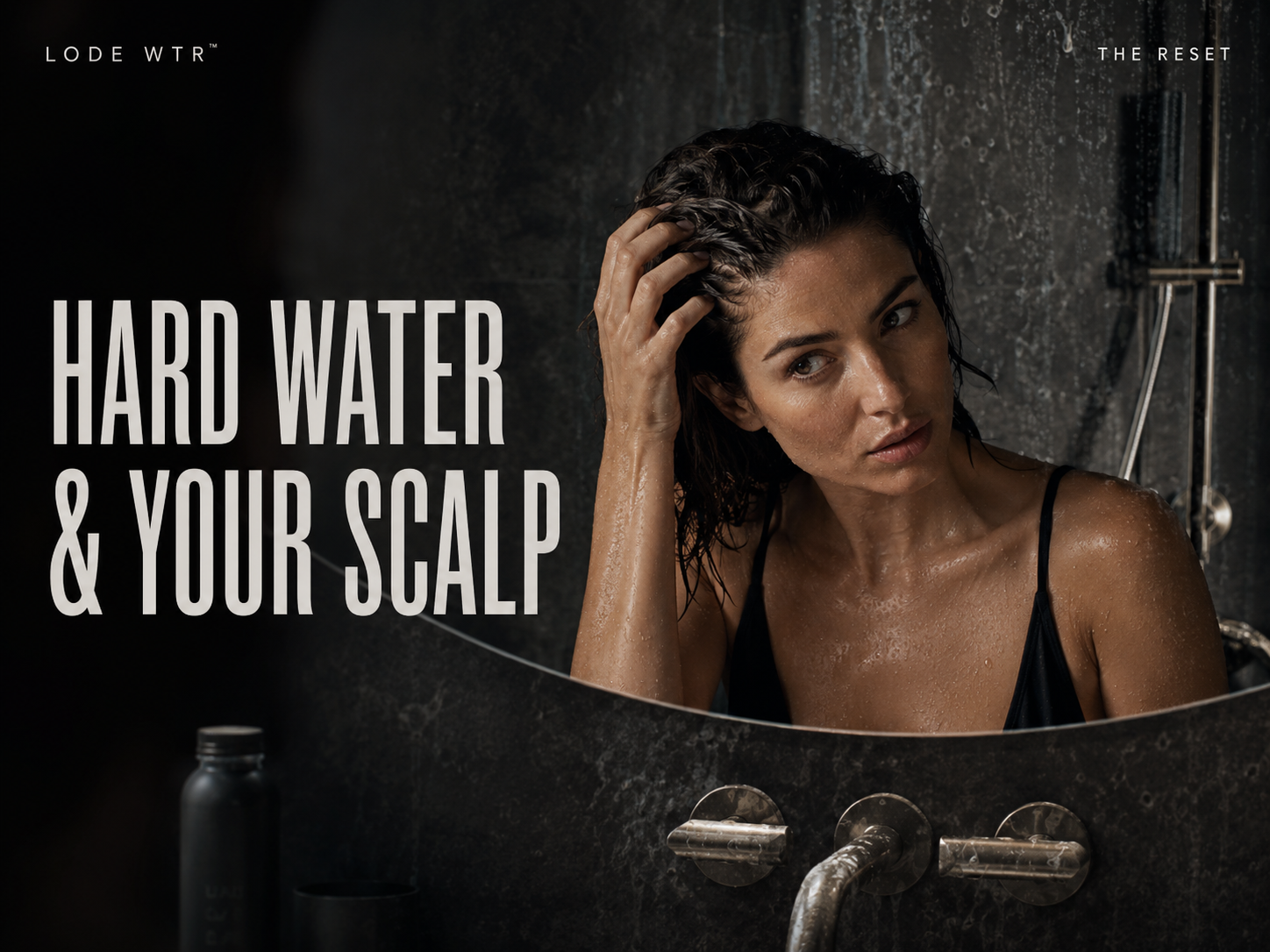

You wash your hair.
You rinse thoroughly.
You use less product.
You even cleaned your shower.
And somehow your hair still feels…
off.
Heavy.
Dull.
A little coated.
Maybe your scalp feels tight or uncomfortable too.
Before you blame your shampoo, your conditioner, your genetics, Mercury retrograde or the entire beauty industry, there’s another possibility worth looking at:
Your water.
More specifically, hard water.
Hard water contains higher levels of dissolved minerals, most commonly calcium and magnesium.
Those minerals aren’t automatically dangerous.
But they can leave deposits behind on surfaces.
Your shower glass knows this very well.
And so might your hair.
Here’s how hard water can affect your scalp and routine — and what you can actually do about it.
What Is Hard Water?
Hard water is simply water with a relatively high concentration of dissolved minerals.
The exact mineral content depends on where you live and where your water comes from.
As water moves through rock and soil, it can pick up minerals such as calcium and magnesium.
When the water reaches your home, those minerals come with it.
You may already recognize the signs.
Think:
- White marks around faucets
- Cloudy shower glass
- Chalky residue
- Scale around the showerhead
- Soap that doesn’t seem to rinse as cleanly
- A kettle that looks like it’s developing its own geological formation
If that’s your bathroom, your hair is being exposed to the same water.
Can Hard Water Cause Buildup on Your Hair?
It can contribute to deposits on the hair surface.
And this is where things get interesting.
When minerals from water combine with:
- Sebum
- Shampoo residue
- Conditioner
- Styling products
- Dry shampoo
- Sweat
…the result can be hair that feels increasingly coated.
You may keep adding products because your hair doesn’t feel right.
Then you wash harder.
Then you add more conditioning products because your hair feels rough.
Then your roots feel heavy.
So you wash again.
At some point, the routine becomes a reaction to buildup rather than actual hair care.
Sound familiar?
Read next: What Is Scalp Buildup? Signs, Causes and How to Reset Your Routine.
7 Signs Hard Water May Be Affecting Your Hair and Scalp
Hard water doesn’t announce itself.
There’s no notification saying:
Congratulations. Your shower is now depositing minerals onto your hair.
Instead, you usually notice small changes.
1. Your Hair Feels Coated Even After Washing
This is one of the biggest clues.
You shampoo.
You rinse.
Your hair dries.
And instead of feeling light and clean, it feels like something is still sitting on it.
Maybe your roots feel waxy.
Maybe the lengths feel dull.
Maybe your entire head just feels heavier than it should.
Product buildup can cause this.
But if you’ve already simplified your routine and the feeling keeps returning, the water itself may be part of the equation.
2. Your Hair Looks Duller Than Usual
Hair looks shiny when light reflects smoothly from its surface.
When residue accumulates, that reflection can become less even.
The result?
Hair that looks flatter, rougher or less glossy.
So naturally, you add shine spray.
Then oil.
Then serum.
Then another product to fix the product you added before.
Not ideal.
Sometimes the issue isn’t that your hair needs more shine.
It may need less sitting on top of it.
3. Your Scalp Feels Tight After Washing
A scalp that consistently feels uncomfortable after washing is worth paying attention to.
Hard water may not be the only factor.
Your cleanser, water temperature, washing frequency and scrubbing technique all matter too.
But if your scalp feels especially tight after showering and you’ve already experimented with a gentler routine, mineral-heavy water may be contributing to that “not quite clean but somehow dry” feeling.
That contradiction is more common than you might think.
Read: Why Does My Scalp Itch After Washing? 7 Possible Reasons.
4. Your Products Suddenly Seem Like They Stopped Working
This one can be frustrating.
You’ve used the same product for months.
Everything was fine.
Then you move.
Travel.
Change apartments.
Or simply notice that your hair behaves differently.
Suddenly your usual routine doesn’t seem to deliver the same result.
Before replacing your entire bathroom shelf, consider whether the water changed.
Hair routines don’t exist in isolation.
The water you’re washing with is part of the routine too.
5. Your Roots Become Greasy Faster
This doesn’t necessarily mean hard water is making your scalp produce more oil.
The more likely issue is how residue changes the way your hair feels and looks.
Mineral deposits mixed with sebum and styling products can make roots feel heavy or coated.
That can look very similar to grease.
So you wash more.
Which may leave your scalp feeling tighter.
Then the roots look bad again.
And suddenly you’re stuck in a wash-repeat-wash-repeat loop.
Read: Can You Overwash Your Hair? 7 Signs Your Scalp Needs a Reset.
6. Your Hair Feels Rough or Hard to Detangle
Hard-water deposits can change the way the hair surface feels.
You may notice:
- More tangling
- Less slip
- Rougher ends
- Hair that feels stiff
- Conditioner that seems less effective
Naturally, this often leads to using more conditioner or hair oil.
But adding more product on top of existing residue can sometimes make the overall problem harder to understand.
More isn’t always the answer.
You’ve heard us say that before.
7. Your Shower Has Visible Mineral Scale
Sometimes your bathroom gives you the evidence.
Look at:
- The showerhead
- Glass doors
- Faucets
- Tiles
- Drains
Do you constantly see white or chalky deposits?
That’s mineral residue.
If your shower needs regular descaling, it’s reasonable to consider what repeated exposure may be doing to your hair routine too.
Does Hard Water Make Your Scalp Itchy?
It can be one factor in scalp discomfort, but itching has many possible causes.
Your scalp may feel itchy because of:
- Product buildup
- Frequent washing
- Hot water
- Scratching
- A product sensitivity
- Dryness
- An underlying scalp condition
So don’t automatically blame hard water every time your scalp itches.
Look at the full routine.
If itching is persistent, severe or accompanied by significant redness, pain, sores or heavy scaling, speak with a dermatologist or healthcare professional.
Your shower filter shouldn’t be expected to solve a medical condition.
Hard Water vs. Product Buildup
These two problems can feel extremely similar.
Product buildup may come from:
- Dry shampoo
- Styling creams
- Oils
- Silicone-rich products
- Hair sprays
- Conditioners
- Leave-ins
Hard-water buildup comes from:
Minerals in the water you use to wash and rinse your hair.
And here’s the annoying part:
You can have both at the same time.
Your hair may be carrying minerals plus styling products plus oil plus sweat.
At that point, figuring out what your scalp wants becomes pretty difficult.
Which is exactly why simplifying your routine can be useful.
Reduce the variables.
See what changes.
Can a Shower Filter Fix Hard Water?
This is where marketing gets messy.
Not every shower filter actually softens hard water.
Many filters are designed to reduce things such as chlorine, sediment or certain impurities.
True water softening typically requires reducing or exchanging the calcium and magnesium ions that create water hardness.
That’s usually a different process.
So if you’re buying a shower filter specifically because you’re worried about hard water, look carefully at what the product actually claims to remove.
“Filtered” and “softened” are not always the same thing.
Don’t let a nice chrome shower attachment do all the talking.
How Do You Know If You Have Hard Water?
The most reliable option is to test it.
You can often:
- Check local water-quality information
- Use a home hardness test
- Ask your water provider
- Test your tap water directly
You don’t need to diagnose hard water based entirely on how your hair behaves.
Because, once again, hair is complicated.
But if you’re seeing mineral scale throughout your bathroom and your hair consistently feels coated, testing the water may help explain what’s happening.
How to Deal With Hard-Water Buildup
If hard water is part of the problem, the goal is not to panic and replace every product you own.
Start strategically.
1. Confirm the Water Is Actually Hard
Before buying gadgets and rebuilding your routine, test or check your local water.
Data first.
Bathroom panic later.
2. Keep Your Routine Simple
If your hair already feels coated, layering more products on top of it can make things worse.
Consider reducing:
- Heavy styling creams
- Root powders
- Excess dry shampoo
- Oils near the scalp
- Unnecessary leave-ins
Give yourself fewer variables to manage.
3. Clean Your Showerhead
Mineral buildup can accumulate around showerhead openings and affect water flow.
Regular descaling can keep the shower working properly.
It won’t soften your water.
But your showerhead will appreciate it.
4. Consider Occasional Clarifying or Chelating Care
Some hair-care products are formulated specifically to help remove mineral deposits or heavy buildup.
These are often described as clarifying or chelating products.
But stronger cleansing isn’t something you necessarily need every single day.
If your scalp is sensitive or already feels dry, use stronger cleansing approaches thoughtfully.
The goal is reset.
Not scorched earth.
5. Pay Attention to How Your Scalp Responds
After changing your routine, watch what happens.
Does your hair feel lighter?
Does your scalp feel more comfortable?
Do your products suddenly work better?
That feedback tells you more than simply adding another product because someone on TikTok said you need it.
What About Washing Your Hair More Often?
If hard-water residue is making your hair feel heavy, the instinct may be to wash more.
But washing more frequently with the same mineral-heavy water may not fix the underlying issue.
And if you’re already using an aggressive cleanser, you might simply end up with:
Coated hair + uncomfortable scalp.
Not exactly the result we’re aiming for.
This is where “more cleansing” and “better cleansing” become two different things.
Your goal should be to remove what needs to be removed without making your scalp feel worse in the process.
Why This Matters for Scalp Care
Most hair-care conversations focus on the bottle.
What’s in your shampoo?
What’s in your conditioner?
What serum do you use?
But your scalp routine is bigger than your products.
It’s also:
- Your water
- Your washing frequency
- Your shower temperature
- Your workouts
- Your styling habits
- Your product layering
- Your environment
Everything adds up.
So if your hair suddenly feels wrong, the answer isn’t always another product.
Sometimes the most useful question is:
What changed around the product?
Stop Treating Every Hair Problem Like a Product Shortage
Modern hair care has trained us well.
Hair looks dull?
Add shine.
Feels dry?
Add oil.
Roots heavy?
Add dry shampoo.
Scalp uncomfortable?
Buy another bottle.
But your bathroom shelf isn’t necessarily missing something.
Sometimes it has too much.
And sometimes the problem is coming straight out of the showerhead.
At LODE WTR, we’re interested in getting closer to the actual problem.
Root of the Problem.
Literally.
Understand what your scalp is dealing with.
Then build the routine around that.
Not around how many products you can fit on a shelf.
Your Water Is Part of Your Routine
If your hair feels coated, dull, heavy or strangely difficult to manage even after washing, don’t immediately assume your products have failed.
Look at the water too.
Hard water may be one more source of buildup in a routine that’s already dealing with oil, sweat and styling products.
And when your scalp is carrying too much?
More product probably isn’t the reset.
Less noise. Better cleansing. More scalp.
Frequently Asked Questions
Is hard water bad for your scalp?
Hard water contains higher levels of dissolved minerals such as calcium and magnesium. These minerals can leave deposits on surfaces, including the hair.
For some people, that residue may contribute to hair that feels coated, dull or difficult to manage.
Can hard water cause scalp buildup?
Hard-water minerals can contribute to residue on the hair and scalp, particularly when combined with sebum, sweat and styling products.
How do I know if my shower has hard water?
Common signs include white mineral deposits around faucets, cloudy shower glass, scale around the showerhead and frequent limescale buildup.
A water-hardness test can provide a clearer answer.
Can hard water make hair greasy?
Hard water doesn’t necessarily increase your scalp’s oil production, but mineral and product residue can make roots feel heavier or appear greasier.
Will a shower filter remove hard water?
Not necessarily. Many shower filters reduce chlorine, sediment or certain contaminants but don’t actually soften water by removing the minerals responsible for hardness.
Check the product specifications carefully.
Can I wash hard-water buildup out of my hair?
Some clarifying and chelating products are designed to help remove accumulated product and mineral residue.
How often you need them depends on your hair, scalp and water.
Can hard water make hair look dull?
Mineral deposits may contribute to hair feeling rougher or looking less shiny by leaving residue on the hair surface.
LODE WTR
Scalp care, stripped back.
Function Over Foam.
Minimal Not Basic.
Root of the Problem.
Rebellion With Receipts.


