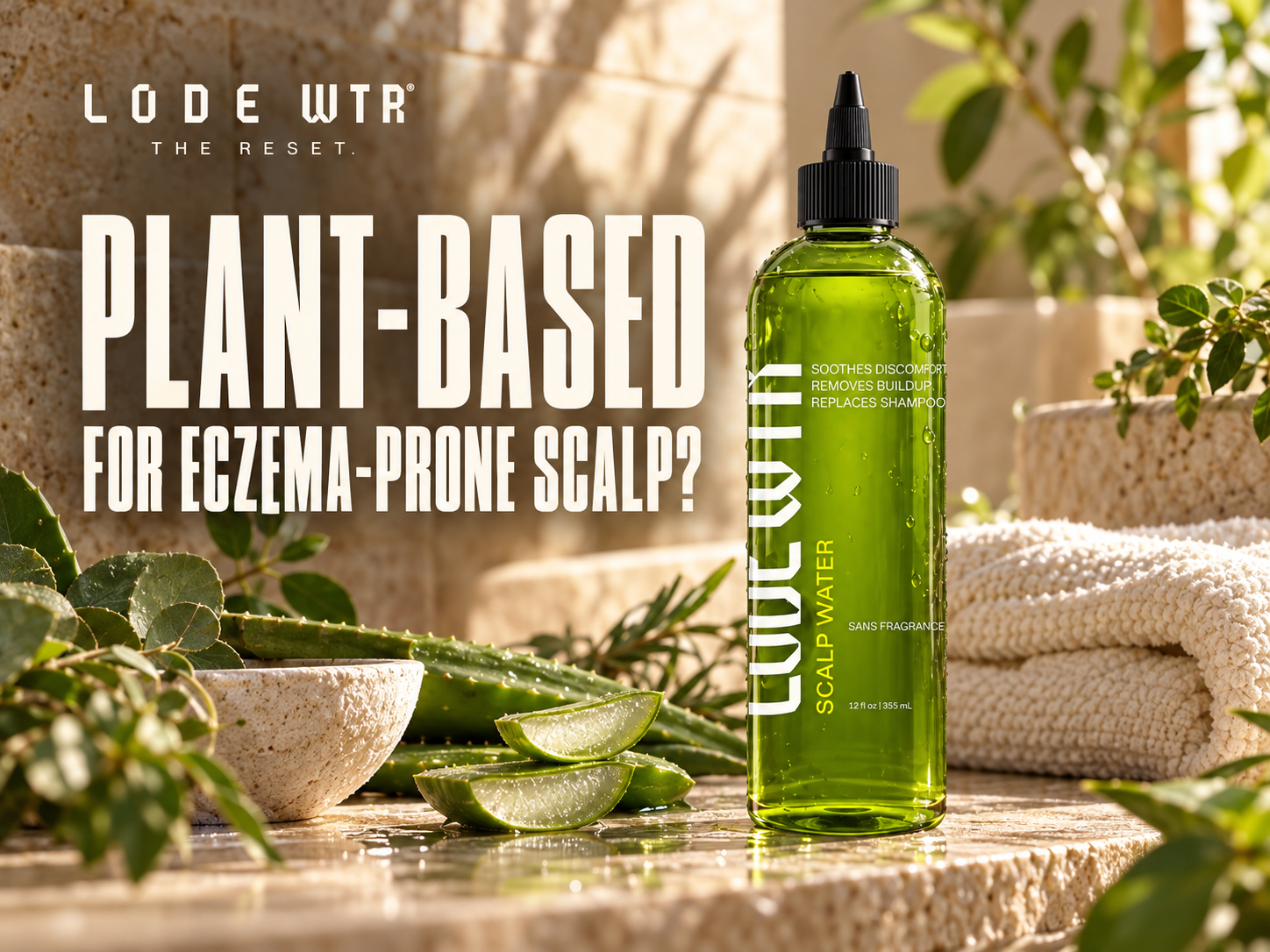
When your scalp is eczema-prone, buying shampoo can feel like a surprisingly high-stakes activity.
One bottle promises:
Deep clean.
Another:
Detox.
Another:
Cooling botanicals.
Another contains enough essential oils to make your bathroom smell like a forest.
Meanwhile, your scalp would simply like everyone to calm down.
So it makes sense that people start searching for:
Plant-based shampoo alternatives.
Something simpler.
Something gentler.
Something that can clean without leaving the scalp feeling:
- Tight
- Itchy
- Burning
- Dry
- More irritated than before
But there is one important rule:
Plant-based does not automatically mean eczema-friendly.
Plants contain active compounds too.
Fragrance can come from plants.
Essential oils come from plants.
And sensitive skin can react to botanical ingredients just as it can react to synthetic ones.
So the goal is not:
Find the most natural cleanser possible.
It is:
Find a cleansing approach your scalp actually tolerates.
First: What Does “Eczema-Prone Scalp” Mean?
“Eczema” is a broad term used for inflammatory skin conditions that can cause symptoms such as:
- Itching
- Dryness
- Redness
- Scaling
- Sensitivity
Different scalp conditions can look similar, and not every itchy or flaky scalp is eczema.
That matters because:
Dry scalp, dandruff, contact dermatitis and other scalp conditions may need different care.
If you have diagnosed eczema, follow the treatment plan recommended by your healthcare professional.
And if you have persistent:
- Severe itching
- Open skin
- Oozing
- Significant redness
- Swelling
- Pain
- Thick scaling
- Hair loss
…a cosmetic shampoo alternative is not the place to experiment your way through the problem.
Get the scalp properly assessed.
Does an Eczema-Prone Scalp Still Need Cleansing?
Yes.
Sensitive does not mean:
Never wash.
The scalp still produces:
- Sebum
- Sweat
And your routine may add:
- Dry shampoo
- Styling cream
- Gel
- Oil
- Leave-in products
If those accumulate, the scalp may become even more uncomfortable.
So the goal is not to avoid cleansing.
It is to find the balance between:
Removing what needs to leave
and
Avoiding unnecessary irritation.
That distinction is everything.
Why Traditional Shampoo Can Feel Too Much for Some Sensitive Scalps
There is nothing inherently wrong with traditional shampoo.
Many people with sensitive skin use shampoo perfectly comfortably.
But some formulas may feel too intense depending on:
- Surfactant system
- Fragrance
- Essential oils
- Washing frequency
- Water temperature
- Individual sensitivity
And sometimes the problem isn’t even the product itself.
It’s the routine.
For example:
Strong cleanser.
Very hot water.
Double shampoo.
Aggressive scratching.
Every day.
Even a reasonable cleanser may become part of an unreasonable routine.
What Should a Plant-Based Shampoo Alternative Actually Do?
Keep the job description simple.
It should help remove:
Excess oil + sweat + residue + buildup.
While ideally avoiding:
- Excessive stripping
- Strong sensory ingredients
- Unnecessary fragrance
- Harsh DIY pH extremes
And afterward?
The scalp should ideally feel:
Clean and comfortable.
Not squeaky.
Not dramatically tingly.
Not like it has survived something.
1. Shikakai-Based Cleansing
Shikakai comes from Acacia concinna and has a long history of use in hair cleansing.
The reason it is relevant is not simply that it is botanical.
Shikakai naturally contains saponins.
Saponins are compounds with soap-like cleansing properties.
They can help interact with oily residue and make it easier to rinse away.
That means Shikakai can contribute to removing:
- Sebum
- Styling residue
- General buildup
without requiring the traditional high-foam shampoo experience.
For someone looking for a plant-based alternative, that makes Shikakai worth understanding.
Not because it is “natural.”
Because it has a cleansing function.
2. Reetha or Soapnut-Based Cleansing
Reetha, also commonly called soapnut, is another botanical source of naturally occurring saponins.
When used as part of a properly formulated cleanser, those saponins can contribute to cleansing oil and residue from the scalp.
At LODE WTR, Shikakai + Reetha are used together as the main botanical cleansing story.
Their role is straightforward:
SHIKAKAI + REETHA
Help lift oil, residue and buildup.
That’s useful.
But here’s an important caution:
If you have an eczema-prone scalp, no botanical ingredient should automatically be assumed safe for you personally.
The full formula matters.
Your individual skin matters.
3. Fragrance-Free Botanical Cleansers
If your scalp is reactive, fragrance is one variable worth paying attention to.
This includes:
Natural fragrance too.
Products can smell “clean” because of:
- Essential oils
- Botanical extracts
- Fragrance blends
But your scalp does not need perfume to become clean.
If fragranced products repeatedly leave your scalp uncomfortable, choosing a simpler fragrance-free cleanser can reduce one unnecessary variable.
The fewer moving parts you have, the easier it becomes to understand what your scalp tolerates.
4. Aloe-Focused Scalp Formulas
Aloe is frequently used in cosmetic formulas designed around skin comfort.
That makes it a reasonable supporting ingredient in products for dry-feeling or sensitive skin.
But again:
Aloe is not eczema medication.
And a product containing Aloe is not automatically suitable for every eczema-prone scalp.
What matters is how Aloe fits into the complete formulation.
In LODE WTR:
ALOE + BOTANICALS
Are included to help support scalp comfort and calm dryness and irritation.
Think:
Supportive ingredient.
Not:
Medical treatment.
5. Scalp Rinses Instead of High-Foam Shampoo
Some people simply prefer a scalp-focused rinse to a conventional shampoo format.
This can make sense when the main concern is:
Roots and scalp
rather than aggressively cleansing every inch of the hair.
The idea is to concentrate cleansing where:
- Sebum originates
- Sweat accumulates
- Dry shampoo collects
- Styling residue builds up
That can be particularly useful if your hair lengths are:
- Curly
- Coily
- Dry
- Processed
while the scalp still needs proper cleansing.
6. Co-Washing — With a Catch
Co-washing uses a conditioning cleanser instead of conventional shampoo.
For some people with:
- Curly hair
- Coily hair
- Dry lengths
it can feel much gentler.
But co-washing is not automatically ideal for eczema-prone scalp.
Why?
Because if the formula is too rich or doesn’t remove enough buildup, you can end up with:
Sensitive scalp + residue.
And that may not feel better.
So if you co-wash, pay attention to:
- How clean the scalp actually feels
- Whether residue accumulates
- Whether itching increases between washes
Gentle cleansing still needs to be cleansing.
7. Low-Foam Cleansing Systems
One of the simplest alternatives to conventional shampoo is:
Stop using foam as your performance metric.
A low-foam cleanser can still remove:
- Oil
- Sweat
- Residue
The amount of lather does not tell you:
- Whether a product is eczema-safe
- Whether it is gentle
- Whether it cleaned properly
Foam is sensory feedback.
Not a medical or cleansing score.
This is why the LODE WTR philosophy keeps coming back to:
Function Over Foam.
Plant-Based Does Not Mean Hypoallergenic
This needs repeating.
Natural ingredients can still irritate sensitive skin.
Examples may include:
- Essential oils
- Botanical fragrances
- Certain plant extracts
So don’t choose a product purely because the front of the bottle says:
Natural.
Instead ask:
- Is it fragranced?
- Does it contain multiple essential oils?
- Is the formula simple?
- What is actually doing the cleansing?
- Does the manufacturer explain the pH?
- Does my scalp tolerate it?
Those questions are far more useful.
Essential Oils: Natural, but Not Automatically Gentle
Tea tree.
Peppermint.
Eucalyptus.
Lavender.
Rosemary.
All extremely popular in scalp care.
And all capable of being irritating for some people.
If your scalp is eczema-prone, an intense cooling or tingling sensation is not necessarily something to celebrate.
A product does not need to make your scalp feel dramatic to prove it is working.
Sometimes the most luxurious scalp sensation is:
Nothing happening at all.
Clean.
Comfortable.
Done.
What About Apple Cider Vinegar?
Apple cider vinegar is a popular natural scalp rinse.
And yes, it is acidic.
But acidity alone does not make something an ideal eczema-prone scalp cleanser.
Two problems:
1. It is not a complete oil-removal system
It does not necessarily perform the same cleansing job as a formulated cleanser.
2. DIY dilution is inconsistent
Too concentrated and a sensitive scalp may react badly.
For an eczema-prone scalp, experimenting with raw acidic ingredients is not necessarily gentler than using a properly formulated product.
What About Baking Soda?
This is one I would avoid recommending for eczema-prone scalp.
Baking soda is alkaline.
Your scalp naturally maintains a more acidic surface environment.
A strong DIY baking-soda wash can be irritating and may also leave the hair feeling rougher.
If your scalp already struggles with sensitivity?
Adding an extreme alkaline treatment does not make much sense.
Natural is not the same as gentle.
What About Clay?
Clay can absorb oil.
That may sound ideal if you have oily roots.
But eczema-prone skin may not love a treatment designed primarily around absorbing and removing oil.
Especially if the scalp already feels:
- Dry
- Tight
- Sensitive
Clay can also be difficult to rinse thoroughly from thick or textured hair.
Again:
Different job.
Not automatically better.
What About Oils?
This is another common reflex.
Eczema-prone scalp?
Apply oil.
Sometimes people find certain oils comfortable.
Others end up with:
- Greasier roots
- More buildup
- Stronger cleansing required afterward
And if your scalp reaction is related to contact sensitivity or another condition, adding oil does not automatically solve it.
So don’t assume:
Dry = oil.
That shortcut often creates a second problem.
What About Water-Only Washing?
Water-only washing sounds appealing because it removes almost every potential ingredient trigger.
But it also removes the cleansing system.
Water alone is not particularly efficient at removing oil.
If your scalp is producing sebum and accumulating styling residue, you may eventually notice:
- Coated roots
- Buildup
- Heaviness
An eczema-prone scalp still needs enough cleansing to keep accumulation under control.
Minimal is good.
Insufficient isn’t.
Why pH Matters for an Eczema-Prone Scalp Routine
Your scalp is skin.
And normal skin maintains a mildly acidic surface environment.
That’s one reason the finished pH of a cleanser matters.
This doesn’t mean:
Acidic = eczema treatment.
It means a thoughtfully formulated product should consider the environment of the skin it is being applied to.
At LODE WTR, the naturally low acidic pH is part of the broader scalp-conscious approach.
Read next: Why Shampoo pH Matters.
Why “Gentle” Still Needs to Remove Buildup
This is one of the hardest balances.
If a cleanser is too aggressive?
Sensitive scalp may feel worse.
If it is too weak?
Oil and product residue accumulate.
Then the scalp may also feel worse.
So the target is not:
Weakest cleanser possible.
It is:
Enough cleansing for your actual routine.
This is particularly important if you use:
- Dry shampoo
- Styling products
- Hair oils
- Leave-ins
An eczema-prone scalp does not benefit from several days of product accumulation simply because you’re afraid to wash it.
What About Medicated Shampoo?
If a dermatologist has prescribed or recommended a medicated shampoo for your eczema or another diagnosed scalp condition:
Use medical guidance first.
A plant-based alternative should not be positioned as a replacement for indicated treatment.
Cosmetic cleansers can help with:
- Oil
- Sweat
- Residue
- General scalp hygiene
They do not replace medication when medication is needed.
This distinction matters.
A lot.
Can You Alternate a Plant-Based Cleanser With Medicated Shampoo?
Possibly, depending on the treatment plan you have been given.
For example, some people use a medicated shampoo on specific days and a gentler cleanser between treatments.
But if you have diagnosed eczema, that schedule is best discussed with your dermatologist or healthcare professional.
The cleanser used between treatment days should not interfere with the medical plan or add unnecessary irritation.
What Should You Avoid in a Shampoo Alternative for Eczema-Prone Scalp?
There isn’t one universal blacklist.
Individual triggers vary.
But if your scalp is reactive, it can make sense to be cautious about products overloaded with:
- Fragrance
- Essential oils
- Menthol-like cooling ingredients
- Multiple exfoliating acids
- Harsh physical scrubs
More ingredients do not automatically equal more scalp care.
Sometimes the simpler formula wins.
What Should You Look For Instead?
A sensible checklist:
Effective cleansing
It must still remove oil and buildup.
Minimal unnecessary fragrance
Especially if fragrance tends to bother you.
No dramatic “cooling” requirement
Your scalp doesn’t need to tingle.
Thoughtful pH
A scalp-conscious formulation should consider the skin environment.
Supportive ingredients
Such as Aloe in products designed around scalp comfort.
Clear ingredient roles
Not twenty botanicals all claiming to do everything.
How LODE WTR Fits Into This Conversation
LODE WTR is not an eczema treatment.
That distinction is important.
It is a scalp-focused cleansing alternative built around:
SHIKAKAI + REETHA
Natural saponins that help lift oil, residue and buildup.
AMLA
Supports scalp health and helps hair feel smoother and more resilient.
ALOE + BOTANICALS
Help support scalp comfort and calm dryness and irritation.
NATURALLY LOW ACIDIC pH
Designed to support the scalp barrier and a balanced wash environment.
That can make the approach interesting for someone looking for an alternative to conventional high-foam shampoo.
But if you have eczema?
Your own skin tolerance and medical guidance come first.
Why Shikakai + Reetha Are Different From “Just Herbs”
Because they have an actual role in cleansing.
This is important for a plant-based shampoo alternative.
A product shouldn’t contain herbs simply because:
Botanical = premium.
Shikakai and Reetha contain natural saponins.
Saponins provide soap-like cleansing behavior.
That makes their inclusion functional.
Not decorative.
Read next: What Are Saponins in Shampoo?
Why Amla Isn’t the Cleansing Ingredient
Amla has its own role.
It helps support:
- Scalp health
- Hair feel
- Smoothness and resilience over time
It is not the ingredient primarily responsible for removing oil.
This distinction matters because good formulation is about assigning ingredients jobs.
Not claiming every botanical:
Cleanses.
Soothes.
Repairs.
Balances.
Strengthens.
Transforms your destiny.
One job at a time.
Why Aloe Matters More Than Marketing Theater
An eczema-prone scalp usually doesn’t need more sensory drama.
It needs comfort.
Aloe and other supporting botanicals can make sense in formulas designed around dryness and irritation.
Again:
They don’t treat eczema.
But they can support a cosmetic formulation designed to feel less aggressive.
That’s a meaningful difference.
How to Wash an Eczema-Prone Scalp More Gently
The product is only half the equation.
Technique matters too.
Use warm water
Not extremely hot.
Massage with fingertips
Not nails.
Clean the scalp, not aggressively every inch of hair
Focus where oil and buildup actually accumulate.
Rinse thoroughly
Residual cleanser may become another irritant.
Avoid automatic double cleansing
Use a second cleanse only when buildup requires it.
Keep the routine simple
Fewer scalp products make it easier to identify triggers.
Avoid the Itch-Scratch Cycle
An itchy scalp makes scratching feel impossible to resist.
But repeated scratching can damage the skin surface and make irritation worse.
Then the scalp itches more.
Then you scratch more.
Not a great system.
If your scalp itching is persistent enough that you are constantly scratching, that is another reason to seek proper medical guidance rather than continuously changing cosmetic products.
Patch Testing Matters
For highly reactive skin, introducing new products one at a time is useful.
You don’t want to simultaneously change:
- Shampoo
- Scalp serum
- Styling product
- Conditioner
Then develop irritation and have absolutely no idea which one caused it.
Simplify.
Introduce carefully.
Observe.
Sensitive-skin care benefits from boring experiments.
Is “Organic” Better for Eczema-Prone Scalp?
Not automatically.
Organic describes how certain agricultural ingredients were produced.
It does not guarantee:
- Less irritation
- Better cleansing
- Better pH
- Better scalp compatibility
An organic essential oil can still irritate skin.
A non-organic cosmetic ingredient can still be extremely well tolerated.
Judge the formula.
Not the marketing badge.
Is “Chemical-Free” Better?
Chemical-free scalp care does not exist.
Water is a chemical.
Amla contains chemicals.
Shikakai contains chemicals.
Your scalp is made of chemicals.
The goal is not:
Avoid chemistry.
It is:
Use chemistry intelligently.
That includes plant chemistry.
What If Your Eczema-Prone Scalp Is Also Oily?
This is where people tend to struggle.
You don’t want to over-cleanse because the scalp is sensitive.
But you also don’t want to leave excess oil and buildup sitting around.
So you need a cleansing approach that is:
Effective enough to remove accumulation
without making:
Maximum stripping the goal.
A scalp-focused botanical cleanser may be one option worth considering, depending on what your skin tolerates.
Read next: LODE WTR vs Traditional Shampoo for Oily Scalp Control.
What If Your Scalp Is Dry and Flaky?
Do not assume every flake is eczema.
Or every flake is dry scalp.
Or every flake is dandruff.
Several scalp issues can look similar.
If the flaking is persistent or severe, get the underlying condition properly identified.
Because the correct routine depends on what you’re actually dealing with.
Read: Dry Scalp vs. Dandruff: What’s Actually Causing the Flakes?
The Best Plant-Based Alternative Is Not the Most “Natural” One
It is the one that:
Cleans enough.
Doesn’t add unnecessary irritation.
Matches your scalp needs.
Works with any medical treatment you’re using.
That may be a botanical scalp rinse.
A fragrance-free cleanser.
A very simple conventional shampoo.
Or a combination recommended by your dermatologist.
The label matters less than the result.
Your Scalp Doesn’t Need a Wellness Trend
It needs a routine that works.
If your scalp is eczema-prone, this is not the time to chase:
Detoxes.
Kitchen recipes.
Intense exfoliation.
Highly fragranced botanical rituals.
The best routine is often deeply unexciting.
Wash.
Rinse.
Comfort.
Done.
That’s a good thing.
Plant-Based, But Still Functional
If you’re looking beyond traditional shampoo, plant-based cleansing can make sense.
But the standard should remain high.
A shampoo alternative should have:
A reason to exist beyond being natural.
Shikakai + Reetha?
They cleanse.
Aloe?
Supports comfort.
Amla?
Supports scalp and hair feel.
Acidic pH?
Part of a scalp-conscious formulation environment.
That is what functional plant-based care looks like.
The Bottom Line
If you have an eczema-prone scalp, the best shampoo alternative is not necessarily the product with the most herbs.
Or the least foam.
Or the prettiest natural label.
It is the one that helps you maintain:
A clean scalp without unnecessary irritation.
And if your eczema requires medicated treatment?
That comes first.
Plant-based cleansing can be part of a scalp-care routine.
It should never pretend to replace medical care.
That’s the difference between:
Marketing.
And useful scalp care.
Function Over Foam.
Frequently Asked Questions
What is the best plant-based shampoo alternative for eczema-prone scalp?
There is no single best option for everyone. Look for a gentle but effective cleansing system, minimal unnecessary fragrance and a formula your individual scalp tolerates. People with diagnosed eczema should follow medical guidance.
Are plant-based shampoos better for eczema?
Not automatically. Botanical ingredients can also irritate sensitive skin. The complete formulation matters more than whether the ingredients are plant-derived.
Is Shikakai good for an eczema-prone scalp?
Shikakai contains natural saponins with cleansing properties, but suitability depends on the finished formula and individual skin sensitivity. It should not be considered an eczema treatment.
Is Reetha good for sensitive scalp?
Reetha provides natural saponins that can support cleansing, but sensitive scalps can react differently to any ingredient.
Is Aloe good for eczema-prone scalp?
Aloe is commonly used in cosmetic formulations designed around skin comfort, but it is not a substitute for eczema medication or professional medical care.
Should I avoid fragrance if I have scalp eczema?
Fragrance can be a trigger for some sensitive individuals. If fragranced products consistently cause problems, a fragrance-free option may be easier to tolerate.
Are essential oils good for eczema-prone scalp?
Not necessarily. Essential oils can irritate sensitive skin in some people, despite being plant-derived.
Is apple cider vinegar good for scalp eczema?
DIY vinegar rinses may irritate sensitive skin if improperly diluted and are not a replacement for prescribed eczema treatment.
Is baking soda good for scalp eczema?
Baking soda is alkaline and may be irritating or drying. It is generally not an obvious choice for an already-sensitive scalp.
Can I use a shampoo alternative with medicated shampoo?
Possibly, but if you are using a medicated shampoo for diagnosed eczema, ask your healthcare professional how to combine it with other scalp cleansers.
Should an eczema-prone scalp be washed less often?
There is no universal washing schedule. Frequency should depend on oil, sweat, buildup, your individual scalp and any medical guidance you have received.
When should I see a dermatologist?
Seek professional care if scalp symptoms are persistent, severe or accompanied by open skin, oozing, swelling, pain, intense redness, thick scaling or hair loss.
LODE WTR
Sensitive scalp still needs clean.
Not more aggression.
Not more noise.
SHIKAKAI + REETHA — Cleanse.
AMLA — Support.
ALOE + BOTANICALS — Calm.
LOW ACIDIC pH — Balance.
Plant-based. Functional. Scalp-first.
Function Over Foam.
Minimal Not Basic.
Root of the Problem.
Rebellion With Receipts.


