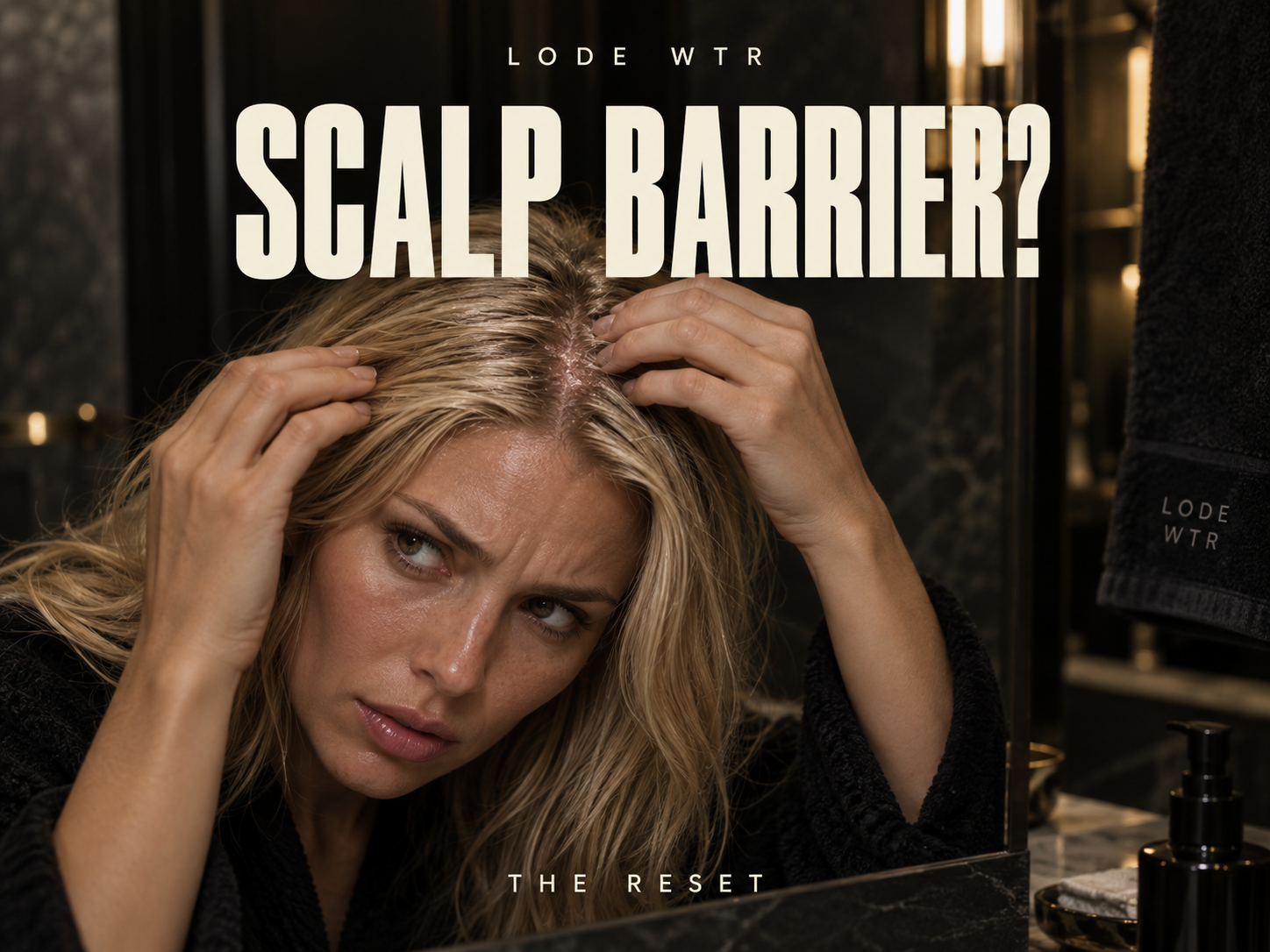
We talk about the skin barrier constantly.
Face feels tight?
Barrier.
New skincare stings?
Barrier.
Dry patches?
Barrier.
Then we move twelve inches upward and suddenly forget the scalp is also skin.
We scrub it.
Clarify it.
Double shampoo it.
Use very hot water.
Layer dry shampoo.
Add scalp acids.
Scratch when it itches.
Then wonder why everything feels irritated.
Your scalp has a protective outer barrier just like the skin elsewhere on your body.
Its job is simple but important:
Help keep the good stuff in and the unwanted stuff out.
When that barrier becomes stressed, the scalp may start feeling:
- Tight
- Dry
- Itchy
- Sensitive
- Flaky
- Easily irritated
That doesn’t automatically mean you have a medical condition.
But it may mean your routine is doing more than your scalp comfortably tolerates.
Here are eight signs worth paying attention to.
First: What Is the Scalp Barrier?
Your scalp is covered by skin.
The outermost part of that skin helps form a barrier between your body and the environment.
That barrier helps support:
- Water retention
- Protection from environmental exposure
- Skin comfort
- A stable scalp environment
It also has to deal with quite a lot.
Every week, your scalp may encounter:
- Shampoo
- Styling products
- Sweat
- Oil
- Dry shampoo
- Hot water
- Friction
- Weather
- Hair dye
- Fragrance
- Exfoliating products
So while the scalp is resilient, it isn’t indestructible.
If you repeatedly push it with aggressive cleansing and irritation, it may start letting you know.
Very clearly.
1. Your Scalp Feels Tight Immediately After Washing
This is one of the most obvious signs that your routine may be too intense.
You finish shampooing.
Your roots look fresh.
But the skin underneath feels:
- Stretched
- Dry
- Uncomfortable
- Almost “too clean”
That tight sensation is often treated like proof that shampoo worked.
But clean does not need to equal tight.
If your scalp feels significantly worse immediately after washing, look at:
- Shampoo strength
- Water temperature
- Washing frequency
- Double cleansing
- How much product you’re using
Your cleanser’s job is to remove what shouldn’t stay.
Not make your scalp feel shrink-wrapped.
Read next: Why Does My Scalp Feel Tight After Washing?
2. Products That Never Bothered You Suddenly Sting
You apply shampoo.
Or a scalp product.
And suddenly there’s a noticeable sting.
Maybe the formula isn’t new.
Maybe you’ve used it plenty of times before.
That can happen when the scalp is already irritated.
A product that feels fine on comfortable skin can feel very different when the scalp has been:
- Scratched
- Over-cleansed
- Exfoliated
- Irritated by another product
This is why it’s useful to look at the entire routine rather than immediately blaming one ingredient.
Sometimes the product isn’t the only thing that changed.
The condition of your scalp did.
3. Your Scalp Is Suddenly More Sensitive to Hot Water
You used to love steaming showers.
Now the water hits your scalp and:
Nope.
It feels hot faster.
More uncomfortable.
Maybe even slightly burning.
That can be a sign the scalp is already sensitized.
Very hot water can add another stressor to skin that is not feeling its best.
So if your scalp has become noticeably reactive, turning down the temperature is one of the easiest changes you can make.
No new product required.
Warm water is enough.
Your shower does not need to double as a sauna for your follicles.
4. You’re Getting Small Flakes Alongside Tightness
Flakes don’t automatically mean dandruff.
They don’t automatically mean dry scalp either.
But when small flakes appear alongside:
- Tightness
- Dry-feeling skin
- Sensitivity after washing
…it may be worth looking at whether your routine is leaving the scalp too dry or irritated.
This becomes especially relevant if you are:
- Washing frequently
- Using clarifying shampoo often
- Scrubbing aggressively
- Taking very hot showers
And remember:
If your flakes are persistent, severe, oily, heavily itchy or accompanied by significant redness, a dermatologist can help determine what’s actually going on.
Read: Dry Scalp vs. Dandruff: What’s Actually Causing the Flakes?
5. Your Scalp Is Itchy Even When It Isn’t Particularly Dirty
Itching usually makes us think:
Time to wash.
But what if you just washed?
Or the scalp isn’t oily?
Itching can have many causes, and irritation is one of them.
If you keep responding to every itch with:
More shampoo.
More scratching.
More clarifying.
You may end up creating a cycle.
Itch → wash aggressively → scalp feels dry → itch → wash again.
At that point, cleansing frequency isn’t solving the issue.
It may be contributing to it.
Read next: Why Does My Scalp Itch After Washing?
6. Your Scalp Burns or Stings After Shampooing
This deserves attention.
Shampoo should clean your scalp.
It should not routinely make it feel like it’s on fire.
Persistent burning or significant stinging may be associated with:
- Product irritation
- Aggressive washing
- Hot water
- Scratching
- A sensitized scalp
- An underlying scalp condition
If one specific product repeatedly causes the reaction, discontinue it and observe.
If burning is persistent, significant or accompanied by redness, sores, swelling or other concerning symptoms, seek professional medical advice.
Read: Why Does My Scalp Burn After Shampooing?
7. You Feel Like You Need More and More Products to Keep Your Scalp Comfortable
This is a subtle one.
First your scalp feels dry.
So you add oil.
Then your roots get greasy.
So you add dry shampoo.
Then buildup develops.
So you clarify.
Now the scalp feels tight.
So you add a serum.
Then another product.
Eventually, your scalp routine has become:
A product solving the side effect of another product.
That can make it almost impossible to identify what your scalp actually needs.
If your routine keeps getting longer while your scalp keeps feeling worse?
Simplification may tell you more than another purchase.
Minimal Not Basic.
8. Your Scalp Never Really Feels Comfortable
Maybe nothing is dramatic.
No severe burning.
No huge flakes.
No obvious redness.
But your scalp is constantly:
- Slightly itchy
- Slightly tight
- Slightly sensitive
- Slightly annoying
All day.
Every day.
That is still useful information.
A healthy-feeling scalp shouldn’t constantly demand your attention.
If your scalp is always background noise, your routine deserves a review.
You shouldn’t need to think about your scalp every twenty minutes.
What Can Stress the Scalp Barrier?
There’s rarely one villain.
Usually it’s the combination.
Over-cleansing
Washing aggressively or more often than your scalp comfortably tolerates may leave it feeling tight or dry.
Very hot water
Heat can make already-sensitive skin feel less comfortable.
Aggressive scratching
Your fingernails create friction.
Repeatedly scratching itchy skin can make irritation worse.
Too many exfoliating products
Scalp acids.
Scrubs.
Clarifying shampoo.
Another exfoliator.
More is not automatically better.
Product sensitivity
Some scalps simply don’t tolerate certain formulas well.
Weather
Cold air, low humidity and indoor heating can influence how scalp skin feels.
Hair treatments
Hair color, bleach and other chemical services can sometimes leave the scalp feeling more sensitive.
The key point?
Your scalp doesn’t experience these things individually.
It experiences the whole routine.
Does an Oily Scalp Mean the Barrier Is Fine?
No.
Oiliness and barrier comfort are different things.
You can have oily roots while the scalp itself feels:
- Tight
- Sensitive
- Dry
- Irritated
Sebum production doesn’t prove that the skin barrier feels comfortable.
That’s why aggressive cleansing based only on how greasy your hair looks can sometimes create a mismatch.
The hair says:
Oily.
The scalp says:
Please stop.
Both can be true.
Read next: Why Is My Scalp Dry but My Hair Gets Greasy?
Can Overwashing Damage the Scalp Barrier?
Frequent cleansing isn’t automatically a problem.
Some people wash daily and feel perfectly comfortable.
What matters is the combination of:
- Frequency
- Cleanser
- Amount used
- Water temperature
- Technique
Daily washing with a well-matched routine may be fine for one person.
Washing every other day with very hot water, aggressive scrubbing and strong clarifying shampoo may feel terrible for another.
The calendar alone doesn’t tell you enough.
Look at the result.
Does the scalp feel clean and comfortable afterward?
That’s the test.
Does Double Shampooing Hurt the Scalp Barrier?
Not inherently.
Double cleansing can be useful when there is significant:
- Oil
- Sweat
- Dry shampoo
- Styling-product buildup
But automatically shampooing twice every single time isn’t necessary for everyone.
If wash number one already did the job?
Stop.
If wash number two consistently leaves your scalp:
- Tight
- Dry
- Itchy
…that’s feedback.
Double shampooing should solve a buildup problem.
It shouldn’t become the cause of a comfort problem.
Read: Should You Shampoo Twice?
What About Clarifying Shampoo?
Clarifying shampoo can be extremely useful.
Especially when your routine creates substantial buildup.
But “clarifying” doesn’t have to mean:
Use constantly because cleaner must be better.
Think of it as a tool.
Heavy buildup?
Useful.
Minimal buildup?
Maybe unnecessary.
If every wash becomes a deep-cleaning event, your scalp may eventually object.
And it usually isn’t subtle about it.
How Does pH Fit Into Scalp Barrier Health?
Your scalp skin naturally exists in a mildly acidic environment.
That is one reason the pH of a finished cleansing formula matters.
A thoughtfully formulated acidic pH can help support the scalp’s natural environment.
At LODE WTR, the naturally low acidic pH is part of the overall formula approach.
Because cleansing isn’t only about removing oil.
It’s also about what the scalp feels like after the rinse.
Clean is only half the job.
Comfort matters too.
Can Botanical Ingredients Support Scalp Comfort?
They can contribute as part of a thoughtfully designed formula.
LODE WTR’s ingredient approach includes:
SHIKAKAI + REETHA
Natural saponins that help lift oil, residue and buildup.
AMLA
Supports scalp health and helps hair feel smoother and more resilient.
ALOE + BOTANICALS
Help calm dryness and irritation.
NATURALLY LOW ACIDIC pH
Helps support the scalp barrier and maintain balance.
The important phrase here is:
As part of a formula.
One ingredient doesn’t carry the entire routine.
The system matters.
Can You “Repair” Your Scalp Barrier Overnight?
This is where marketing gets ambitious.
You’ll see products promising instant barrier repair.
Real scalp comfort is usually less dramatic.
If your routine is causing irritation, the first useful step is often:
Stop repeatedly irritating it.
That may mean:
- Less hot water
- Less aggressive washing
- Fewer exfoliating products
- Less scratching
- Removing a product that consistently stings
Supportive products can help.
But you can’t endlessly create the same irritation and expect one serum to clean up after it.
Fix the routine first.
How to Simplify a Stressed Scalp Routine
If your scalp feels sensitive, go back to basics.
1. Reduce the Number of Scalp Products
For a while, consider minimizing:
- Scalp scrubs
- Exfoliating acids
- Dry shampoo
- Root powders
- Heavy oils
- Multiple serums
Give yourself fewer variables.
2. Use Warm Water
Not freezing.
Not boiling.
Comfortable.
3. Clean Gently
Focus shampoo where oil and residue accumulate.
Massage with fingertips.
No nails.
4. Start With One Cleanse
If one shampoo leaves the scalp clean, you’re done.
Add a second only when buildup genuinely warrants it.
5. Rinse Thoroughly
Especially around:
- Hairline
- Crown
- Nape
- Behind the ears
Residual product won’t help a sensitive scalp.
6. Stop Scratching
If the scalp itches enough that scratching is constant, investigate the cause rather than repeatedly traumatizing the skin.
7. Change One Thing at a Time
This is important.
Don’t simultaneously:
Change shampoo.
Stop washing daily.
Buy three scalp serums.
Install a shower filter.
Add oil.
Start using aloe.
Because if your scalp improves?
You learned absolutely nothing.
Change one meaningful variable.
Observe.
Then adjust.
Rebellion With Receipts.
How Long Should a Stressed Scalp Take to Feel Better?
There is no universal timeline.
It depends on:
- What is causing the discomfort
- How irritated the scalp is
- Whether the trigger is still present
- Whether there is an underlying scalp condition
Mild routine-related sensitivity may improve once the irritating factor is removed.
Persistent symptoms deserve more attention.
Especially if your scalp continues to feel painful, inflamed or significantly irritated despite simplifying your routine.
When It’s Probably Not Just a Barrier Problem
This matters.
It’s easy to blame every scalp symptom on “barrier damage.”
Don’t.
Persistent:
- Thick scaling
- Significant redness
- Open sores
- Oozing
- Swelling
- Severe burning
- Sudden hair loss
- Significant pain
…can indicate something that needs professional assessment.
A dermatologist can help distinguish cosmetic irritation from an actual scalp condition.
No amount of ingredient TikTok can replace that.
Stop Trying to Feel Your Shampoo Working
This idea needs to die.
Burning doesn’t mean working.
Extreme tingling doesn’t mean working.
Squeaky doesn’t mean working.
Pain doesn’t mean working.
A cleanser can be effective without creating a dramatic sensory event.
What matters is:
Did it remove excess oil and residue?
Does the scalp feel comfortable afterward?
That’s it.
Your scalp doesn’t need special effects.
Your Scalp Is Skin
This should be obvious.
But hair care often behaves like it isn’t.
Imagine washing your face until it burned.
Then scrubbing it.
Then applying powder because it became oily.
Then exfoliating again because it felt rough.
You’d probably reconsider the routine.
Do the same for your scalp.
Clean it.
Respect it.
Stop assuming more intensity means more care.
Better Scalp Health Usually Starts With Less Noise
You don’t need to obsess over your scalp barrier.
And you don’t need a twelve-product “repair protocol.”
Pay attention to the basics.
How does the scalp feel after washing?
What products consistently irritate it?
Are you over-scrubbing?
Is the water too hot?
Are you layering unnecessary products?
The scalp usually gives you plenty of information.
You just need to stop covering that information with another step.
Clean effectively.
Treat discomfort as feedback.
Keep the routine functional.
That’s scalp health.
A Comfortable Scalp Should Be the Baseline
Not tight.
Not burning.
Not constantly itchy.
Not something you’re thinking about all day.
Your scalp doesn’t need to feel dramatic to be healthy.
Sometimes the best sign your routine is working is that you barely notice your scalp at all.
That’s the reset.
Less irritation.
Less over-cleansing.
Less noise.
Function Over Foam.
Frequently Asked Questions
What is the scalp barrier?
The scalp barrier is the outer protective layer of scalp skin that helps retain moisture and protect the skin from environmental exposure and irritants.
How do I know if my scalp barrier is damaged?
Possible signs of a stressed scalp barrier include tightness, dryness, sensitivity, burning, itching or small flakes, particularly after washing.
These symptoms can also have other causes, so persistent problems may require professional assessment.
Can shampoo damage the scalp barrier?
A cleansing routine that is too aggressive for your scalp may contribute to dryness or irritation.
The formula, washing frequency, water temperature and technique all matter.
Can overwashing affect the scalp barrier?
Frequent or aggressive washing may leave some scalps feeling tight, dry or sensitive.
However, washing frequency is individual, and some people comfortably wash daily.
Does hot water affect the scalp barrier?
Very hot water may leave sensitive skin feeling drier or more irritated.
Using comfortably warm water is a simple adjustment worth trying.
Can dry shampoo affect scalp health?
Repeated dry-shampoo use can contribute to product accumulation around the roots.
If your scalp feels coated, itchy or uncomfortable, it may be time for proper cleansing.
Can an oily scalp have a damaged or stressed barrier?
Yes. Oiliness and scalp comfort are separate issues.
Your roots can appear oily while the scalp skin underneath feels dry, tight or irritated.
Does scalp pH matter?
The scalp naturally maintains a mildly acidic environment, so the pH of a finished cleansing formula can be relevant to scalp comfort and barrier support.
Should I use scalp oil to repair my scalp barrier?
Not automatically. First identify whether your routine includes potential triggers such as aggressive cleansing, hot water or irritating products.
Adding oil doesn’t necessarily address the cause.
When should I see a dermatologist?
Seek professional advice if symptoms are persistent, severe or accompanied by significant redness, swelling, pain, sores, oozing, thick scaling, burning or sudden hair loss.
LODE WTR
Scalp care, stripped back.
Clean doesn’t need to burn.
Healthy doesn’t need to feel squeaky.
Comfort isn’t optional.
Respect the barrier.
Function Over Foam.
Minimal Not Basic.
Root of the Problem.
Rebellion With Receipts.


