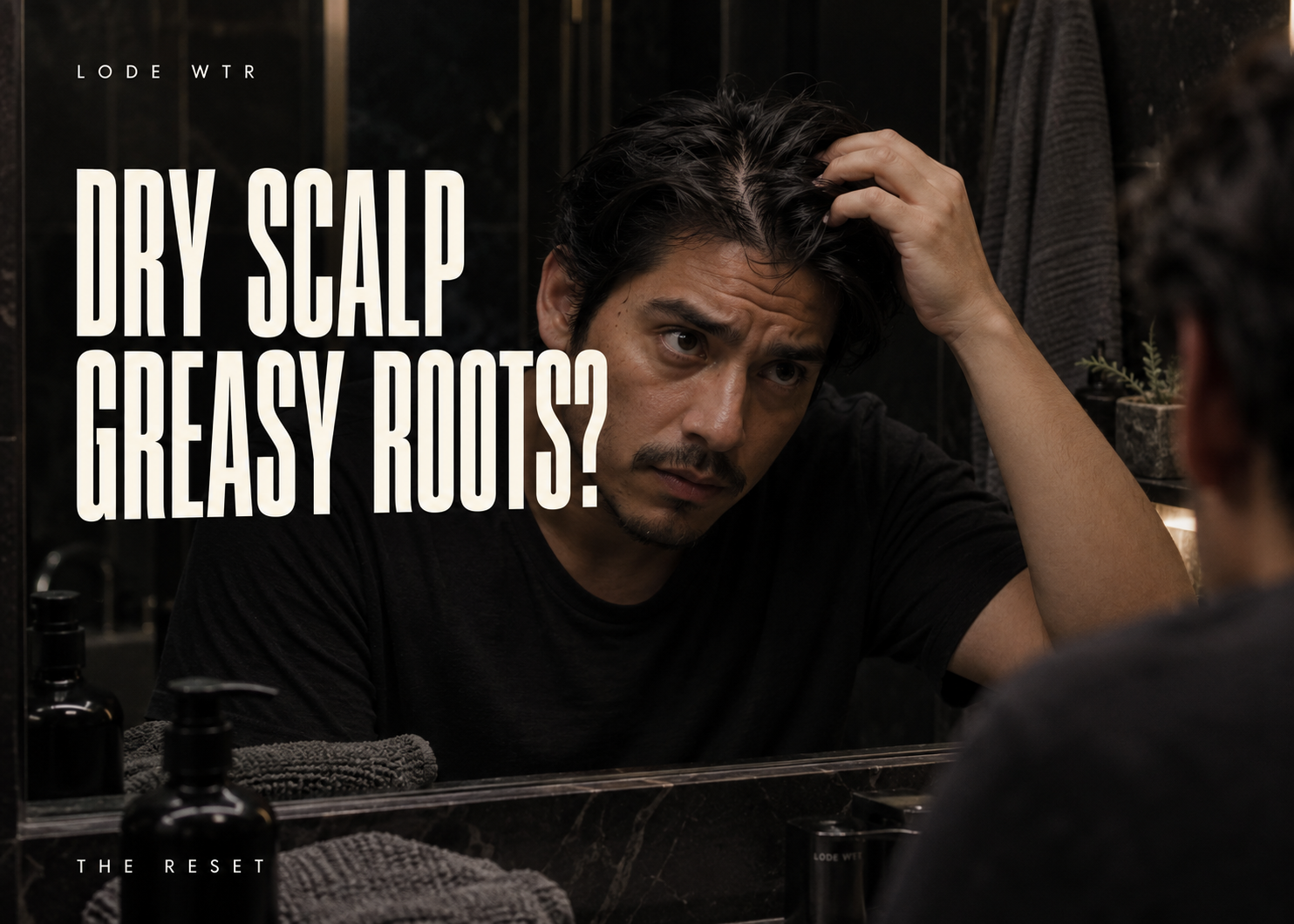
Your roots look oily.
So you wash them.
Then your scalp feels dry.
But somehow, by the next day, your hair looks greasy again.
Excellent.
Now you’ve somehow managed to have:
Dry scalp + oily hair.
Which sounds contradictory until you remember one important thing:
How your scalp feels and how your hair looks are not the same measurement.
Your scalp is skin.
Your hair is collecting sebum, sweat, product and whatever else your routine adds to it.
That means the skin underneath your hair can feel dry, tight or irritated while the roots still look heavy or greasy.
And if your reaction is always:
“More oil means stronger shampoo.”
You may end up making the dry feeling worse.
Let’s unpack what’s actually going on.
First: Oiliness and Dryness Are Not Opposites
This is the biggest misconception.
A scalp that feels dry does not necessarily mean there is zero oil present.
And greasy-looking hair does not prove that your scalp skin is well hydrated or comfortable.
You can have:
- Sebum around the hair roots
- Product buildup on the hair
- Sweat
- Dry or irritated scalp skin
All at the same time.
So when someone says:
“My scalp is dry but my hair is oily.”
That isn’t impossible.
It’s actually a useful clue that the problem may involve more than oil production.
1. You’re Washing Harder Because Your Roots Look Greasy
This is probably the easiest cycle to fall into.
Roots look greasy.
So you use more shampoo.
Maybe twice.
Maybe something clarifying.
Maybe very hot water because the scalp needs to feel really clean.
For a few hours?
Success.
Then the scalp starts feeling:
- Tight
- Dry
- Itchy
- Uncomfortable
Meanwhile, natural sebum continues to accumulate around the roots.
And by the next day?
Greasy again.
So you wash harder.
Again.
If this sounds familiar, the answer may not be stronger cleansing.
It may be better-matched cleansing.
The scalp needs to be clean.
It does not need to feel stripped.
2. Product Buildup Is Making Your Hair Look Oilier Than It Is
Not everything that looks greasy is pure scalp oil.
Your roots may also be carrying:
- Dry shampoo
- Leave-in conditioner
- Hair oil
- Styling cream
- Gel
- Root sprays
- Conditioner residue
Combine those with natural sebum and your hair may start looking:
- Flat
- Separated
- Heavy
- Shiny
- Greasy
That doesn’t necessarily mean your sebaceous glands suddenly went into overdrive.
Sometimes your hair is simply carrying too much product.
Meanwhile, the skin underneath may still feel dry or irritated.
This is exactly why scalp condition and hair appearance need to be evaluated separately.
Read next: What Is Scalp Buildup? Signs, Causes and How to Reset Your Routine.
3. Your Water Is Too Hot
Very hot showers can make your scalp feel less comfortable after washing.
And because the hair looks fresh immediately afterward, it’s easy to miss what the skin is telling you.
A typical routine might be:
Hot water.
Strong shampoo.
Aggressive massage.
Perfectly clean roots.
Tight scalp.
Then oil gradually returns to the hair over the next day.
Now you have greasy-looking roots sitting on top of a scalp that still feels dry.
If you consistently feel tightness after washing, try reducing the water temperature.
Comfortably warm is enough.
Your scalp doesn’t need to be pressure-washed with steam.
4. You’re Using Dry Shampoo to Fix Oiliness — and Creating More Buildup
Dry shampoo is extremely useful.
Until every oily-root problem gets answered with:
Another spray.
Dry shampoo absorbs some visible oil.
But it also adds product to the roots.
So the sequence becomes:
Natural oil.
Dry shampoo.
More oil.
More dry shampoo.
Sweat.
Styling product.
Eventually, your roots may feel coated.
And because the scalp underneath still hasn’t necessarily been properly cleansed or may already feel sensitive, you end up with the strange combination of:
Dry-feeling scalp + heavy greasy-looking hair.
If you’re repeatedly spraying dry shampoo onto uncomfortable roots, the solution may be water.
Read: Is Dry Shampoo Bad for Your Scalp? What Happens When You Use Too Much.
5. Heavy Conditioner Is Reaching Your Roots
Your hair lengths and your scalp do not always need the same thing.
Dry ends?
A richer conditioner may feel great.
Apply that same conditioner directly around fine or oil-prone roots?
Different story.
Conditioners, masks and oils can make the hair around the scalp look greasy faster.
Meanwhile, your actual scalp skin may still feel dry from:
- Washing
- Hot water
- Irritation
- Environmental factors
So you’re left thinking:
“How can this be dry? It looks oily.”
Because you’re looking at hair.
Not necessarily the skin underneath it.
Unless a product is specifically designed for scalp application, consider keeping richer conditioning products mostly on the mid-lengths and ends.
6. Your Environment Is Drying Out Your Scalp
Your scalp doesn’t live separately from the rest of your skin.
Weather matters.
You may notice more scalp dryness during:
- Winter
- Cold weather
- Low humidity
- Heavy indoor heating
- Air-conditioned environments
But your sebaceous glands don’t necessarily stop producing oil because the air became dry.
So the scalp may feel tighter or flakier while the hair still becomes oily on its normal schedule.
That creates an especially confusing winter combination:
Dry skin. Greasy roots.
Your routine may need to adjust seasonally instead of staying identical year-round.
7. You’re Scratching an Already-Dry Scalp
Dry scalp feels itchy.
So you scratch.
Then the scalp becomes more irritated.
Now it feels even more uncomfortable.
Meanwhile, oil and product continue accumulating on the hair.
This is how you can end up with roots that look greasy while the skin itself feels:
- Sore
- Dry
- Sensitive
- Itchy
Scratching doesn’t solve the underlying dryness.
It mostly adds mechanical irritation.
When washing, use your fingertips.
Not your nails.
Your scalp is not a scratch card.
8. The Scalp May Be Irritated Rather Than Simply “Dry”
This distinction matters.
People often describe any uncomfortable scalp as dry.
But sensations like:
- Tightness
- Burning
- Stinging
- Redness
- Persistent itching
…may involve irritation rather than simple dryness alone.
If your scalp starts feeling uncomfortable specifically after using a particular product, the issue may be the formula rather than a lack of oil.
And adding scalp oil on top of an irritating product doesn’t address the problem.
First ask:
What changed?
New shampoo?
New styling product?
Clarifying treatment?
More frequent washing?
Start there.
Why Does My Scalp Feel Dry Right After Washing but Oily the Next Day?
This is one of the clearest patterns.
Immediately after washing:
Your scalp feels clean but tight.
The next day:
Your roots become visibly oily.
That doesn’t mean your scalp “created oil because you stripped it” in some simple instant rebound mechanism.
The more useful interpretation is:
Your wash may be leaving the skin uncomfortable, while normal sebum accumulation still becomes visible on the hair afterward.
Those two things can happen together.
So don’t get trapped trying to scrub away every trace of oil.
Your goal is:
Clean scalp + comfortable scalp.
Not one at the expense of the other.
Is My Scalp Actually Dry or Just Dehydrated?
Hair-care language loves separating “dry” and “dehydrated.”
In real life, scalp discomfort is rarely something you need to self-diagnose with perfect terminology.
What matters more is the pattern.
Does your scalp:
- Feel tight after washing?
- Flake?
- Itch?
- Burn?
- Feel comfortable until shampooing?
- Improve when you change products?
Those observations are more useful than trying to determine whether your scalp meets a social-media definition of “dry” versus “dehydrated.”
Treat the routine.
Not the buzzword.
Can a Dry Scalp Still Produce Oil?
Yes.
Sebum production and scalp comfort are different things.
Your scalp can continue producing oil while the skin itself feels dry or irritated.
That’s why oiliness alone shouldn’t determine how aggressively you cleanse.
Look at both:
What does the hair look like?
and
How does the scalp feel?
You need both pieces of information.
Does an Oily Scalp Need Moisture?
Possibly — but this doesn’t automatically mean applying oil.
The word “moisture” in hair care gets used very loosely.
If your scalp feels dry or uncomfortable, the first step should often be to review what might be causing that feeling:
- Cleansing intensity
- Hot water
- Washing frequency
- Product irritation
- Weather
Sometimes the best way to support scalp comfort isn’t adding another layer.
It’s removing the thing that keeps making it feel dry.
Should You Put Oil on a Dry Scalp With Greasy Hair?
Not automatically.
This is where things can get worse quickly.
You see flakes or feel dryness.
So you apply oil directly to the scalp.
Now your hair looks even greasier.
But the scalp still doesn’t necessarily feel better.
Adding oil may change how the surface feels temporarily, but it doesn’t automatically address:
- Over-cleansing
- Hot water
- Product sensitivity
- Irritation
If your roots already get oily quickly, identify the cause of the discomfort before covering the scalp in more oil.
More product isn’t always more care.
Should You Wash Less If Your Scalp Is Dry?
Maybe.
But frequency alone isn’t the entire answer.
Someone washing every day with a gentle, well-matched routine may feel perfectly comfortable.
Someone washing twice a week with very hot water and aggressive clarifying shampoo may feel dry every time.
Look at:
- Frequency
- Shampoo strength
- Amount of shampoo
- Water temperature
- Double cleansing
- Scrubbing
The routine works as a system.
Changing only one variable may not tell the whole story.
What If Your Scalp Is Dry and Flaky?
Dryness and flakes often occur together.
But remember:
Not every flake means dry scalp.
Flaking may also be associated with:
- Dandruff
- Product buildup
- Styling residue
- Irritation
If the scalp feels genuinely tight and dry, dryness may be involved.
If it’s oily, itchy and heavily flaky?
That’s a different pattern.
Read next: Dry Scalp vs. Dandruff: What’s Actually Causing the Flakes?
What If Your Scalp Is Dry and Burning?
Burning deserves more attention.
A dry-feeling scalp may be uncomfortable.
But if you’re experiencing persistent:
- Burning
- Stinging
- Significant redness
- Pain
…look closely at your products and washing routine.
If a particular formula consistently causes the reaction, discontinue it.
And if symptoms persist or are significant, seek professional medical advice.
Read: Why Does My Scalp Burn After Shampooing?
What If Your Scalp Is Dry and Itchy?
Dryness can certainly make the scalp itchy.
But itching can also happen with:
- Buildup
- Product sensitivity
- Dandruff
- Sweat
- Other scalp conditions
So rather than automatically treating itching with more oil, look at when it occurs.
Immediately after washing?
After several days?
After a certain styling product?
After workouts?
Patterns give you better clues than symptoms in isolation.
How to Wash Greasy Hair Without Making a Dry Scalp Feel Worse
This is the practical part.
You still need to remove oil.
The answer isn’t avoiding shampoo indefinitely.
Try making the cleansing step more intentional.
1. Focus Shampoo on the Roots
That’s where excess sebum and buildup accumulate.
You don’t need to aggressively scrub the full hair length.
2. Use Comfortable Water
Warm.
Not extremely hot.
Simple.
3. Start With One Cleanse
If one shampoo removes the oil and buildup, stop.
Use a second cleanse when your routine actually creates enough accumulation to justify it.
Read: Should You Shampoo Twice?
4. Massage Gently
Use the pads of your fingertips.
No nails.
No aggressive scratching.
5. Rinse Thoroughly
Residual shampoo or conditioner is not helping an uncomfortable scalp.
Give the rinse time to reach every area.
6. Keep Rich Conditioner Mostly on the Lengths
Especially if your roots become greasy easily.
Your ends and your scalp can have different needs.
That’s normal.
7. Reduce Dry Shampoo for a While
If your roots feel coated, give yourself a clearer baseline.
You need to know what your scalp feels like without layers of powder sitting on it.
What About Clarifying Shampoo?
Clarifying products can be useful for significant buildup.
But if your scalp already feels dry?
Use stronger cleansing strategically.
Not automatically.
Your routine should address the amount of residue present.
If there’s minimal buildup, using your strongest cleanser every time may be unnecessary.
The goal is a reset.
Not demolition.
Why Scalp pH Matters
Your scalp is skin, and skin naturally maintains a mildly acidic environment.
That’s one reason the pH of a finished cleansing formula matters.
At LODE WTR, the naturally low acidic pH is part of the overall formulation approach designed to support the scalp environment while cleansing.
Because removing oil is only one part of wash day.
How the scalp feels afterward matters too.
Clean and comfortable.
That’s the standard.
Ingredients Don’t Need to Strip to Clean
This also connects to how we think about ingredients.
LODE WTR uses Shikakai + Reetha as sources of naturally occurring saponins that help lift oil, residue and buildup.
Then:
Amla supports scalp health and hair feel.
Aloe + botanicals help support scalp comfort.
The point isn’t to attack oil with the strongest thing available.
It’s to create a cleansing system.
Read next: What Are Saponins in Shampoo? Why Shikakai and Reetha Clean Differently.
Can Curly Hair Have Dry Scalp and Oily Roots?
Absolutely.
Curly and textured hair can make this combination especially noticeable.
Natural oil begins at the scalp but may not travel easily through curly or coily lengths.
So you can have:
Oily scalp + dry hair lengths.
Add an uncomfortable or dry-feeling scalp underneath?
Now you have three different needs happening on one head.
That’s why one universal treatment for roots and ends doesn’t always work.
Clean the scalp according to what it needs.
Condition the lengths according to what they need.
Read: How Often Should You Wash Curly Hair?
Your Scalp and Your Hair Aren’t the Same Thing
This is probably the biggest takeaway.
We often talk about “oily hair” and “dry scalp” as if one should cancel out the other.
But they describe different things.
Greasy roots describe what’s sitting on and around the hair.
Dry scalp describes how the skin underneath feels.
Both can exist.
Once you understand that, the routine gets much easier to troubleshoot.
Stop Punishing Your Scalp for Having Oily Hair
If your roots get greasy quickly, cleanse them.
That’s what shampoo is for.
But don’t assume the scalp needs to feel:
- Squeaky
- Tight
- Raw
- Completely oil-free
…to prove that cleansing worked.
Oil isn’t a failure.
And dryness isn’t evidence that you cleaned well.
A good wash routine removes what needs to go while keeping the scalp comfortable enough that you don’t spend the next day trying to fix what wash day did.
That’s the reset.
The Goal Is Balance, Not Zero Oil
Your scalp isn’t supposed to be completely oil-free.
Your hair isn’t supposed to stay freshly washed forever.
And your bathroom doesn’t need ten products trying to negotiate between oily roots and dry skin.
Start with the basics.
Clean effectively.
Use less heat.
Reduce unnecessary product layering.
Condition where you need it.
And listen to what the scalp feels like after the wash.
Less stripping.
Less covering up.
Less noise.
Function Over Foam.
Frequently Asked Questions
Can your scalp be dry while your hair is oily?
Yes. Your scalp skin can feel dry, tight or irritated while sebum and product residue make your roots look oily.
They describe different aspects of your scalp and hair.
Why is my scalp dry but my hair gets greasy so quickly?
Possible reasons include natural sebum production, product buildup, heavy conditioners, dry shampoo and a cleansing routine that leaves the scalp feeling uncomfortable.
Should I wash oily hair if my scalp is dry?
You still need to remove excess oil and buildup. Focus on cleansing effectively without unnecessarily making the scalp feel more stripped or irritated.
Should I use oil on a dry scalp if my hair is already greasy?
Not automatically. First consider whether the dryness may be related to hot water, over-cleansing, irritation or product sensitivity.
Adding more oil may simply make the roots heavier.
Can overwashing cause a dry scalp with greasy hair?
Frequent or aggressive washing may leave some scalps feeling dry or tight, while natural sebum continues to accumulate around the roots afterward.
Why does my scalp feel dry after washing but oily the next day?
Your wash routine may be leaving the scalp skin feeling tight while normal oil accumulation still becomes visible on the hair over time.
Can dry shampoo cause dry scalp and greasy roots?
Repeated dry-shampoo use can contribute to residue and buildup around the roots, potentially creating hair that looks greasy or coated while the scalp itself feels uncomfortable.
Can conditioner cause greasy roots?
Rich conditioners or masks applied near the scalp can weigh down certain hair types and make the roots look greasy faster.
Can winter cause a dry scalp even if my hair is oily?
Yes. Low humidity and indoor heating may make scalp skin feel drier even while natural oil production continues.
When should I see a dermatologist?
Seek professional advice if scalp dryness is persistent or accompanied by significant redness, burning, pain, sores, severe itching, thick scaling or hair loss.
LODE WTR
Scalp care, stripped back.
Dry doesn’t always mean oil-free.
Greasy doesn’t always mean comfortable.
Clean the scalp. Respect the barrier.
Function Over Foam.
Minimal Not Basic.
Root of the Problem.
Rebellion With Receipts.


