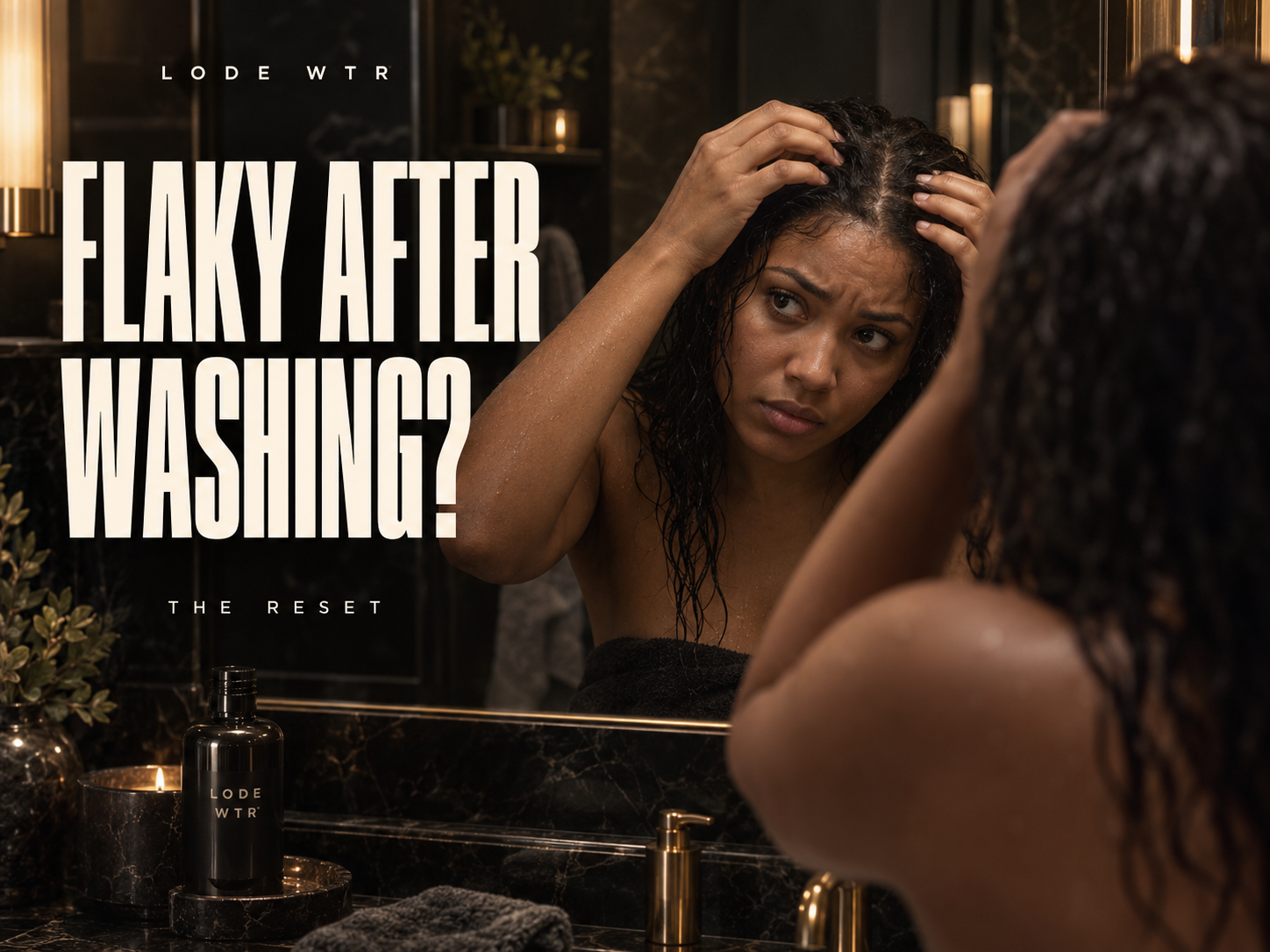
You wash your hair.
The whole reason?
The flakes.
You shampoo carefully.
Rinse.
Maybe shampoo again.
Step out of the shower.
Then your hair starts drying and somehow…
There they are again.
Tiny white flakes around your part.
On your hairline.
Maybe already making their way toward your black shirt.
Which raises a very reasonable question:
How can my scalp still be flaky when I literally just washed it?
Because washing removes material from the scalp.
It doesn’t necessarily fix whatever caused the flaking in the first place.
And sometimes the washing routine itself may actually be part of why the scalp feels flaky afterward.
Before you shampoo again, here are eight possibilities worth looking at.
First: Washing Doesn’t Automatically Fix Flaking
This is the biggest misconception.
We see flakes.
We think:
Dirty scalp.
So the obvious solution feels like washing.
But visible scalp flakes can appear for different reasons.
They may be related to:
- Dry-feeling scalp skin
- Dandruff
- Product residue
- Buildup
- Irritation
- Aggressive cleansing
- Certain scalp conditions
That means you can successfully remove oil and residue while still seeing flakes afterward.
Because shampoo cleans.
It doesn’t automatically diagnose or resolve every reason your scalp is shedding visible material.
Flakes are information.
The useful question is why they’re appearing.
1. Washing May Be Making Your Scalp Feel Too Dry
Start with what happens immediately after your shower.
Does your scalp feel:
- Tight
- Dry
- Stretched
- Slightly itchy
- Less comfortable than before washing?
If yes, your cleansing routine may be removing more oil than your scalp comfortably tolerates.
This is especially worth considering if you:
- Wash frequently
- Double shampoo every time
- Use strong clarifying products
- Take very hot showers
Sebum isn’t something your scalp produces by mistake.
Natural oils help lubricate the skin and hair.
The goal is to remove excess oil and buildup.
Not necessarily every trace of oil available.
If your scalp feels like shrink-wrap after every shampoo?
That’s feedback.
Read next: Why Does My Scalp Feel Tight After Washing?
2. Your Shower Water Is Too Hot
A steaming shower may feel fantastic.
Your scalp might have a less enthusiastic opinion.
Very hot water can leave skin feeling drier and more uncomfortable.
If your scalp is already prone to flaking, adding very hot water to an aggressive wash routine may make the post-shower sensation more noticeable.
You don’t need to switch to an ice bath.
Just try comfortably warm water.
Especially if your current routine involves:
Very hot water + strong shampoo + two cleanses + aggressive scalp massage.
Your scalp came for wash day.
Not survival training.
3. Washing Loosened Flakes That Were Already There
Sometimes the shampoo didn’t create the flakes.
It simply made them easier to see.
Water, massaging and cleansing can loosen material that was already attached to the scalp.
Then as your hair dries, those flakes become visible between the strands.
So you may look in the mirror and think:
“The flakes came back immediately.”
When really?
Some of them never fully left.
This is one reason aggressive scratching isn’t the answer.
You want to cleanse the scalp gently and rinse loose material away.
Not scrape until everything looks temporarily clear.
4. You’re Not Rinsing as Thoroughly as You Think
Some “flakes” aren’t scalp skin at all.
They may be dried product residue.
That could include:
- Shampoo
- Conditioner
- Hair masks
- Styling products
- Gel
- Curl cream
This becomes particularly easy to miss with thick, dense or textured hair.
You rinse for twenty seconds.
The surface feels fine.
But product may still be sitting around:
- The crown
- Nape
- Behind the ears
- Underneath dense sections
Then the hair dries.
White residue appears.
And suddenly you’re blaming your scalp.
Try rinsing significantly more thoroughly during your next wash.
Part the hair.
Move it around.
Let water actually reach the scalp.
Not glamorous.
Very useful.
5. Dry Shampoo Is Still Part of the Situation
Dry shampoo is one of the easiest things to mistake for flakes.
Especially after repeated use.
Maybe your week looked like:
Monday: dry shampoo.
Tuesday: more dry shampoo.
Wednesday: workout.
Thursday: dry shampoo again.
Friday: finally wash.
If the product isn’t completely removed, some residue may remain around the roots.
Once your hair dries, it can look surprisingly similar to:
- Dry scalp
- Dandruff
- General flaking
This is why it’s useful to ask:
What was sitting on my scalp before wash day?
Not every white particle is skin.
Read next: Is Dry Shampoo Bad for Your Scalp? What Happens When You Use Too Much.
6. Product Buildup May Not Be Fully Removed in One Wash
Now zoom out beyond dry shampoo.
Your scalp may have been carrying:
- Sebum
- Sweat
- Gel
- Styling creams
- Oils
- Hair spray
- Leave-in products
- Root powders
That combination can create buildup that doesn’t always disappear completely with a quick shampoo.
And once residue mixes with loosened skin cells?
The result can look flaky.
This is particularly common if your roots also feel:
- Waxy
- Sticky
- Coated
- Heavy
- Greasy despite washing
At that point, the problem may be less:
“My scalp is dry.”
And more:
“There’s a lot sitting on my scalp.”
Read: What Is Scalp Buildup? Signs, Causes and How to Reset Your Routine.
7. You’re Scrubbing Too Hard
Flakes can make people aggressive.
You see them.
You want them gone.
So during shampooing:
Scratch.
Scrub.
Scrape.
The immediate result may look satisfying.
But the scalp is skin.
And repeated mechanical irritation can leave it feeling:
- Sensitive
- Red
- Sore
- Itchy
- More uncomfortable afterward
Then you notice flakes again.
And scrub even harder next time.
You’ve now created a very unhelpful loop.
Use the pads of your fingertips.
Massage gently.
Your fingernails aren’t scalp-care equipment.
8. The Flaking May Not Be a Simple Wash-Routine Problem
This is important.
Persistent flaking can sometimes be associated with scalp conditions that won’t be solved by switching washing frequency alone.
If your flakes repeatedly return and you’re also experiencing:
- Significant redness
- Severe itching
- Thick scaling
- Pain
- Burning
- Sores
- Oozing
- Sudden hair loss
…consider speaking with a dermatologist or healthcare professional.
This matters especially when sensible routine changes make little difference.
Cosmetic scalp care can help manage things like oil, residue and wash habits.
It cannot diagnose every scalp condition.
Why Is My Scalp Flaky but Also Greasy?
Because those two things are not opposites.
This confuses a lot of people.
You can have:
Visible flakes + oily roots.
That may occur when scalp oil, skin shedding and product residue are all present together.
So if your roots are greasy and your scalp is flaky, don’t automatically assume:
“I need oil because my scalp is dry.”
You may already have plenty of oil.
Look at the full picture.
Does the scalp feel:
Dry and tight?
Or oily and coated?
Or itchy and greasy?
Different patterns point toward different routine issues.
Read next: Dry Scalp vs. Dandruff: What’s Actually Causing the Flakes?
Why Are My Flakes Worse After Shampooing?
Sometimes shampooing simply makes existing flakes more visible.
Other times the wash itself may leave the scalp feeling drier or more irritated.
Look at:
Your cleanser
Does the scalp feel excessively stripped afterward?
The water temperature
Are you using very hot water?
Your technique
Are you scratching aggressively?
Frequency
Are you cleansing more often than your scalp comfortably tolerates?
Product residue
Are you rinsing thoroughly?
Those five variables are more useful than immediately buying another anti-flake product.
Does Double Shampooing Help Flakes?
Sometimes.
But not automatically.
If what you’re seeing is partly caused by:
- Oil
- Dry shampoo
- Styling residue
- Heavy product buildup
…a second gentle cleanse may help remove more of that accumulation.
But if your scalp is already:
- Dry
- Tight
- Irritated
…double cleansing every time may leave it even less comfortable.
This is why double shampooing should solve a specific problem.
Not become a religious practice.
Read: Should You Shampoo Twice? When Double Cleansing Helps — and When It’s Too Much.
Can Washing Too Often Make Flakes Worse?
For some people, frequent or aggressive washing may leave the scalp feeling drier and more uncomfortable.
That doesn’t mean everybody should wash less.
Some people have oily scalps and feel best washing frequently.
What matters is the response.
If you’re washing daily and the pattern is:
Wash → tight scalp → flakes → wash again → tighter scalp → more flakes
…your routine deserves attention.
Don’t focus only on frequency either.
Also look at:
- Shampoo amount
- Formula
- Water temperature
- Double cleansing
- Scrubbing
Sometimes the issue isn’t washing too often.
It’s washing too aggressively.
Can Not Washing Enough Cause Flaky-Looking Buildup?
Yes.
And because scalp care enjoys contradictions, the opposite extreme isn’t necessarily better.
Go long enough between washes while using:
- Dry shampoo
- Oils
- Gel
- Styling cream
…and the scalp can accumulate considerable material.
Add sweat and natural sebum.
Now flakes, residue and buildup may all be sitting together.
So:
Wash more isn’t a universal answer.
But neither is:
Wash less.
The right schedule depends on your scalp and what you’re putting on it.
Why Do Flakes Keep Appearing Around My Hairline?
The hairline comes into contact with a surprising number of things.
Think:
- Shampoo
- Conditioner
- Styling gel
- Edge products
- Facial skincare
- Makeup
- Sweat
That also makes it an easy area to over-scrub because the flakes are more visible there.
If your flaking is concentrated around the hairline, pay attention to every product touching that area.
Not only shampoo.
And resist the temptation to keep scratching flakes away.
Why Are There Flakes at the Back of My Head?
The back of the scalp is easy to neglect during washing.
You naturally focus on:
Your part.
Hairline.
Top of the head.
Meanwhile, the crown and nape may not get the same attention.
Thick or dense hair makes this even easier to miss.
Try dividing your hair into sections during washing and intentionally reaching the back of the scalp.
Also rinse that area thoroughly.
Residue loves places we forget exist.
Why Does My Scalp Flake More in Winter?
Cold weather and indoor heating can change how your skin feels.
Low humidity may leave some people noticing:
- More dryness
- More tightness
- More visible flaking
Your routine may therefore need to change with the season.
Something that felt perfectly comfortable in summer may suddenly feel too aggressive in January.
Scalp care is not static.
Your environment changes.
Your routine can too.
What About Flakes With Curly or Textured Hair?
Curly and textured routines can make the situation more complex because they often involve more styling products and longer intervals between wash days.
You may be layering:
- Leave-in
- Curl cream
- Gel
- Oil
- Refresh spray
Then several days pass.
Now any visible particles around the scalp could potentially include:
- Skin flakes
- Dried styling product
- Buildup
The solution isn’t to aggressively shampoo the lengths.
Focus on the scalp.
Clean where the accumulation lives.
Respect the hair lengths.
Read next: How Often Should You Wash Curly Hair? A Scalp-First Guide for Curls, Coils and Textured Hair.
Should You Oil a Flaky Scalp After Washing?
Not automatically.
Oil seems logical.
Flakes look dry.
Dry means oil.
Right?
Not always.
Flaking can occur alongside oiliness and buildup.
So adding oil immediately may simply make the roots heavier without solving the cause.
Before adding scalp oil, ask:
Does my scalp actually feel dry?
Or:
Does it feel greasy, itchy and coated?
Those are very different situations.
One symptom doesn’t tell the whole story.
Should You Use a Scalp Scrub for Flakes?
Not automatically.
Physical exfoliation may sound satisfying.
Especially when you can literally see flakes.
But if your scalp is already irritated, red or sensitive, aggressive exfoliation may make it feel worse.
Your scalp isn’t a countertop.
It doesn’t need sanding.
Start with effective, gentle cleansing.
Then reassess.
How to Wash a Flaky Scalp More Intentionally
If your scalp repeatedly flakes after washing, try adjusting the routine before adding more products.
1. Use Warm, Not Extremely Hot Water
Easy change.
Worth testing.
2. Focus the Cleanser on Your Scalp
Oil and buildup accumulate around the roots.
That’s where your cleansing effort should go.
3. Massage With Your Fingertips
No nails.
No scraping.
No aggressive scalp excavation.
4. Rinse Thoroughly
Especially around:
- Crown
- Nape
- Hairline
- Behind the ears
Make sure shampoo and conditioner actually leave.
5. Don’t Automatically Double Shampoo
Use a second cleanse if there’s significant buildup.
Skip it if the first cleanse did the job.
6. Reduce Root Product Layering
If flakes are difficult to identify, simplify for several days.
Less:
- Dry shampoo
- Root powder
- Oils
- Styling products
Fewer variables.
Clearer scalp feedback.
7. Watch What Happens After the Wash
Does the scalp feel:
- Tight?
- Comfortable?
- Greasy immediately?
- Itchy?
- Burning?
That information helps you understand the actual problem.
Should Your Scalp Feel Squeaky Clean?
Not necessarily.
That ultra-squeaky sensation often gets interpreted as a successful wash.
But cleanliness doesn’t require discomfort.
The goal is to remove:
Excess oil + sweat + residue + buildup.
Then stop.
If your scalp feels clean and comfortable, you have probably achieved more than enough.
No scalp heroics required.
The Biggest Mistake? Treating Every Flake the Same
A flake appears.
We immediately assign it a cause.
Dry scalp.
Dandruff.
Dirty hair.
Product buildup.
But scalp symptoms overlap.
That’s why blindly treating flakes can create a chain reaction:
See flakes.
Wash harder.
Scalp feels dry.
Add oil.
Roots get greasy.
Add dry shampoo.
Dry shampoo creates residue.
See more flakes.
Excellent.
Instead:
Look at the pattern.
Your oil levels.
Your products.
How the scalp feels after washing.
How quickly flakes return.
That’s how you get closer to the actual issue.
Flakes Coming Back Doesn’t Mean You Failed Wash Day
If your scalp is flaky immediately after shampooing, the answer isn’t necessarily:
Wash again.
Look deeper.
Maybe the scalp feels dry.
Maybe existing flakes were loosened.
Maybe there’s residue.
Maybe you’re using too much product.
Maybe you’re scrubbing too aggressively.
Or maybe the problem deserves professional attention.
The useful response starts with understanding.
Not adding another random step.
That’s how we think about scalp care at LODE WTR.
Root of the Problem.
Not symptom theater.
Clean the Scalp. Don’t Fight It.
Your scalp shouldn’t have to endure increasingly complicated routines because you spotted something white near your part.
Start simple.
Clean effectively.
Rinse properly.
Be gentle.
Pay attention.
Then adjust based on what your scalp actually tells you.
Less scratching.
Less guessing.
Less noise.
Function Over Foam.
Frequently Asked Questions
Why is my scalp flaky immediately after washing?
Flakes after washing may be related to dryness, loosened existing skin, product residue, buildup, aggressive cleansing or an underlying scalp condition.
How your scalp feels after washing can provide useful clues.
Why do I still have dandruff after washing my hair?
Washing can remove visible flakes and oil, but it does not necessarily address the underlying cause of dandruff. Persistent dandruff may require targeted treatment or professional advice.
Can shampoo cause a flaky scalp?
A cleansing routine that is too aggressive for your scalp may contribute to dryness or irritation in some people.
Consider the formula, frequency, water temperature and washing technique.
Can hot water make scalp flakes worse?
Very hot water may leave some scalps feeling drier or more irritated, which can make flaking more noticeable.
Is it normal to see flakes after shampooing?
Occasional flakes can happen, especially when washing loosens material that was already present.
Persistent or significant flaking deserves closer attention.
Can product residue look like dandruff?
Yes. Dried shampoo, conditioner, dry shampoo and styling-product residue can sometimes appear as white particles around the roots.
Should I wash my hair again if I see flakes after washing?
Not automatically.
If your scalp has already been cleansed, immediately shampooing again may not solve the underlying issue and could make a dry or irritated scalp feel worse.
Does washing hair too often cause flakes?
Frequent or aggressive cleansing can leave some scalps feeling dry or uncomfortable. Your ideal washing frequency depends on your scalp, products and lifestyle.
Can not washing enough cause flakes?
Longer wash intervals can allow oil, sweat and styling-product residue to accumulate, which may contribute to a flaky or coated appearance.
Should I put oil on my scalp if it is flaky?
Not automatically. Flaking can occur on both dry-feeling and oily scalps.
First consider whether the scalp actually feels dry or whether oil and buildup are already present.
When should I see a dermatologist for scalp flakes?
Consider professional evaluation if flaking is persistent, severe or accompanied by significant redness, intense itching, burning, pain, thick scaling, sores, oozing or hair loss.
LODE WTR
Scalp care, stripped back.
Flakes are information.
Find the cause before adding the fix.
Function Over Foam.
Minimal Not Basic.
Root of the Problem.
Rebellion With Receipts.


